Survivorship and Inequality in Cancer, Danish Cancer Institute, Copenhagen, Denmark.
National Institute of Public Health, University of Southern Denmark, Copenhagen, Denmark.
Cancer Med. 2023 Oct;12(19):20150-20162. doi: 10.1002/cam4.6596. Epub 2023 Sep 29.
With a growing population of cancer survivors in Denmark, the evaluation of health-related quality of life (HRQoL) has become increasingly important. We describe variations in HRQoL between educational groups in a national population of cancer survivors.
We conducted a cross-sectional questionnaire study among breast, prostate, lung, and colon cancer survivors diagnosed in 2010-2019 in Denmark. We used the EORTC QLQ-C30 to assess HRQoL including physical, role, emotional, cognitive, social functioning, and symptoms (fatigue, nausea and vomiting, pain, dyspnea, insomnia, appetite loss, constipation, diarrhea, and financial difficulties). Information on educational level and clinical data were extracted from national registers and clinical databases. Levels of impaired functioning and severe symptoms were identified using newly established thresholds for clinical importance. Multivariate logistic regression was used to examine associations between education and HRQoL. All statistical tests were 2-sided.
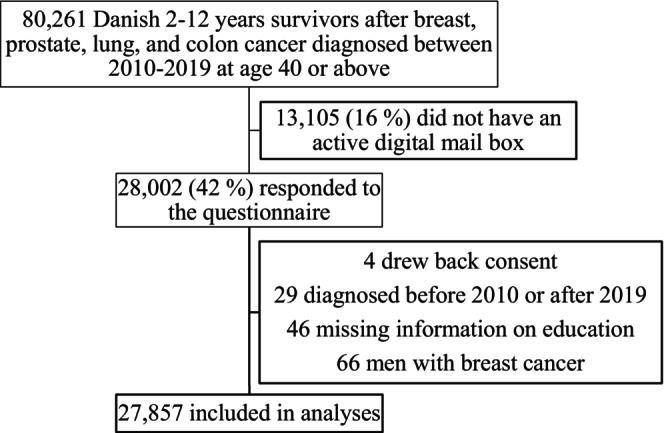
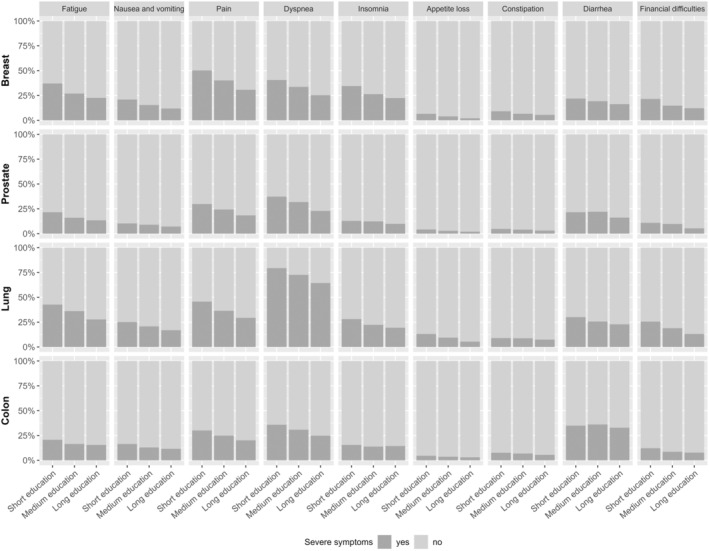
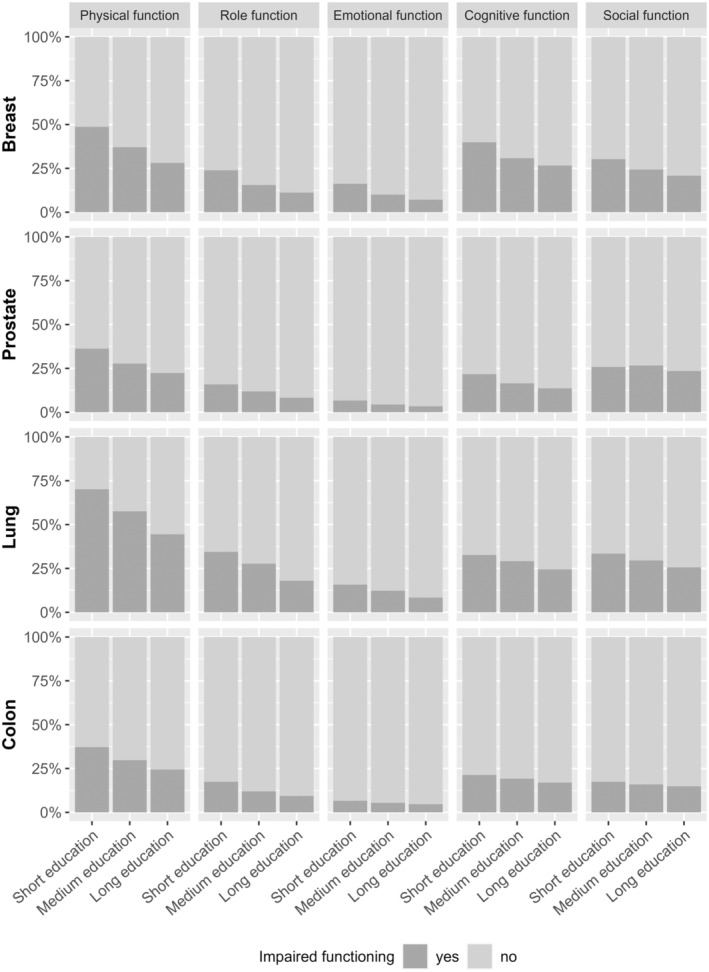
In total, 27,857 (42%) participated in the study. Up to 72% and 75% of cancer survivors with short education (≤9 years) reported impaired functioning and severe symptoms, respectively. Cancer survivors with short compared to long education (>12 years) were more likely to report impaired functioning and severe symptoms, with for example significantly higher odds ratios (ORs) for impaired physical function (breast OR = 2.41, 99% CI = 2.01-2.89; prostate OR = 1.81, 99% CI = 1.48-2.21; lung OR = 2.97, 99% CI = 1.95-4.57; and colon cancer OR = 1.69, 99% CI = 1.28-2.24).
Cancer survivors with short education are at greater risk of impaired HRQoL than survivors with long education 2-12 years after diagnosis. This underscores the need for systematic screening and symptom management in cancer aftercare, in order to reach all cancer survivors, also cancer survivors with short education.
随着丹麦癌症幸存者人数的增长,对健康相关生活质量(HRQoL)的评估变得越来越重要。我们描述了丹麦全国癌症幸存者中不同教育群体之间 HRQoL 的差异。
我们对 2010-2019 年在丹麦诊断出的乳腺癌、前列腺癌、肺癌和结肠癌幸存者进行了一项横断面问卷调查研究。我们使用 EORTC QLQ-C30 评估 HRQoL,包括身体、角色、情感、认知、社会功能和症状(疲劳、恶心和呕吐、疼痛、呼吸困难、失眠、食欲下降、便秘、腹泻和经济困难)。教育程度和临床数据信息从国家登记处和临床数据库中提取。使用新建立的临床重要性阈值来确定功能受损和严重症状的水平。多变量逻辑回归用于检查教育程度与 HRQoL 之间的关联。所有统计检验均为双侧检验。
共有 27857 人(42%)参与了研究。高达 72%和 75%的受教育程度较低(≤9 年)的癌症幸存者报告存在功能受损和严重症状。与受教育程度较高(>12 年)的癌症幸存者相比,受教育程度较低的癌症幸存者更有可能报告存在功能受损和严重症状,例如功能受损的物理功能方面的比值比(OR)显著更高(乳腺癌 OR=2.41,99%CI=2.01-2.89;前列腺癌 OR=1.81,99%CI=1.48-2.21;肺癌 OR=2.97,99%CI=1.95-4.57;结肠癌 OR=1.69,99%CI=1.28-2.24)。
在诊断后 2-12 年,受教育程度较低的癌症幸存者的 HRQoL 受损风险高于受教育程度较高的幸存者。这凸显了在癌症康复护理中进行系统筛查和症状管理的必要性,以便能够接触到所有癌症幸存者,包括受教育程度较低的癌症幸存者。