Mehnert-Theuerkauf Anja, Goerling Ute, Zimmermann Tanja, Ernst Jochen, Hermann Myriel, Hornemann Beate, Keilholz Ulrich, Lordick Florian, Knesebeck Olaf von dem, Kissane David, Köditz Anne-Kathrin, Springer Franziska
Department of Medical Psychology and Medical Sociology, Comprehensive Cancer Center Central Germany (CCCG), University Medical Center Leipzig, Leipzig, Germany.
Corporate Member of Freie Universität Berlin, Humboldt-Universität zu Berlin, and Berlin Institute of Health, Charité Comprehensive Cancer Center, Charité-Universitätsmedizin Berlin, Berlin, Germany.
Cancer Med. 2025 Aug;14(15):e71076. doi: 10.1002/cam4.71076.
Socioeconomic status' (SES) impact on distress during cancer survivorship has been insufficiently studied, although the consequences of low SES can be cumulative and adversely impact a person's ability to access resources required for improved health and quality of life.
We conducted a prospective study involving newly diagnosed patients within 2 months of diagnosis (t1), and at 6-, 12-, and 18-month follow-up (t2-t4) using the Distress Thermometer (DT). Generalized Linear Mixed Models (GLMM) were used to test for changes in distress over time, with fixed effects of time, SES, and age.
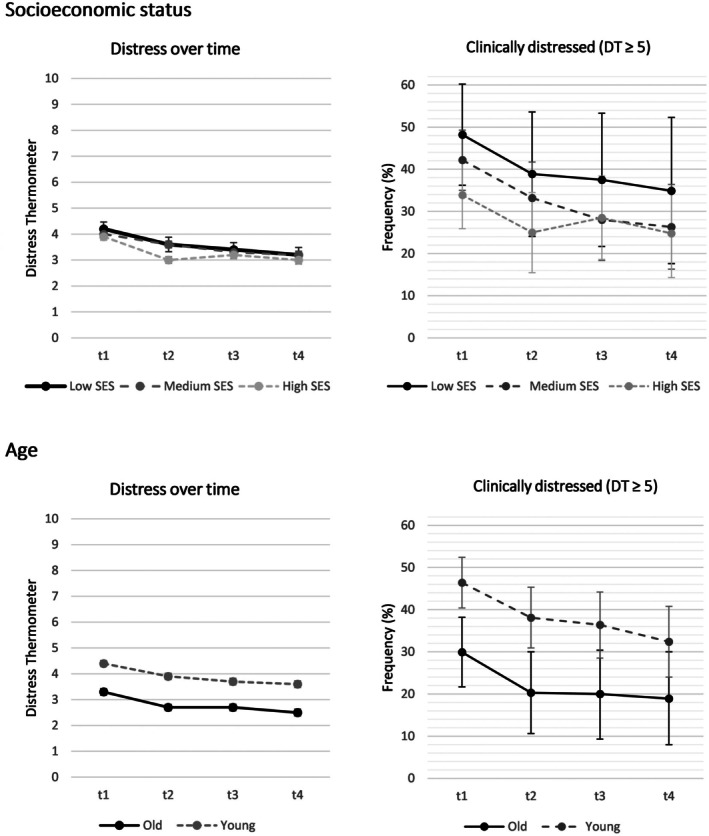
Out of 1702 eligible patients, 965 completed the baseline DT (53% men, 60.5 years); 779, 681, and 626 participated at follow-ups. Out of 554 completers, 9% were chronically distressed, while 40.8% were never distressed. Distress decreased in 21.3%, increased in 11.0%, and 17.8% fluctuated over time. Low-SES patients consistently had the highest rates of distress. Distress scores and the frequency of distress (DT ≥ 5) decreased over time in all SES and age groups: For DT mean scores, GLMM revealed a significant effect of time (χ(3) = 72.0, p < 0.001), but not of SES (χ(2) = 5.9, p = 0.052). For frequency of distress, there was a main effect of time (χ(3) = 41.4, p < 0.001) and SES (χ(2) = 15.5, p < 0.001). Younger patients (< 65 years) consistently experienced more distress than older patients (≥ 65 years). For DT mean scores, GLMM showed an effect of time (χ(3) = 72.1, p < 0.001) and age (χ(1) = 66.2, p < 0.001). Similarly, for frequency of distress we found an effect of time (χ(3) = 41.7, p < 0.001) and age (χ(1) = 52.8, p < 0.001).
Effective psychosocial interventions require a customized approach to decrease distress in vulnerable groups.
This study was registered in the International Clinical Trials Registry (NCT04620564, https://clinicaltrials.gov/).
社会经济地位(SES)对癌症幸存者痛苦程度的影响尚未得到充分研究,尽管低社会经济地位的后果可能会累积,并对一个人获取改善健康和生活质量所需资源的能力产生不利影响。
我们进行了一项前瞻性研究,纳入诊断后2个月内(t1)新确诊的患者,并在6个月、12个月和18个月随访时(t2 - t4)使用痛苦温度计(DT)。采用广义线性混合模型(GLMM)来测试痛苦程度随时间的变化,固定效应包括时间、社会经济地位和年龄。
在1702名符合条件的患者中,965人完成了基线DT评估(53%为男性,平均年龄60.5岁);779人、681人和626人参与了随访。在554名完成者中,9%长期处于痛苦状态,而40.8%从未感到痛苦。21.3%的患者痛苦程度下降,11.0%的患者痛苦程度增加,17.8%的患者痛苦程度随时间波动。低社会经济地位患者的痛苦发生率始终最高。所有社会经济地位和年龄组的痛苦得分及痛苦频率(DT≥5)随时间下降:对于DT平均得分,GLMM显示时间有显著影响(χ(3)=72.0,p<0.001),但社会经济地位无显著影响(χ(2)=5.9,p=0.052)。对于痛苦频率,时间有主效应(χ(3)=41.4,p<0.001)和社会经济地位有主效应(χ(2)=15.5,p<0.001)。较年轻患者(<65岁)始终比年长患者(≥65岁)经历更多痛苦。对于DT平均得分,GLMM显示时间有影响(χ(3)=72.1,p<0.001)和年龄有影响(χ(1)=66.2,p<0.001)。同样,对于痛苦频率,我们发现时间有影响(χ(3)=41.7,p<0.001)和年龄有影响(χ(1)=52.8,p<0.001)。
有效的心理社会干预需要采用定制化方法来减轻弱势群体的痛苦。
本研究已在国际临床试验注册中心注册(NCT04620564,https://clinicaltrials.gov/)。