Harris Lauren, Bal Jarnail S, Drosos Evangelos, Matloob Samir, Roberts Nicola Y, Hammerbeck-Ward Charlotte, Pathmanaban Omar, Evans Gareth, King Andrew T, Rutherford Scott A, Pollock Jonathan, Shoakazemi Alireza
1Department of Neurosurgery, Essex Neuroscience Centre, Queens Hospital, Romford, United Kingdom.
2Manchester Centre for Clinical Neurosciences, Northern Care Alliance Foundation Trust, Manchester, United Kingdom.
J Neurosurg Case Lessons. 2023 Sep 25;6(13). doi: 10.3171/CASE23179.
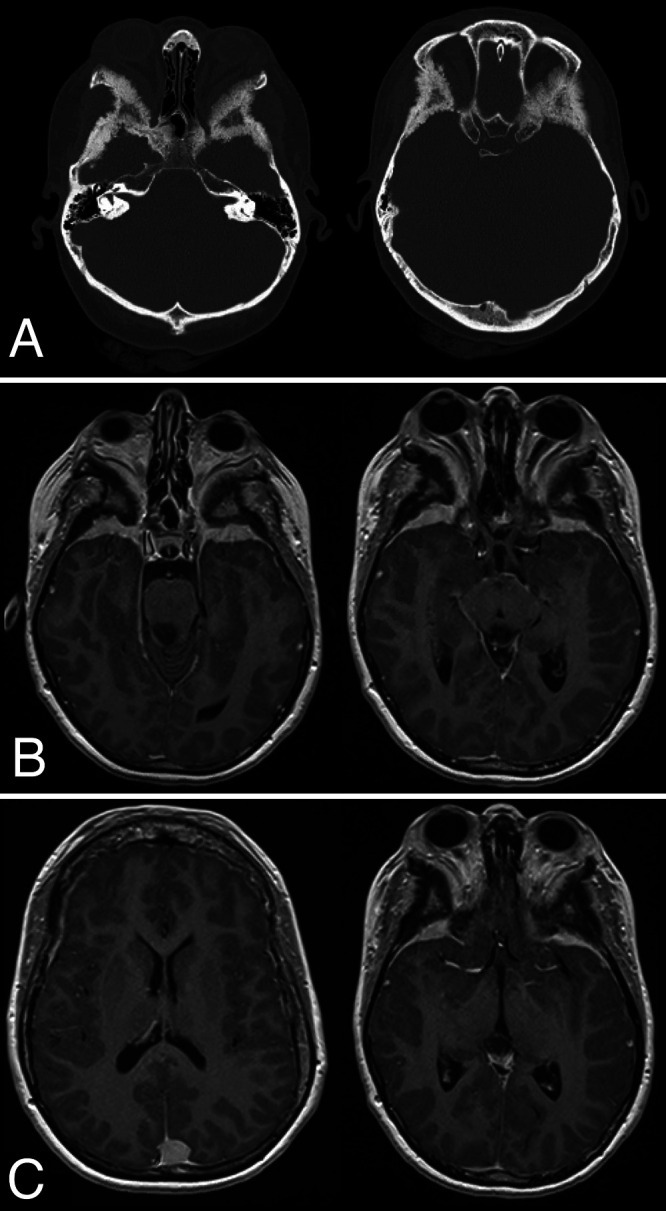
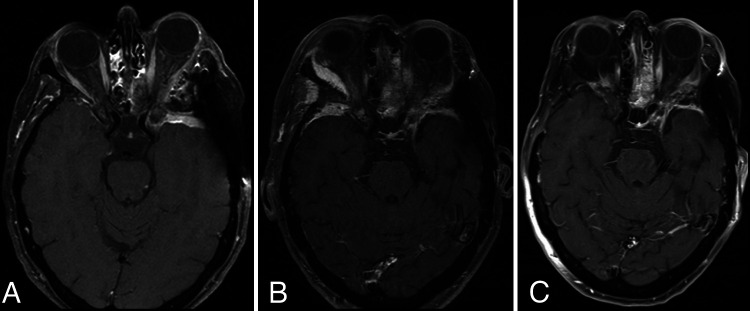
The occurrence of hyperostotic bilateral spheno-orbital meningiomas (BSOMs) is very rare. Patients present with bilateral symptoms and require bilateral treatment. This series describes 6 patients presenting to 2 UK neurosurgical units and includes a literature review. To the best of the authors' knowledge, this is the largest series documented.
This is a retrospective review of patients with BSOMs presenting between 2006 and 2023. Six females, whose mean age was 43 (range: 36-64) years, presented with features of visual disturbance. Bilateral sphen-oorbital meningiomas were identified. All patients underwent bilateral staged resections. The patients had an initial improvement in their symptoms. Extensive genetic testing was performed in 4 patients, with no variants in the NF2, LZTR1, SMARCB1, SMARCE1, and SMARCA4 genes or other variants detected. The mean follow-up was 100.3 (range: 64-186) months. Sixty-seven percent of patients had good long-term visual acuity. The progression rate was 75% and was particularly aggressive in 1 patient. Four patients required radiation therapy, and 2 needed further surgery.
Hyperostotic BSOMs are extensive, challenging tumors causing significant disability. They can recur, with significant patient impact. Multidisciplinary management and indefinite long-term follow-up are essential. The biology of these tumors remains unclear. As molecular testing expands, the understanding of BSOM oncogenesis and potential therapeutic targets is likely to improve.
双侧蝶骨-眶部骨肥厚性脑膜瘤(BSOM)的发生极为罕见。患者表现为双侧症状,需要双侧治疗。本系列描述了就诊于英国两个神经外科单位的6例患者,并进行了文献综述。据作者所知,这是已记录的最大系列病例。
这是一项对2006年至2023年间出现的BSOM患者的回顾性研究。6名女性患者,平均年龄43岁(范围:36 - 64岁),表现出视力障碍特征。确诊为双侧蝶骨-眶部脑膜瘤。所有患者均接受了双侧分期切除术。患者症状最初有所改善。对4例患者进行了广泛的基因检测,未检测到NF2、LZTR1、SMARCB1、SMARCE1和SMARCA4基因的变异或其他变异。平均随访时间为100.3个月(范围:64 - 186个月);67%的患者长期视力良好。进展率为75%,其中1例患者进展尤为迅速。4例患者需要放射治疗,2例需要进一步手术。
骨肥厚性BSOM是广泛且具有挑战性的肿瘤,可导致严重残疾。它们可能复发,对患者影响重大。多学科管理和无限期的长期随访至关重要。这些肿瘤的生物学特性仍不清楚。随着分子检测的扩展,对BSOM肿瘤发生机制和潜在治疗靶点的理解可能会有所改善。