Department of Physical Education and Sport Science, School of Physical Education, Sport Science and Dietetics, University of Thessaly, Karies, 42100, Trikala, Greece.
Eur J Appl Physiol. 2024 Mar;124(3):881-896. doi: 10.1007/s00421-023-05317-x. Epub 2023 Sep 30.
To determine the recovery kinetics of performance and exercise-induced muscle damage following different sprint-training protocols.
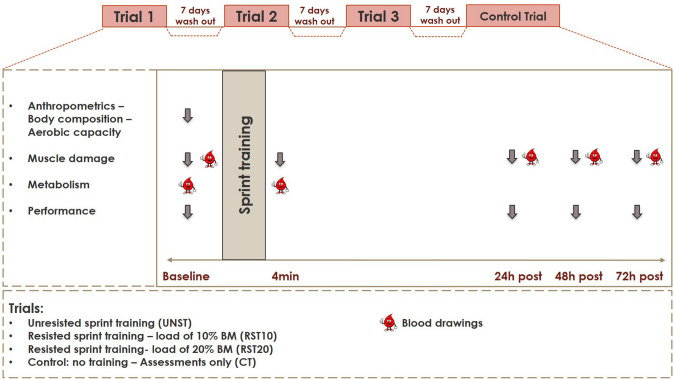
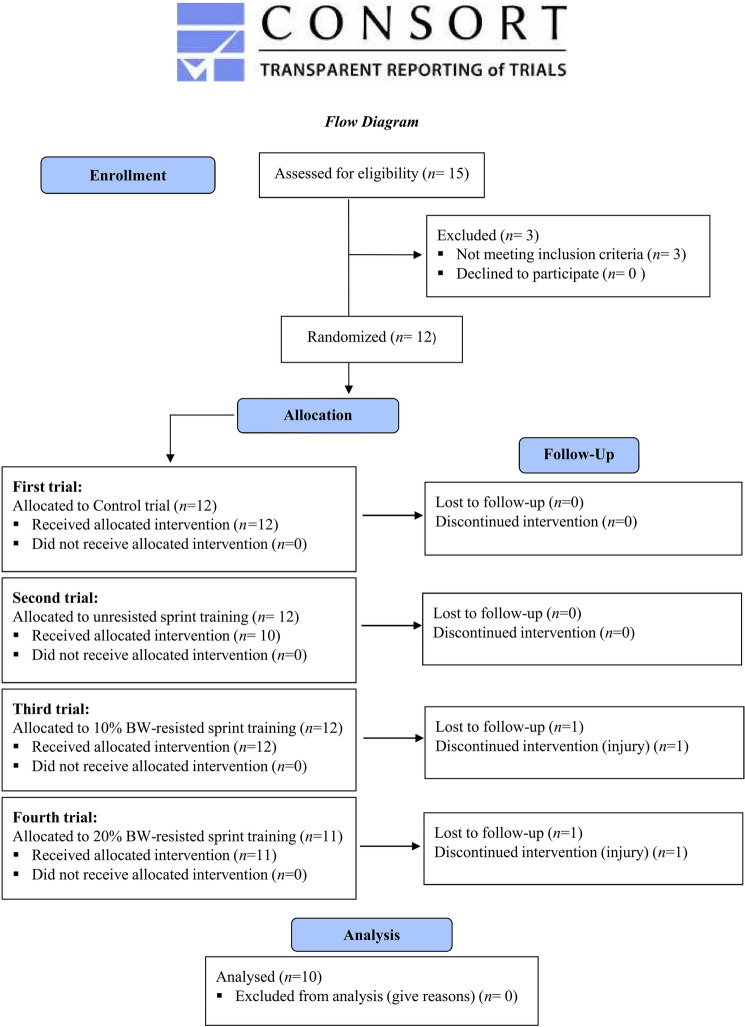
In a crossover design, ten male and female athletes (20.6 ± 2.4 years) performed 2 × (3 × 20 m: 2 min rest) and 1× (3 × 30 m: 3 min rest) of: (a) unresisted sprints (UST), (b) resisted sprints with 10% of body mass (BM) load (RST10), (c) resisted sprints with 20% BM load (RST20), against a control trial (no-training).
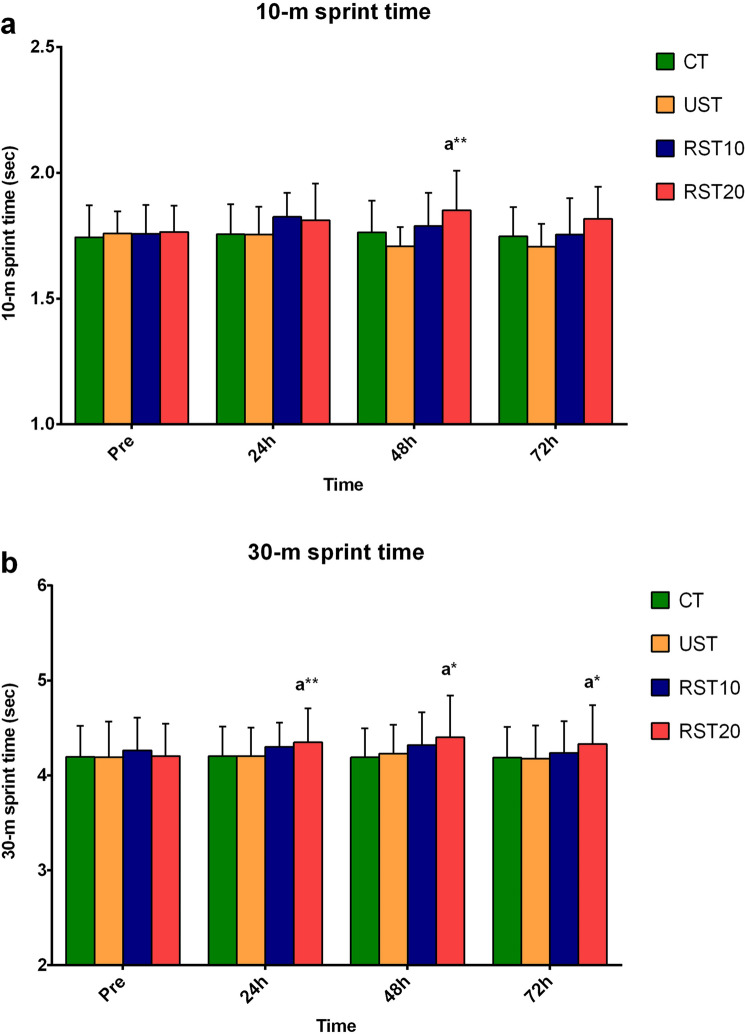
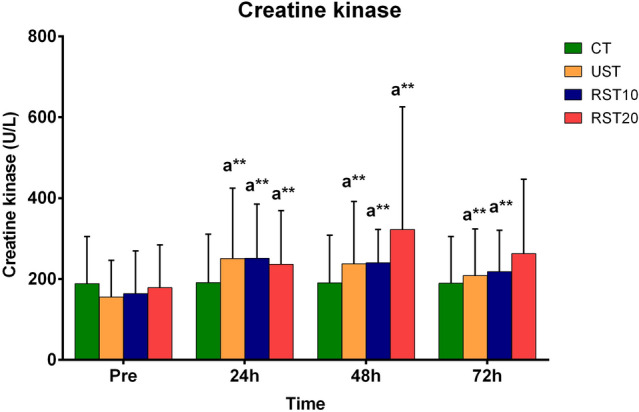
Blood lactate (mmol/L) increased post-training versus pre-training in all sprint-training trials (6.7 ± 2.4 vs 1.2 ± 0.2, 5.6 ± 2.4 vs 1.3 ± 0.3, 7.3 ± 2.7 vs 1.2 ± 0.3, in UST, RST10, RST20, respectively), as did creatine kinase (U/L) 24 h, 48 h and 72 h post-training (UST: 251 ± 173, 238 ± 154, 209 ± 115 vs 155 ± 9, RST10: 252 ± 134, 240 ± 83, 218 ± 103 vs 164 ± 106; RST20: 237 ± 133, 323 ± 303, 262 ± 184 vs 179 ± 106, respectively). DOMS of knee-extensors (KE) and knee-flexors (KF) increased post-training up to 72 h in all sprint-training trials versus pre-training (ranging from 1.6 ± 1.3 to 3.8 ± 2.8 vs 1.0 ± 0, respectively). Eccentric torque (N m) of the KE of the non-dominant limb, decreased 24 h post-training versus pre-training in all sprint-training trials (UST: 249 ± 49 vs 266 ± 54; RST10: 229 ± 52 vs 273 ± 72; RST20: 253 ± 6 vs 262 ± 56), as did that of the KF of the dominant limb (UST: 135 ± 29 vs 144 ± 26; RST10: 130 ± 29 vs 140 ± 25; RST20: 139 ± 33 vs 142 ± 26). 10-m sprint-time (s) increased 48 h post-training versus pre-training (1.81 ± 0.15 vs 1.77 ± 0.11), and 30-m sprint-time increased 24 h, 48 h, 72 h post-training versus pre-training (4.35 ± 0.36, 4.40 ± 0.44, 4.33 ± 0.41 vs 4.21 ± 0.34, respectively), only in RST20.
Unresisted and resisted sprint-training induces prolonged reduction of muscle strength (24 h), and sprinting performance (72 h), associated with prolonged increase of DOMS and CK (72 h).
确定不同短跑训练方案后运动表现和运动诱导性肌肉损伤的恢复动力学。
在交叉设计中,10 名男性和女性运动员(20.6±2.4 岁)进行了 2×(3×20m:2 分钟休息)和 1×(3×30m:3 分钟休息)的以下测试:(a)无阻力短跑(UST),(b)用 10%体重(BM)负荷进行阻力短跑(RST10),(c)用 20%BM 负荷进行阻力短跑(RST20),与对照试验(无训练)相比。
与训练前相比,所有短跑训练试验后血液乳酸(mmol/L)均升高(分别为 6.7±2.4 比 1.2±0.2、5.6±2.4 比 1.3±0.3、7.3±2.7 比 1.2±0.3,在 UST、RST10、RST20 中),肌酸激酶(U/L)在 24 小时、48 小时和 72 小时后也升高(分别为 UST:251±173、238±154、209±115 比 155±9,RST10:252±134、240±83、218±103 比 164±106;RST20:237±133、323±303、262±184 比 179±106)。与训练前相比,所有短跑训练试验后,膝伸肌(KE)和膝屈肌(KF)的 DOMS 在 72 小时内均增加(范围从 1.6±1.3 到 3.8±2.8 比 1.0±0)。非优势侧 KE 的离心扭矩(N m)在所有短跑训练试验后 24 小时均下降(UST:249±49 比 266±54;RST10:229±52 比 273±72;RST20:253±6 比 262±56),优势侧 KF 的离心扭矩也下降(UST:135±29 比 144±26;RST10:130±29 比 140±25;RST20:139±33 比 142±26)。10 米短跑时间(s)在训练后 48 小时增加(1.81±0.15 比 1.77±0.11),30 米短跑时间在训练后 24 小时、48 小时和 72 小时增加(4.35±0.36、4.40±0.44、4.33±0.41 比 4.21±0.34),仅在 RST20 中。
无阻力和阻力短跑训练会导致肌肉力量(24 小时)和短跑表现(72 小时)持续下降,同时伴有 DOMS 和 CK 持续增加(72 小时)。