Department of Clinical Sciences, Danderyd Hospital, 18288, Stockholm, Sweden.
Academic Primary Health Care Centre, Solnavägen 1E, 104 31, Stockholm, Sweden.
Alzheimers Res Ther. 2023 Oct 2;15(1):161. doi: 10.1186/s13195-023-01308-4.
Chronic stress and depression are potential risk factors for mild cognitive impairment and dementia, including Alzheimer disease. The aim was to investigate whether any such risk is additive.
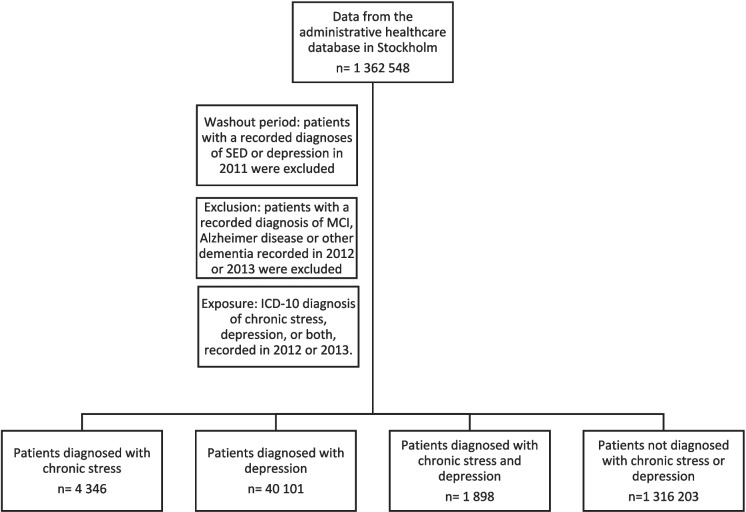
Cohort study including 1 362 548 people (665 997 women, 696 551 men) with records in the Region Stockholm administrative healthcare database (VAL). Exposure was a recorded ICD-10 diagnosis of chronic stress, depression, or both, recorded in 2012 or 2013. Outcome was a diagnosis of Alzheimer disease, other dementia, or mild cognitive impairment recorded from 2014 through 2022. Odds ratios with 99% confidence intervals (CI) adjusted for age, sex, neighborhood socioeconomic status, diabetes, and cardiovascular disorders were calculated.
During the exposure period, 4 346 patients were diagnosed with chronic stress, 40 101 with depression, and 1 898 with both. The average age at baseline was around 40 years in all groups. In the fully adjusted model, the odds ratio of Alzheimer disease was 2.45 (99% CI 1.22-4.91) in patients with chronic stress, 2.32 (99% CI 1.85-2.90) in patients with depression, and 4.00 (99% CI 1.67-9.58) in patients with chronic stress and depression. The odds ratio of mild cognitive impairment was 1.87 (99% CI 1.20-2.91) in patients with chronic stress, 2.85 (99% CI 2.53-3.22) in patients with depression, and 3.87 (99% CI 2.39-6.27) in patients with both. When other dementia was analyzed, the odds ratio was significant only in patients with depression, 2.39 (99% CI 1.92-2.96).
Documented chronic stress increased the risk of mild cognitive impairment and Alzheimer disease. The same was seen with depression. The novel finding is the potential additive effect of chronic stress to depression, on risk of MCI and AD.
慢性压力和抑郁是轻度认知障碍和痴呆症(包括阿尔茨海默病)的潜在风险因素。目的是研究是否存在这种风险的累加效应。
这是一项队列研究,纳入了在斯德哥尔摩地区行政保健数据库(VAL)中有记录的 1362548 人(女性 665997 人,男性 696551 人)。暴露因素为 2012 年或 2013 年记录的慢性应激、抑郁或两者的 ICD-10 诊断。结果为 2014 年至 2022 年记录的阿尔茨海默病、其他痴呆症或轻度认知障碍的诊断。计算了经过年龄、性别、邻里社会经济地位、糖尿病和心血管疾病调整后的 99%置信区间(CI)的比值比。
在暴露期间,4346 例患者被诊断为慢性应激,40101 例为抑郁,1898 例为两者兼有。所有组别的基线平均年龄约为 40 岁。在完全调整的模型中,慢性应激患者患阿尔茨海默病的比值比为 2.45(99%CI 1.22-4.91),抑郁患者为 2.32(99%CI 1.85-2.90),慢性应激和抑郁患者为 4.00(99%CI 1.67-9.58)。慢性应激患者患轻度认知障碍的比值比为 1.87(99%CI 1.20-2.91),抑郁患者为 2.85(99%CI 2.53-3.22),两者兼有患者为 3.87(99%CI 2.39-6.27)。当分析其他痴呆症时,仅在抑郁患者中比值比具有显著性,为 2.39(99%CI 1.92-2.96)。
有记录的慢性应激增加了轻度认知障碍和阿尔茨海默病的风险。抑郁也是如此。新发现是慢性应激对抑郁、轻度认知障碍和 AD 风险的潜在累加效应。