Yoon Dan-Il, Mulay Nishad, Baltazar Jericko, Cao Dang Khoa, Perez Valeria, Nelson Weker Johanna, Lee Min Hwan, Miller Robert D, Oh Dahyun, Lee Sang-Joon John
Department of Chemical and Materials Engineering, San Jose State University, One Washington Square, San Jose, California 95192-0082, United States.
Department of Mechanical Engineering, San Jose State University, One Washington Square, San Jose, California 95192-0087, United States.
ACS Appl Energy Mater. 2023 Sep 9;6(18):9400-9408. doi: 10.1021/acsaem.3c01357. eCollection 2023 Sep 25.
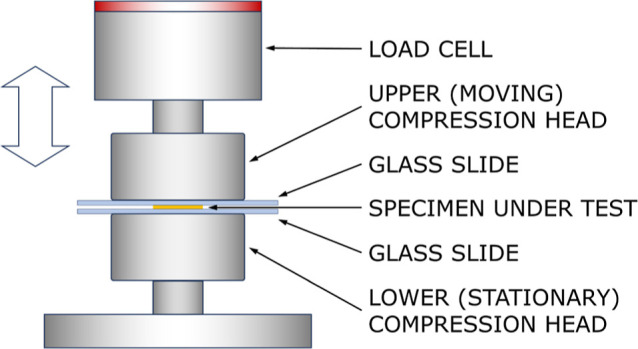
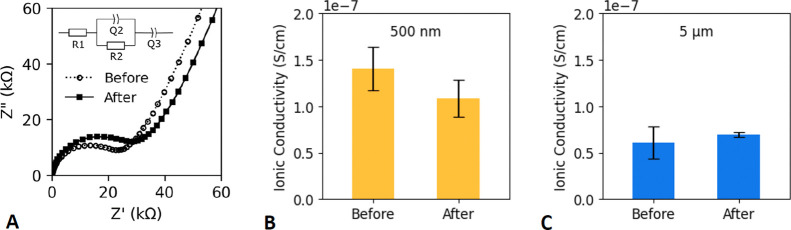
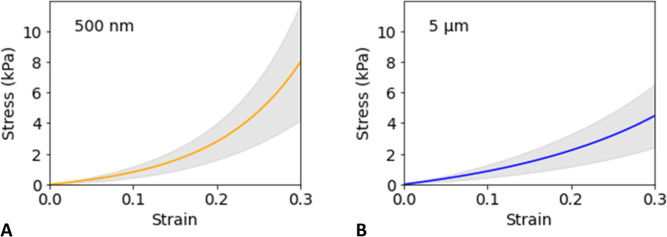
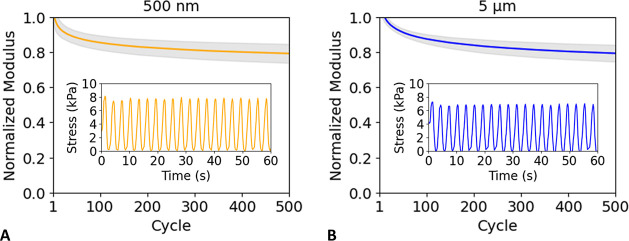
Composite polymer electrolytes (CPEs) strike an effective balance between ionic conductivity and mechanical flexibility for lithium-ion solid-state batteries. Long-term performance, however, is limited by capacity fading after hundreds of charge and discharge cycles. The causes of performance degradation include multiple contributing factors such as dendrite formation, physicochemical changes in electrolytes, and structural remodeling of porous electrodes. Among the many factors that contribute to performance degradation, the effect of stress specifically on the composite electrolyte is not well understood. This study examines the mechanical changes in a poly(ethylene oxide) electrolyte with bis(trifluoromethane) sulfonimide. Two different sizes of LiLaZrTaO particles (500 nm and 5 μm) are compared to evaluate the effect of the surface-to-volume ratio of the ion-conducting fillers within the composite. Cyclic compression was applied to mimic stress cycling in the electrolyte, which would be caused by asymmetric volume changes that occur during charging and discharging cycles. The electrolytes exhibited fatigue softening, whereby the compressive modulus gradually decreased with an increase in the number of cycles. When the electrolyte was tested for 500 cycles at 30% compressive strain, the compressive modulus of the electrolyte was reduced to approximately 80% of the modulus before cycling. While the extent of softening was similar regardless of particle size, CPEs with 500 nm particles exhibited a significant reduction in ionic conductivity after cyclic compression (1.4 × 10 ± 2.3 × 10 vs 1.1 × 10 ± 2.0 × 10 S/cm, mean ± standard deviation, = 4), whereas there was no significant change in ionic conductivity for CPEs with 5 μm particles. These observations -performed deliberately in the absence of charge-discharge cycles -show that repetitive mechanical stresses can play a significant role in altering the performance of CPEs, thereby revealing another possible mechanism for performance degradation in all-solid-state batteries.
复合聚合物电解质(CPEs)在锂离子固态电池的离子电导率和机械柔韧性之间实现了有效的平衡。然而,长期性能受到数百次充放电循环后容量衰减的限制。性能退化的原因包括多个因素,如枝晶形成、电解质的物理化学变化以及多孔电极的结构重塑。在导致性能退化的众多因素中,应力对复合电解质的具体影响尚未得到充分理解。本研究考察了含双(三氟甲烷)磺酰亚胺的聚环氧乙烷电解质的力学变化。比较了两种不同尺寸的LiLaZrTaO颗粒(500纳米和5微米),以评估复合材料中离子导电填料的表面积与体积比的影响。施加循环压缩以模拟电解质中的应力循环,这是由充放电循环期间发生的不对称体积变化引起的。电解质表现出疲劳软化,即压缩模量随着循环次数的增加而逐渐降低。当电解质在30%的压缩应变下测试500次循环时,电解质的压缩模量降低到循环前模量的约80%。尽管无论颗粒尺寸如何,软化程度相似,但含500纳米颗粒的CPEs在循环压缩后离子电导率显著降低(1.4×10±2.3×10对1.1×10±2.0×10 S/cm,平均值±标准差,=4),而含5微米颗粒的CPEs的离子电导率没有显著变化。这些在没有充放电循环的情况下特意进行的观察表明,重复的机械应力在改变CPEs的性能方面可以发挥重要作用,从而揭示了全固态电池性能退化的另一种可能机制。