
无龋和患龋个体口腔蛋白质丰度的比较——一项系统评价和荟萃分析
Comparison of oral cavity protein abundance among caries-free and caries-affected individuals-a systematic review and meta-analysis.
作者信息
da Silveira Eliane Garcia, Prato Laura Schaurich, Pilati Sarah Freygang Mendes, Arthur Rodrigo Alex
机构信息
Department of Preventive and Community Dentistry, Federal University of Rio Grande do Sul, Porto Alegre, Brazil.
Faculty of Dentistry, University of Vale do Itajaí, Itajaí, Brazil.
出版信息
Front Oral Health. 2023 Sep 15;4:1265817. doi: 10.3389/froh.2023.1265817. eCollection 2023.
OBJECTIVE
Some salivary proteins seem to be differently abundant among caries-free (CF) and caries-affected (CA) individuals, but previous results are contradictory precluding that definitive conclusion be drawn. A pooled analysis of the available evidence may provide more robust data on identifying oral cavity protein patterns among CF and CA individuals. This systematic review and meta-analysis (PROSPERO CRD42021269079) aimed to compare the oral cavity protein abundance among caries-free and caries-affected individuals.
METHODS
This study was conducted following PRISMA guidelines. PubMed, Embase, and Web of Science databases were systematically assessed (up to February 2023) to retrieve clinical studies written in English, German, or in Latin-based languages that compared the oral cavity protein abundance among CF and CA individuals. Data extraction and methodological quality assessment (NIH guidelines) were independently performed by two investigators. Qualitative synthesis was performed from all included studies and meta-analysis was performed using a random-effects model with inverse variance for studies that reported the concentration of proteins or enzymatic activity. Standardized mean difference (SMD) with respective 95% confidence interval (CI) were calculated for each outcome.
RESULTS
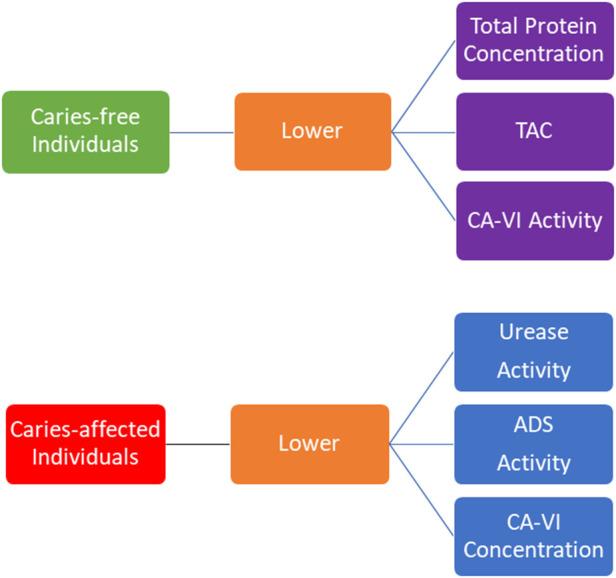
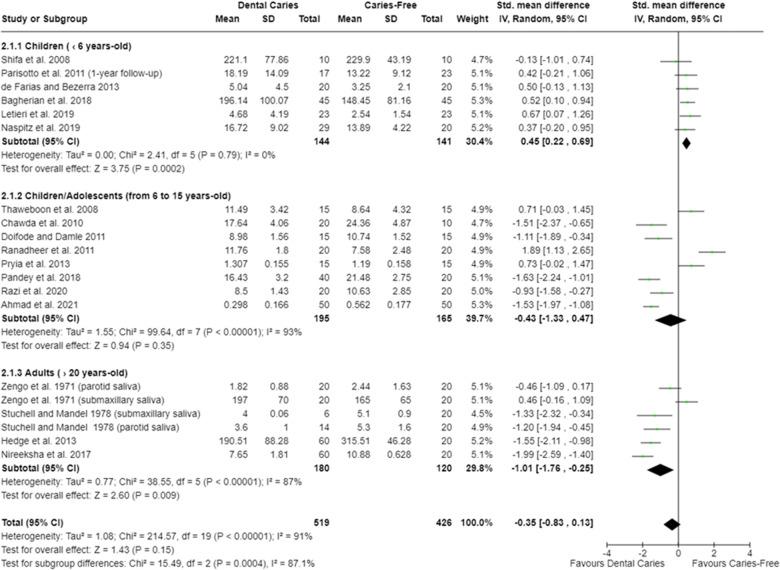
A total of 90 studies (two cohort and 88 cross-sectional designs) of more than 6,000 participants were selected for data extraction, being the quality of evidence graded as "fair" for most of them. The oral cavity of CF individuals presented lower total protein concentration [SMD = 0.37 (95% CI: 0.07-0.68; 18 studies)], lower total antioxidant capacity [SMD = 1.29 (95% CI: 0.74-1.85); 17 studies], and lower carbonic anhydrase activity [SMD = 0.83 (95% CI: 0.58-1.09); three studies], whereas CA individuals presented lower carbonic anhydrase concentration [SMD = -0.66 (95% CI: -1.00 to -0.32); three studies], urease [SMD = -0.95 (IC 95%: -1.72 to -0.17); four studies], and arginine deiminase system [SMD = -2.07 (95% CI: -3.53 to -0.62); three studies] activities. Antimicrobial peptides, secretory immunoglobulin-A concentrations and alpha-amylase activity were similar among individuals.
CONCLUSION
Differences on oral cavity protein abundance were observed among CF and CA individuals. These data indicate some protein patterns for the oral health and dental caries conditions. Even when statistically significant, some of the results were not very consistent. Cohort studies need to be conducted to validate these results.
目的
一些唾液蛋白在无龋(CF)和患龋(CA)个体中的丰度似乎存在差异,但先前的结果相互矛盾,无法得出明确结论。对现有证据进行汇总分析可能会提供更有力的数据,以识别CF和CA个体的口腔蛋白质模式。本系统评价和荟萃分析(PROSPERO CRD42021269079)旨在比较无龋和患龋个体的口腔蛋白质丰度。
方法
本研究按照PRISMA指南进行。系统评估了PubMed、Embase和Web of Science数据库(截至2023年2月),以检索用英语、德语或拉丁系语言撰写的临床研究,这些研究比较了CF和CA个体的口腔蛋白质丰度。数据提取和方法学质量评估(NIH指南)由两名研究人员独立进行。对所有纳入研究进行定性综合,并对报告蛋白质浓度或酶活性的研究使用随机效应模型和逆方差进行荟萃分析。计算每个结局的标准化均数差(SMD)及其95%置信区间(CI)。
结果
共选择了90项研究(两项队列研究和88项横断面设计),涉及6000多名参与者进行数据提取,其中大多数研究的证据质量被评为“中等”。CF个体的口腔总蛋白浓度较低[SMD = 0.37(95%CI:0.07 - 0.68;18项研究)],总抗氧化能力较低[SMD = 1.29(95%CI:0.74 - 1.85);17项研究],碳酸酐酶活性较低[SMD = 0.83(95%CI:0.58 - 1.09);3项研究],而CA个体的碳酸酐酶浓度较低[SMD = -0.66(95%CI:-1.00至-0.32);3项研究],脲酶[SMD = -0.95(IC 95%:-1.72至-0.17);4项研究]和精氨酸脱亚氨酶系统[SMD = -2.07(95%CI:-3.53至-0.62);3项研究]活性较低。抗菌肽、分泌型免疫球蛋白A浓度和α-淀粉酶活性在个体之间相似。
结论
在CF和CA个体中观察到口腔蛋白质丰度存在差异。这些数据表明了一些与口腔健康和龋齿状况相关的蛋白质模式。即使具有统计学意义,一些结果也不是非常一致。需要进行队列研究来验证这些结果。




 Zotero 插件