Schmitz Léa, Pirotte Michelle, Lebeau Alizée, Ernst Marie, Fillet Marianne, Devey Anais, Schmitt Justine, Cobraiville Gaël, Binsfeld Marilène, Gofflot Stéphanie, Beguin Yves, Vertenoeil Gaëlle
Department of Hematology and GIGA Laboratory of Hematology, University Hospital of Liège and ULiège, Liège, Belgium.
Laboratory of Experimental Pathology, GIGA Cancer, University Hospital of Liège and ULiège, Liège, Belgium.
Ther Adv Hematol. 2023 Sep 28;14:20406207231199837. doi: 10.1177/20406207231199837. eCollection 2023.
For more than 2 years medical practice has been dealing with the Covid-19 pandemic. Atypical symptoms, such as frostbites and acrosyndromes, have appeared, and autoimmune anemias (some of which with cold agglutinins) have been described.
We planned to study the prevalence of positive direct Coombs tests (DCTs) and hemolytic autoimmune anemia in patients infected with Severe Acute Respiratory Syndrome Coronavirus 2 (SARS-CoV-2) and its correlation with complications, and then investigate the impact of the infection on iron metabolism.
This is an observational, cross-sectional, single-center, exploratory study.
We obtained Coombs tests in a population of 179 infected patients at the CHU of Liège. We then studied iron metabolism in some of these patients, by measuring serum ferritin, erythropoietin (EPO), erythroferrone and hepcidin.
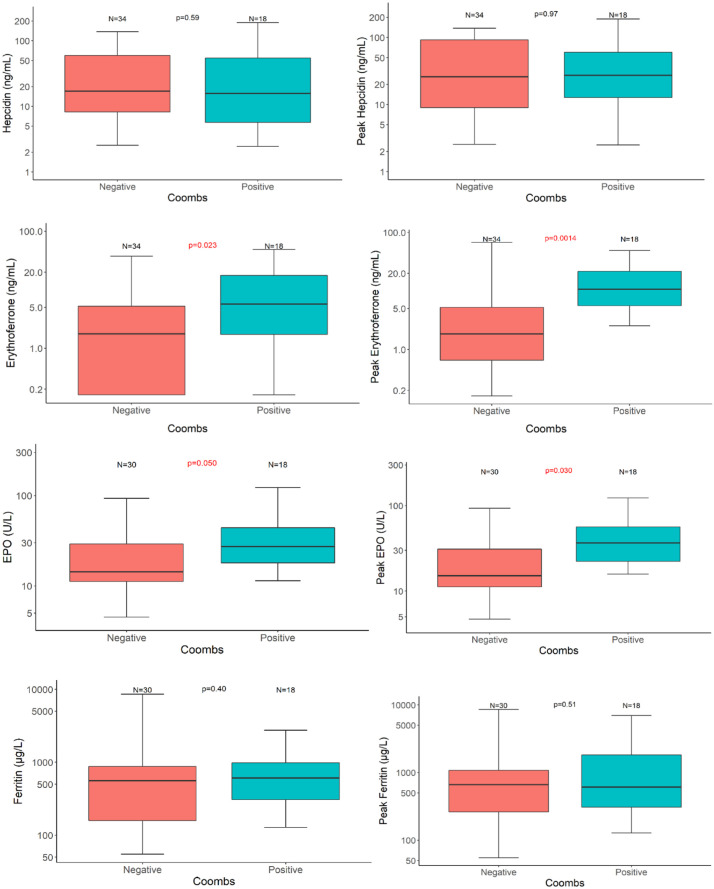
We did not identify any case of autoimmune hemolysis. However, there was a 20.3% prevalence of positive DCT, mainly with IgG (91.7%). These patients, compared to DCT-negative patients, were not only more anemic and transfused, but also required more transfers to intensive care units and had longer hospital stays and mechanical ventilation. The pattern of anemia was consistent with the anemia of inflammation, showing elevated hepcidin and ferritin levels, while EPO and erythroferrone values were lower than expected at this degree of anemia. Erythroferrone was higher and Hb was lower in DCT-positive patients. Finally, we identified a correlation between iron parameters and complicated forms of infection.
Covid-19 patients suffered from inflammatory anemia with more severe forms of infection correlated to positive DCT status. This could potentially be of interest for future clinical practice.
两年来,医疗实践一直在应对新冠疫情。出现了冻伤和肢端综合征等非典型症状,并且已经有自身免疫性贫血(其中一些伴有冷凝集素)的相关描述。
我们计划研究严重急性呼吸综合征冠状病毒2(SARS-CoV-2)感染患者直接抗人球蛋白试验(DCT)阳性和溶血性自身免疫性贫血的患病率及其与并发症的相关性,然后研究感染对铁代谢的影响。
这是一项观察性、横断面、单中心的探索性研究。
我们在列日大学医院对179名感染患者进行了抗人球蛋白试验。然后,我们通过测量血清铁蛋白、促红细胞生成素(EPO)、红细胞铁调素和铁调素,对其中一些患者的铁代谢进行了研究。
我们未发现任何自身免疫性溶血病例。然而,DCT阳性的患病率为20.3%,主要为IgG型(91.7%)。与DCT阴性患者相比,这些患者不仅贫血更严重且需要输血,而且需要更多次转入重症监护病房,住院时间更长,机械通气时间也更长。贫血模式与炎症性贫血一致,铁调素和铁蛋白水平升高,而EPO和红细胞铁调素值低于该贫血程度预期的值。DCT阳性患者的红细胞铁调素较高,血红蛋白较低。最后,我们确定了铁参数与复杂感染形式之间的相关性。
新冠患者患有炎症性贫血,更严重的感染形式与DCT阳性状态相关。这可能对未来的临床实践具有潜在意义。