Department of Surgical Oncology, Tata Memorial Centre, and Homi Bhabha National Institute, Mumbai, India.
Homi Bhabha National Institute, Mumbai, India.
JAMA Netw Open. 2023 Oct 2;6(10):e2335941. doi: 10.1001/jamanetworkopen.2023.35941.
Patients with early breast cancer must choose between undergoing breast conservation surgery or mastectomy. This decision is often difficult as there are trade-offs between breast conservation and adverse effects, and women with higher decisional conflict have a harder time choosing the therapy that suits their preferences.
To study the impact of a decision aid with a patient preference assessment tool for surgical decision-making on patients' decisional conflict scale (DCS) score.
DESIGN, SETTING, AND PARTICIPANTS: This 3-group randomized clinical trial was conducted between June 2017 and December 2019 at a single high-volume tertiary care cancer center in Mumbai, India. A research questionnaire comprising 16 questions answered on a Likert scale (from 1, strongly agree, to 5, strongly disagree) was used to measure DCS scores and other secondary psychological variables, with higher scores indicating more decisional conflict. The Navya Patient Preference Tool (Navya-PPT) was developed as a survey-based presentation of evidence in an adaptive, conjoint analysis-based module for and trade-offs between cosmesis, adverse effects of radiotherapy, and cost of mandatory radiation following breast-conserving surgery. Adult patients with histologically proven early breast cancer (cT1-2, N0-1) who were eligible for breast-conserving surgery as per clinicoradiological assessment were included. Those who were pregnant or unable to read the research questionnaire or who had bilateral breast cancer were excluded. Data were analyzed from January to June 2020.
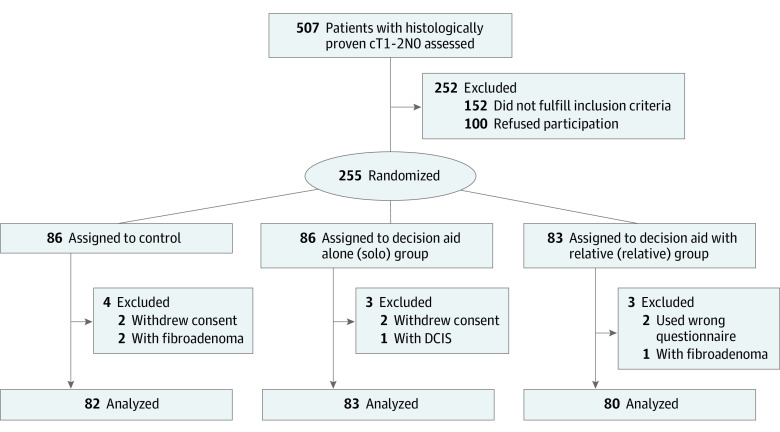
Patients were randomized 1:1:1 to study groups: standard care including clinical explanation about surgery (control), standard care plus the Navya-PPT provided to the patient alone (solo group), and standard care plus the Navya-PPT provided to the patient and a caregiver (joint group).
The primary end point of the study was DCS score. The study was 80% powered with 2-sided α = .01 to detect an effect size of 0.25 measured by Cohen d, F test analysis of variance, and fixed effects.
A total of 245 female patients (median [range] age, 48 [23-76] years) were randomized (82 to control, 83 to the solo group, and 80 to the joint group). The median (range) pathological tumor size was 2.5 (0-6) cm. A total of 153 participants (62.4%) had pN0 disease, 185 (75.5%) were hormone receptor positive, 197 (80.4%) were human epidermal growth factor receptor 2 negative, 144 (58.6%) were of middle or lower socioeconomic status, and 114 (46.5%) had an education level lower than a college degree. DCS score was significantly reduced in the solo group compared with control (1.34 vs 1.66, respectively; Cohen d, 0.50; SD, 0.31; P < .001) and the joint group compared with control (1.31 vs 1.66, respectively; Cohen d, 0.54; SD, 0.31; P < .001).
The results of this study demonstrated lower decisional conflict as measured by DCS score following use of the online, self-administered Navya-PPT among patients with early breast cancer choosing between breast-conserving surgery vs mastectomy.
Clinical Trials Registry of India Identifier: CTRI/2017/11/010480.
早期乳腺癌患者必须在保乳手术和乳房切除术之间做出选择。由于保乳和不良反应之间存在权衡,且决策冲突较高的患者更难以选择符合其偏好的治疗方法,因此这一决策通常较为困难。
研究一种带有患者偏好评估工具的决策辅助工具对手术决策中患者决策冲突量表(DCS)评分的影响。
设计、地点和参与者:这是一项 3 组随机临床试验,于 2017 年 6 月至 2019 年 12 月在印度孟买的一家单中心高容量癌症治疗中心进行。使用包含 16 个问题的研究问卷(采用 1-5 分制回答,1 分表示强烈同意,5 分表示强烈不同意)来衡量 DCS 评分和其他次要心理变量,得分越高表示决策冲突越严重。Navya 患者偏好工具(Navya-PPT)是作为一种基于调查的证据呈现方式开发的,采用适应性、联合分析模块来权衡美容效果、放射治疗的不良反应以及保乳手术后强制性放射治疗的成本。纳入符合临床和影像学评估标准、适合行保乳手术的组织学证实的早期乳腺癌(cT1-2、N0-1)成年患者。排除妊娠或无法阅读研究问卷或双侧乳腺癌的患者。数据分析于 2020 年 1 月至 6 月进行。
患者以 1:1:1 的比例随机分为 3 组:接受标准护理(包括手术相关的临床解释)的对照组、单独接受 Navya-PPT 的单独组和同时接受 Navya-PPT 和护理人员的联合组。
本研究的主要终点为 DCS 评分。该研究的效力为 80%,双侧α值为.01,以检测 Cohen d、方差分析 F 检验和固定效应测量的 0.25 效应量。
共纳入 245 名女性患者(中位数[范围]年龄,48[23-76]岁),随机分为对照组(82 人)、单独组(83 人)和联合组(80 人)。中位(范围)病理肿瘤大小为 2.5(0-6)cm。共有 153 名患者(62.4%)患有 pN0 疾病,185 名(75.5%)患者为激素受体阳性,197 名(80.4%)患者为人表皮生长因子受体 2 阴性,144 名(58.6%)患者为中低社会经济地位,114 名(46.5%)患者教育水平低于大学程度。与对照组相比,单独组的 DCS 评分明显降低(分别为 1.34 和 1.66,Cohen d 为 0.50,标准差为 0.31,P<0.001),联合组的 DCS 评分也明显降低(分别为 1.31 和 1.66,Cohen d 为 0.54,标准差为 0.31,P<0.001)。
本研究结果表明,在早期乳腺癌患者中,与保乳手术和乳房切除术相比,使用在线自我管理的 Navya-PPT 可降低 DCS 评分,从而降低决策冲突。
印度临床试验注册处标识符:CTRI/2017/11/010480。