Department of Public Health, Aarhus University, Aarhus, Denmark.
Population Health Sciences, Bristol Medical School, University of Bristol, Bristol, UK.
Obes Rev. 2024 Jan;25(1):e13644. doi: 10.1111/obr.13644. Epub 2023 Oct 2.
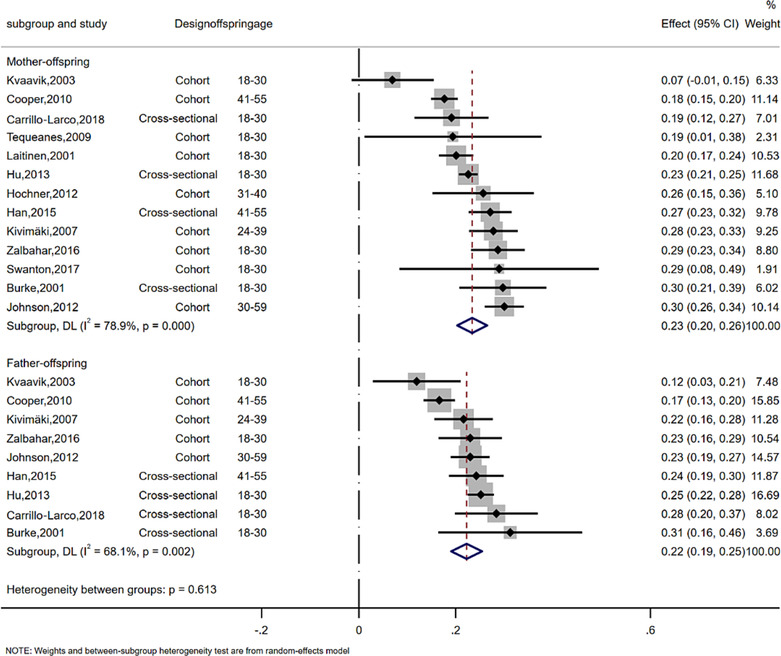
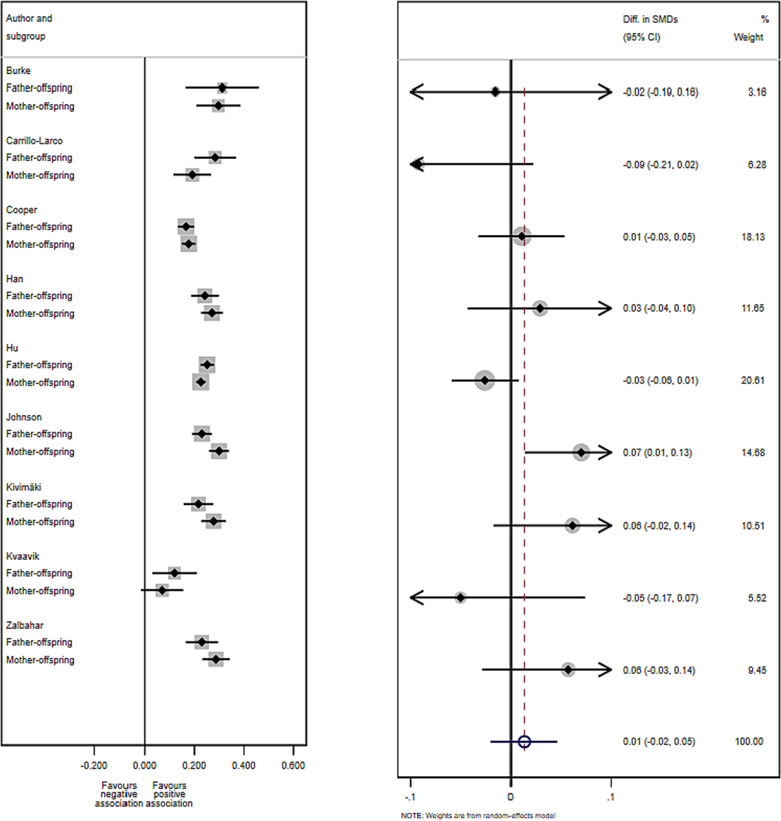
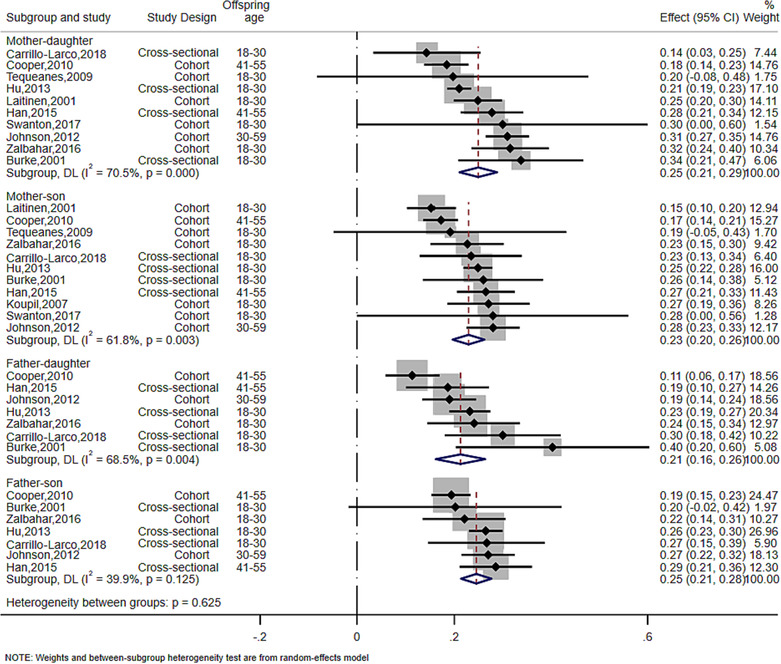
Obesity may track across generations, due to genetics and shared family environmental factors, or possibly intrauterine programming. However, many studies only assess associations between maternal body mass index (BMI) and offspring BMI in childhood. To determine whether maternal and paternal associations with offspring BMI differ and whether associations persist into adulthood, a systematic review and meta-analysis was done. PubMed, Embase, Web of Science, and Google Scholar (to October 2022) were searched. Observational studies reporting associations between maternal or paternal BMI and adult offspring BMI were included. Offspring BMIs were reported as continuous or categorical measures. Forty-six studies were included in the systematic review. Meta-analyses were conducted using random-effects models. Parental BMI was positively associated with offspring BMI in adulthood. The pooled mother-offspring standardized mean difference (SMD) was 0.23 (95% confidence interval [CI]: 0.20, 0.26), and father-offspring SMD was similar: 0.22 (95% CI: 0.19, 0.25) in adjusted models. Offspring of mothers with overweight or obesity had the same risk of higher BMI as offspring of fathers with overweight or obesity. If these associations are causal, they support interventions targeting all family members, rather than focusing solely on mothers, to obtain a healthy weight development among offspring.
肥胖可能会通过遗传和共同的家庭环境因素,或者可能是宫内编程在代际间传播。然而,许多研究仅评估了母亲体重指数 (BMI) 与儿童期后代 BMI 之间的关联。为了确定母亲和父亲与后代 BMI 的关联是否存在差异,以及这些关联是否持续到成年期,进行了系统评价和荟萃分析。检索了 PubMed、Embase、Web of Science 和 Google Scholar(截至 2022 年 10 月)。纳入了报告母亲或父亲 BMI 与成年后代 BMI 之间关联的观察性研究。后代 BMI 以连续或分类测量报告。系统评价纳入了 46 项研究。使用随机效应模型进行了荟萃分析。父母 BMI 与成年后代 BMI 呈正相关。调整模型中母子标准化均数差(SMD)的合并值为 0.23(95%置信区间 [CI]:0.20,0.26),父子 SMD 相似:0.22(95% CI:0.19,0.25)。超重或肥胖母亲的后代与超重或肥胖父亲的后代有相同的更高 BMI 风险。如果这些关联是因果关系的,它们支持针对所有家庭成员的干预措施,而不是仅针对母亲,以实现后代健康的体重发育。