Boren Justin P, Veksler Alice E
Department of Communication, Santa Clara University, 500 El Camino Real, Santa Clara, CA, 95053-0277, USA.
Department of Communication, Christopher Newport University, Newport News, VA, USA.
J Occup Med Toxicol. 2023 Oct 2;18(1):22. doi: 10.1186/s12995-023-00390-6.
Nurses experience a constellation of negative outcomes such as lost productivity, based on their high levels of organizational stress. Following recommendations for best practices in health communication can dramatically improve the organizational climate for nurses and can have a significant effect on patient outcomes. In this study, we evaluate the impact of Communicative Restricted Organizational Stress (CROS) and effort-reward imbalance (ERI).
A mixed-methods approach was employed. A professional survey research vendor was contracted to obtain an appropriate national sample (N = 299) of working nurses in the United States of America. Participants completed an online closed-ended questionnaire for the quantitative portion of the study. Qualitative data were gathered from member-checking follow-up interviews.
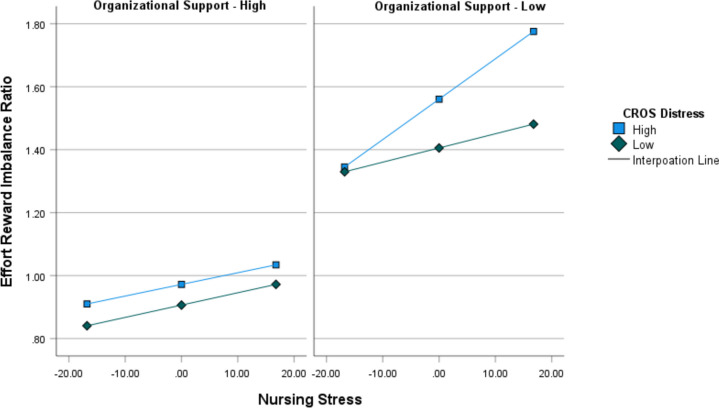
Results of the quantitative analysis indicated that nurses experience CROS, that these experiences are distressing, that CROS functions as an effort in the effort-reward-imbalance model, and that CROS and ERI contribute to negative outcomes such as insomnia, productivity lost, and poor general health. Specifically, a moderated moderation model accounted for 53% of the variance [F (7,290) = 47.363, p < .001] indicating that nurses with high levels of CROS distress and low levels of organizational support experienced the highest level of ERI in the presence of high nursing stress, t (296) = 3.05, p = .03, 95% CI [0.0038, 0.0178]. These findings were validated through member-checking qualitative interviews and specific overarching themes were explicated.
CROS is an important variable in understanding the experience of nursing stress. Furthermore, CROS serves as an effort in the ERI Model and serves to exacerbate nursing stress. We recommend practical implications for the improvement of psychosocial stress in an occupational environment for nurses.
护士由于组织压力水平较高,会经历一系列负面结果,如生产力下降。遵循健康沟通最佳实践的建议可显著改善护士的组织氛围,并对患者结局产生重大影响。在本研究中,我们评估了沟通受限的组织压力(CROS)和努力-回报失衡(ERI)的影响。
采用混合方法。委托一家专业调查研究供应商在美国获取一个合适的在职护士全国样本(N = 299)。参与者完成了一份在线封闭式问卷,作为研究的定量部分。定性数据通过成员核对后续访谈收集。
定量分析结果表明,护士经历了CROS,这些经历令人苦恼,CROS在努力-回报失衡模型中起到一种努力的作用,并且CROS和ERI会导致失眠、生产力下降和总体健康状况不佳等负面结果。具体而言,一个调节中介模型解释了53%的方差[F(7,290) = 47.363,p <.001],表明在护理压力较高的情况下,CROS苦恼程度高且组织支持水平低的护士经历的ERI水平最高,t(296) = 3.05,p =.03,95% CI[0.0038, 0.0178]。这些发现通过成员核对定性访谈得到验证,并阐述了具体的总体主题。
CROS是理解护理压力体验的一个重要变量。此外,CROS在ERI模型中起到一种努力的作用,并加剧护理压力。我们建议针对改善护士职业环境中的心理社会压力提出实际建议。