Neurology Service, Marqués de Valdecilla University Hospital, Avda. de Valdecilla 25, Santander, Cantabria, 39008, Spain.
Institute for Research Marqués de Valdecilla (IDIVAL), Santander, Cantabria, 39011, Spain.
Alzheimers Res Ther. 2023 Oct 2;15(1):163. doi: 10.1186/s13195-023-01319-1.
The arrival of new disease-modifying treatments for Alzheimer's disease (AD) requires the identification of subjects at risk in a simple, inexpensive, and non-invasive way. With tools allowing an adequate screening, it would be possible to optimize the use of these treatments. Plasma markers of AD are very promising, but it is necessary to prove that alterations in their levels are related to alterations in gold standard markers such as cerebrospinal fluid or PET imaging. With this research, we want to evaluate the performance of plasma Aβ40, Aβ42, and p-tau181 to detect the pathological changes in CSF using the automated Lumipulse platform.
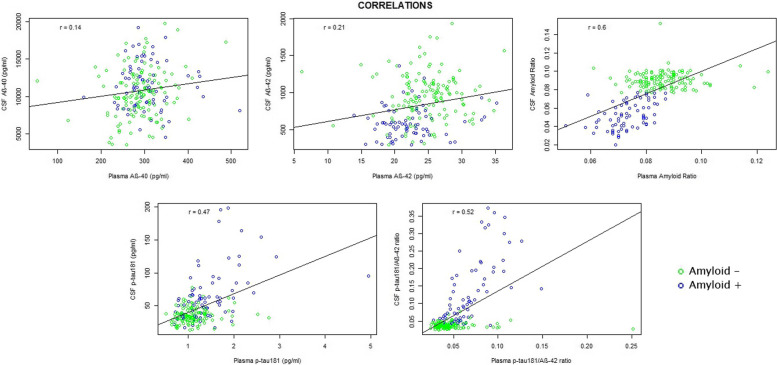
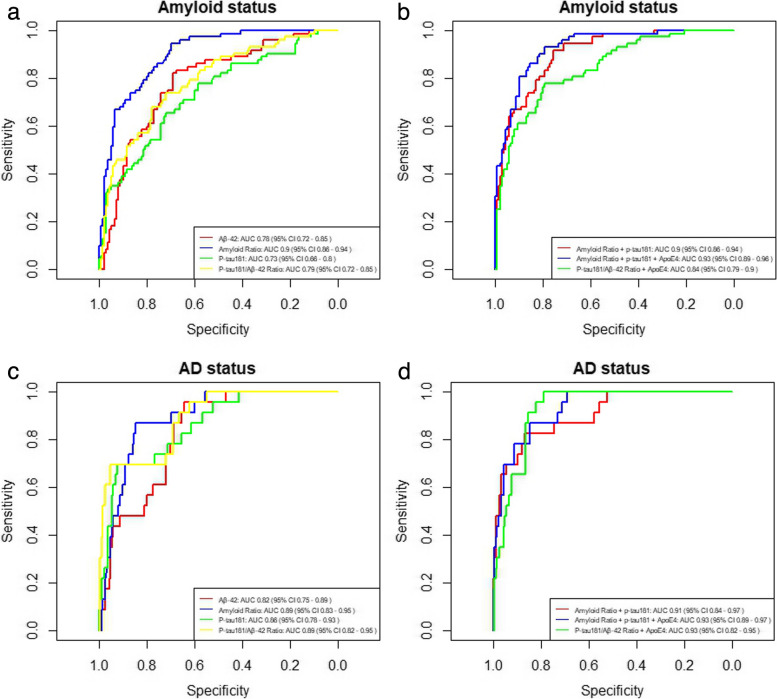
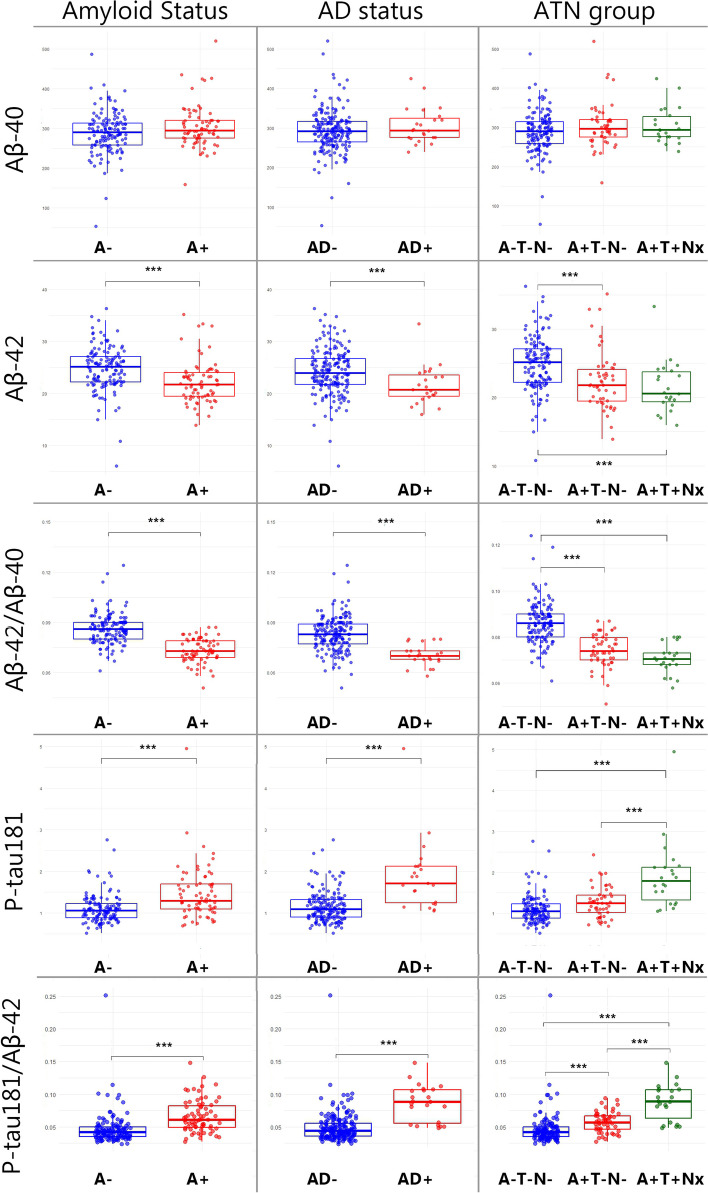
Both plasma and CSF Aβ40, Aβ42, and p-tau181 have been evaluated in a group of 208 cognitively unimpaired subjects with a 30.3% of ApoE4 carriers. We have correlated plasma and CSF values of each biomarker. Then, we have also assessed the differences in plasma marker values according to amyloid status (A - / +), AD status (considering AD + subjects to those A + plus Tau +), and ATN group defined by CSF. Finally, ROC curves have been performed, and the area under the curve has been measured using amyloid status and AD status as an outcome and different combinations of plasma markers as predictors.
Aβ42, amyloid ratio, p-tau181, and p-tau181/Aβ42 ratio correlated significantly between plasma and CSF. For these markers, the levels were significantly different in the A + / - , AD + / - , and ATN groups. Amyloid ratio predicts amyloid and AD pathology in CSF with an AUC of 0.89.
Plasma biomarkers of AD using the automated Lumipulse platform show good diagnostic performance in detecting Alzheimer's pathology in cognitively unimpaired subjects.
新的阿尔茨海默病(AD)治疗方法的出现需要以简单、廉价和非侵入性的方式来识别高危人群。通过使用适当的筛查工具,就有可能优化这些治疗方法的使用。AD 的血浆标志物非常有前景,但有必要证明其水平的变化与脑脊液或 PET 成像等金标准标志物的变化有关。通过这项研究,我们希望使用自动化 Lumipulse 平台评估血浆 Aβ40、Aβ42 和 p-tau181 检测脑脊液中病理变化的性能。
我们评估了 208 名认知正常的受试者的血浆和 CSF Aβ40、Aβ42 和 p-tau181,其中 30.3%的受试者为 ApoE4 携带者。我们对每个生物标志物的血浆和 CSF 值进行了相关性分析。然后,我们还根据淀粉样蛋白状态(A-/-、A+/+)、AD 状态(将 A+ 受试者视为 A+ 加上 Tau+)和 CSF 定义的 ATN 组评估了血浆标志物值的差异。最后,我们进行了 ROC 曲线分析,并使用淀粉样蛋白状态和 AD 状态作为结果,以及不同的血浆标志物组合作为预测因子,测量了曲线下面积。
Aβ42、淀粉样蛋白比值、p-tau181 和 p-tau181/Aβ42 比值在血浆和 CSF 之间显著相关。对于这些标志物,在 A+/-、AD+/+和 ATN 组中,水平有显著差异。淀粉样蛋白比值预测 CSF 中的淀粉样蛋白和 AD 病理,AUC 为 0.89。
使用自动化 Lumipulse 平台的 AD 血浆生物标志物在检测认知正常的受试者的阿尔茨海默病病理方面具有良好的诊断性能。