Bazo Perez Maria, Hayes Timothy B, Frazier Leslie D
Department of Psychology, Florida International University, 11200 SW 8th Street, Miami, FL, 33199, USA.
J Eat Disord. 2023 Oct 2;11(1):173. doi: 10.1186/s40337-023-00890-0.
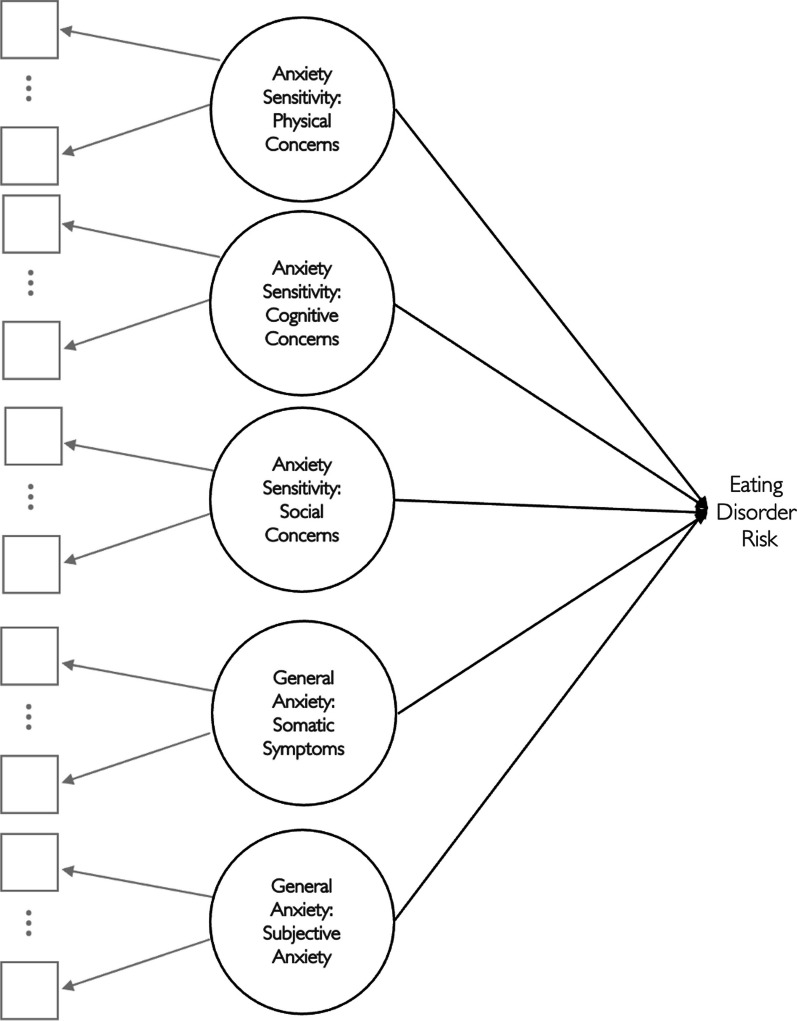
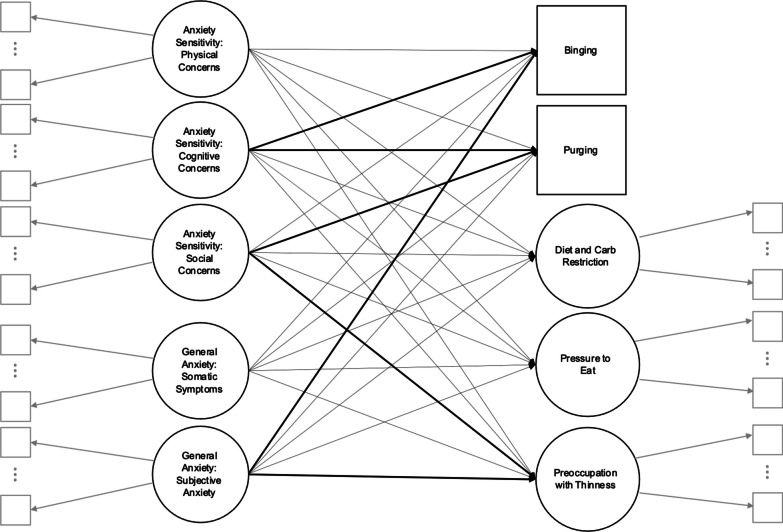
Anxiety and eating disorders (EDs) are rising at alarming rates. These mental health disorders are often comorbid, yet the factors associated with their comorbidity are not well understood. The present study examined a theoretical model of the pathways and relative associations of anxiety sensitivity (AS) with different dimensions of ED risk, controlling for generalized anxiety.
Participants (N = 795) were undergraduate students with an average age of 21 (SD = 4.02), predominantly female (71%), and Hispanic (71.8%). Participants completed an online survey with established measures of AS (i.e., Anxiety Sensitivity Index-3; ASI-3), general anxiety (i.e., Beck Anxiety Inventory; BAI), and eating behaviors (i.e., Eating Attitudes Test-26; EAT-26).
The results of our structural equation models indicated that AS subscales were significantly associated with dimensions of the EAT-26, even when controlling for generalized anxiety. Specifically, the ASI-3 factors reflecting cognitive and social concerns provided the most consistent significant associations with EDs. Whereas reporting higher cognitive concerns was associated with higher ED symptoms (e.g., reporting the urge to vomit after a meal), reporting higher social concerns was associated with fewer ED symptoms. These differential results may suggest risk and resilience pathways and potential protective or buffering effects of social concerns on ED risk.
Findings advance understanding of the role of AS in the comorbidity of anxiety and EDs, demonstrating the strong association of AS with ED pathology. These findings provide cognitive indicators for transdiagnostic therapeutic intervention in order to reduce the risk of EDs.
焦虑症和饮食失调症(EDs)的发病率正以惊人的速度上升。这些心理健康障碍常常共存,但与它们共存相关的因素尚未得到充分理解。本研究检验了一个理论模型,该模型阐述了焦虑敏感性(AS)与饮食失调风险不同维度之间的路径及相对关联,并对广泛性焦虑进行了控制。
参与者(N = 795)为本科生,平均年龄21岁(标准差 = 4.02),主要为女性(71%),西班牙裔(71.8%)。参与者完成了一项在线调查,其中包括已确立的焦虑敏感性测量工具(即焦虑敏感性指数-3;ASI-3)、广泛性焦虑测量工具(即贝克焦虑量表;BAI)和饮食行为测量工具(即饮食态度测试-26;EAT-26)。
我们的结构方程模型结果表明,即使控制了广泛性焦虑,AS分量表仍与EAT-26的维度显著相关。具体而言,反映认知和社交担忧的ASI-3因子与饮食失调症的关联最为一致且显著。报告较高的认知担忧与较高的饮食失调症状相关(例如,报告饭后有呕吐冲动),而报告较高的社交担忧则与较少的饮食失调症状相关。这些不同的结果可能表明存在风险和恢复力路径,以及社交担忧对饮食失调风险的潜在保护或缓冲作用。
研究结果推进了对AS在焦虑症和饮食失调症共病中作用的理解,证明了AS与饮食失调病理学之间的紧密关联。这些发现为跨诊断治疗干预提供了认知指标,以降低饮食失调症的风险。