Sokale Itunu O, Rosales Omar, Montealegre Jane R, Oluyomi Abiodun O, Thrift Aaron P
Section of Epidemiology and Population Sciences, Department of Medicine, Baylor College of Medicine, Houston, Texas.
Dan L. Duncan Comprehensive Cancer Center, Baylor College of Medicine, Houston, Texas.
AJPM Focus. 2022 Dec 10;2(1):100055. doi: 10.1016/j.focus.2022.100055. eCollection 2023 Mar.
Mortality rates from colorectal cancer have declined over the past decades owing to population-based life-saving screening interventions. However, screening inequalities continue among racial and ethnic minorities despite having a higher disease burden. In this study, we assessed the patterns of up-to-date colorectal cancer screening rates among racial/ethnic groups across the U.S. Census Bureau Divisions.
This population-based cross-sectional study used weighted data from 4 cycles of the Behavioral Risk Factors Surveillance System (2014, 2016, 2018, and 2020) of adults aged 50‒75 years without a previous diagnosis of colorectal cancer. The primary outcome was guideline-recommended up-to-date colorectal cancer screening. We used logistic regression models to examine temporal trends in up-to-date colorectal cancer screening from 2014 to 2020. In addition, we conducted detailed descriptive statistics of up-to-date screening rates, comparing trends in 2020 with those in 2014 overall by race/ethnicity and U.S. census divisions.
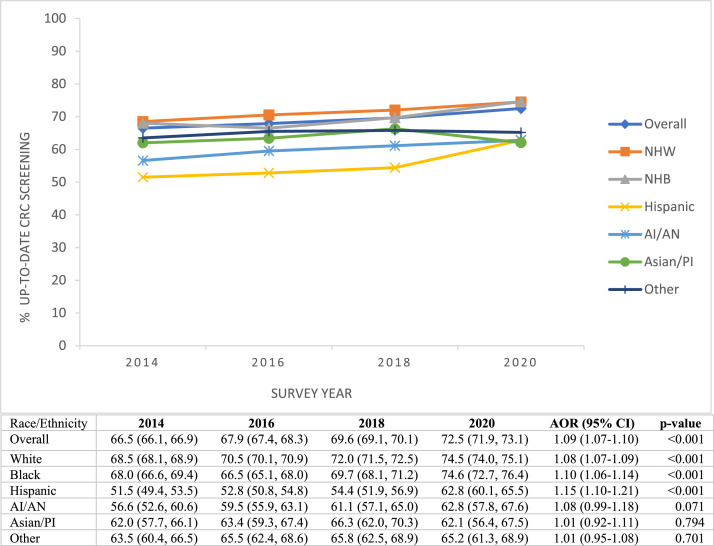
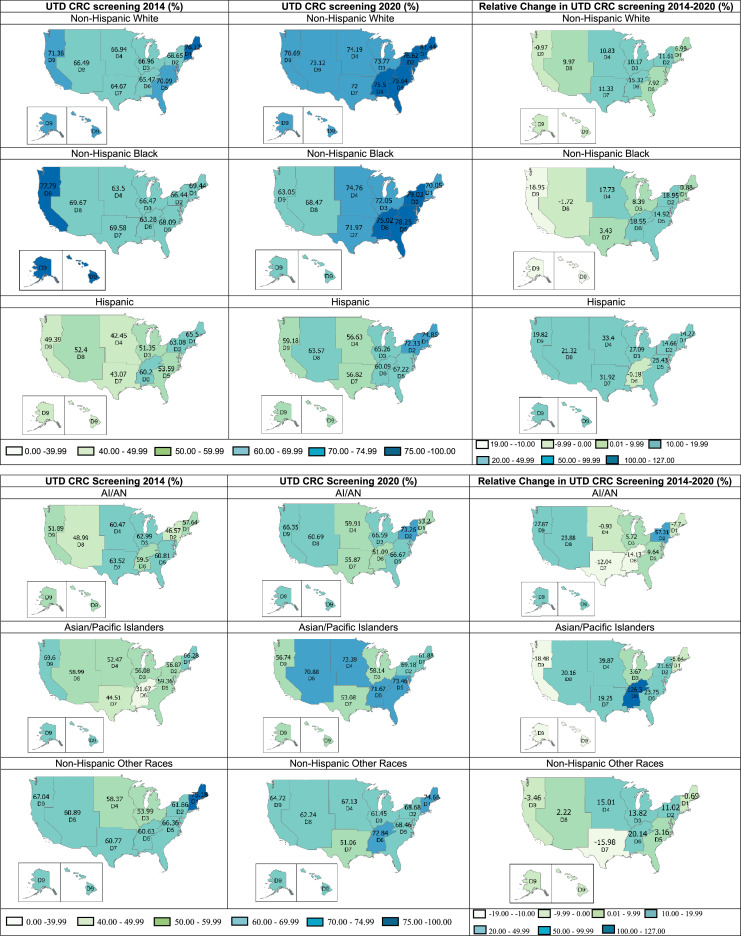
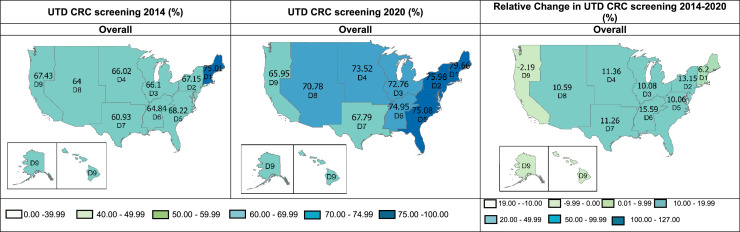
The overall proportion of individuals with up-to-date colorectal cancer screening increased from 66.5% in 2014 to 72.5% in 2020 (<0.001). For racial/ethnic subgroups, from 2014 to 2020, screening rates increased significantly among non-Hispanic Whites (68.5%‒74.5%, <0.001), non-Hispanic Blacks (68.0%‒74.6%, <0.001), and Hispanics (51.5%‒62.8%, <0.001). However, increases were not observed in all U.S. Census Bureau Divisions.
Although colorectal cancer screening rates improved over time, they fall short of the 80% target. Substantial racial/ethnic and geographic disparities remain. Future studies investigating the factors influencing these disparities are needed.
在过去几十年中,由于基于人群的挽救生命的筛查干预措施,结直肠癌死亡率有所下降。然而,尽管疾病负担较高,但种族和少数民族之间的筛查不平等现象仍然存在。在本研究中,我们评估了美国人口普查局各分区不同种族/族裔群体的最新结直肠癌筛查率模式。
这项基于人群的横断面研究使用了行为危险因素监测系统4个周期(2014年、2016年、2018年和2020年)中50至75岁且先前未被诊断患有结直肠癌的成年人的加权数据。主要结果是指南推荐的最新结直肠癌筛查。我们使用逻辑回归模型来研究2014年至2020年期间最新结直肠癌筛查的时间趋势。此外,我们对最新筛查率进行了详细的描述性统计,按种族/族裔和美国人口普查分区比较了2020年与2014年的趋势。
进行了最新结直肠癌筛查的个体总体比例从2014年的66.5%增至2020年的72.5%(<0.001)。对于种族/族裔亚组,从2014年到2020年,非西班牙裔白人(68.5%至74.5%,<0.001)、非西班牙裔黑人(68.0%至74.6%,<0.001)和西班牙裔(51.5%至62.8%,<0.001)的筛查率显著上升。然而,并非所有美国人口普查局分区都有上升。
尽管随着时间的推移结直肠癌筛查率有所提高,但仍未达到80%的目标。种族/族裔和地理差异仍然很大。未来需要开展研究调查影响这些差异的因素。