Zanti Maria, Loizidou Maria A, O'Mahony Denise G, Dorling Leila, Dennis Joe, Devilee Peter, Easton Douglas F, Panayiotidis Mihalis I, Hadjisavvas Andreas, Michailidou Kyriaki
Biostatistics Unit, The Cyprus Institute of Neurology and Genetics, Nicosia, Cyprus.
Department of Cancer Genetics, Therapeutics and Ultrastructural Pathology, The Cyprus Institute of Neurology and Genetics, Nicosia, Cyprus.
Front Genet. 2023 Sep 18;14:1248492. doi: 10.3389/fgene.2023.1248492. eCollection 2023.
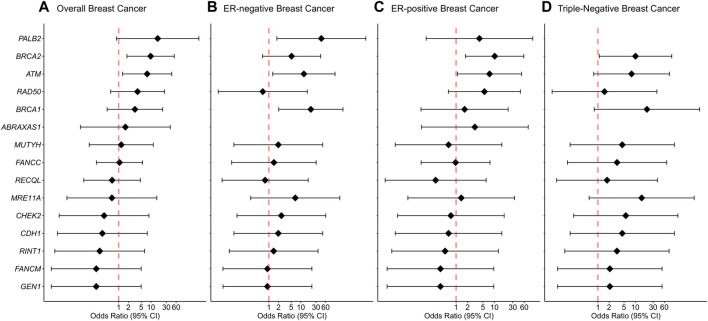
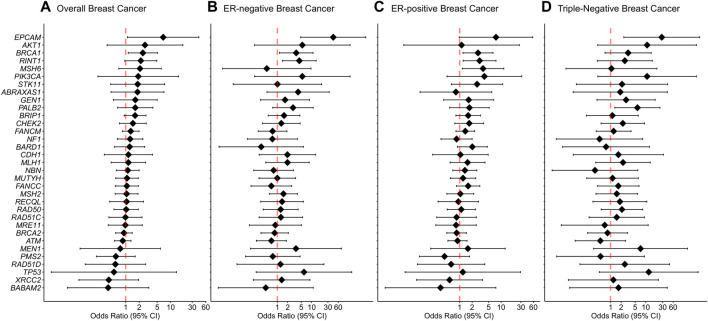
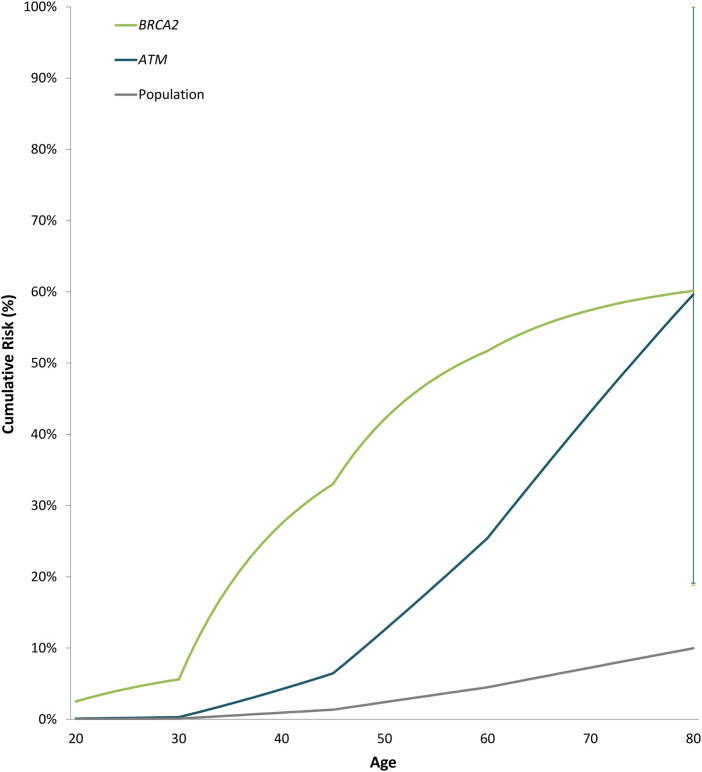
It is estimated that around 5% of breast cancer cases carry pathogenic variants in established breast cancer susceptibility genes. However, the underlying prevalence and gene-specific population risk estimates in Cyprus are currently unknown. We performed sequencing on a population-based case-control study of 990 breast cancer cases and 1094 controls from Cyprus using the BRIDGES sequencing panel. Analyses were conducted separately for protein-truncating and rare missense variants. Protein-truncating variants in established breast cancer susceptibility genes were detected in 3.54% of cases and 0.37% of controls. Protein-truncating variants in and were associated with a high risk of breast cancer, whereas PTVs in and were associated with a high risk of estrogen receptor (ER)-negative disease. Among participants with a family history of breast cancer, PTVs in , , , and were associated with an increased risk of breast cancer. Furthermore, an additional 19.70% of cases and 17.18% of controls had at least one rare missense variant in established breast cancer susceptibility genes. For and , rare missense variants were associated with an increased risk of overall and triple-negative breast cancer, respectively. Rare missense variants in , , and domains, were associated with increased risk of disease subtypes. This study provides population-based prevalence and gene-specific risk estimates for protein-truncating and rare missense variants. These results may have important clinical implications for women who undergo genetic testing and be pivotal for a substantial proportion of breast cancer patients in Cyprus.
据估计,约5%的乳腺癌病例在已确定的乳腺癌易感基因中携带致病变异。然而,塞浦路斯潜在的患病率和基因特异性人群风险估计目前尚不清楚。我们使用BRIDGES测序面板,对来自塞浦路斯的990例乳腺癌病例和1094例对照进行了基于人群的病例对照研究测序。分别对蛋白质截短变异和罕见错义变异进行了分析。在3.54%的病例和0.37%的对照中检测到已确定的乳腺癌易感基因中的蛋白质截短变异。 和 中的蛋白质截短变异与乳腺癌高风险相关,而 和 中的蛋白质截短变异与雌激素受体(ER)阴性疾病高风险相关。在有乳腺癌家族史的参与者中, 、 、 、 和 中的蛋白质截短变异与乳腺癌风险增加相关。此外,另有19.70%的病例和17.18%的对照在已确定的乳腺癌易感基因中至少有一个罕见错义变异。对于 和 ,罕见错义变异分别与总体乳腺癌和三阴性乳腺癌风险增加相关。 、 、 和 结构域中的罕见错义变异与疾病亚型风险增加相关。本研究提供了基于人群的蛋白质截短变异和罕见错义变异的患病率及基因特异性风险估计。这些结果可能对接受基因检测的女性具有重要临床意义,并且对塞浦路斯相当一部分乳腺癌患者至关重要。