
基于深度学习的水稻穗上籽粒高通量免分离表型分析方法
High-throughput and separating-free phenotyping method for on-panicle rice grains based on deep learning.
作者信息
Lu Yuwei, Wang Jinhu, Fu Ling, Yu Lejun, Liu Qian
机构信息
Key Laboratory of Biomedical Engineering of Hainan Province, School of Biomedical Engineering, Hainan University, Haikou, China.
Britton Chance Center for Biomedical Photonics, Wuhan National Laboratory for Optoelectronics, Huazhong University of Science and Technology, Wuhan, Hubei, China.
出版信息
Front Plant Sci. 2023 Sep 18;14:1219584. doi: 10.3389/fpls.2023.1219584. eCollection 2023.
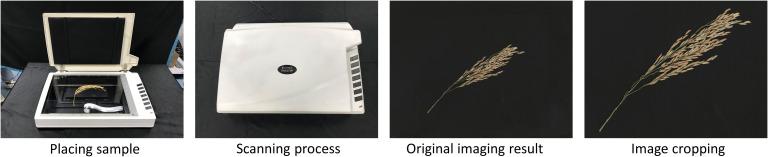
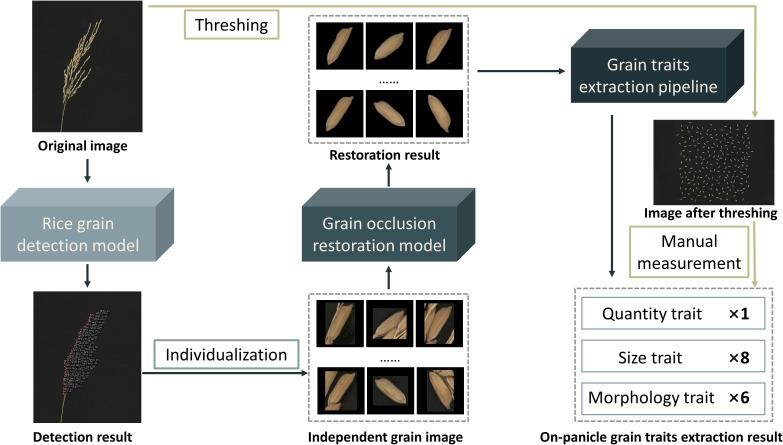
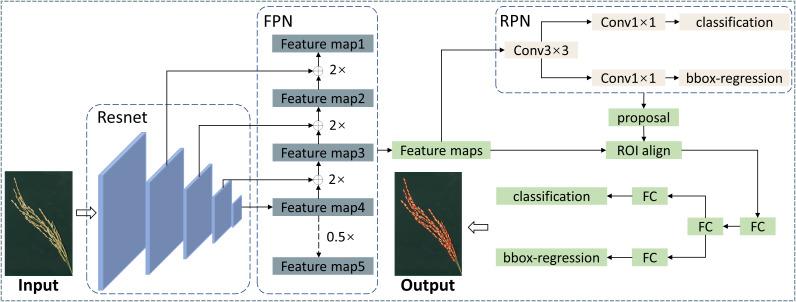
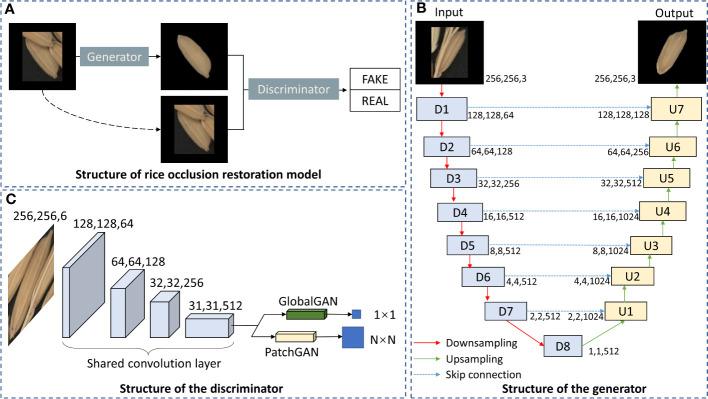
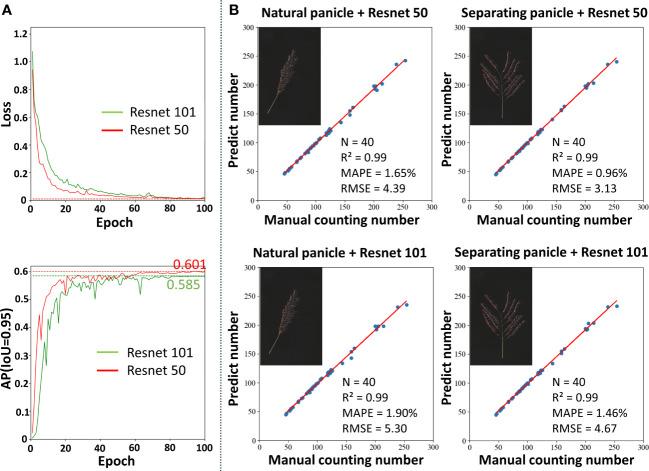
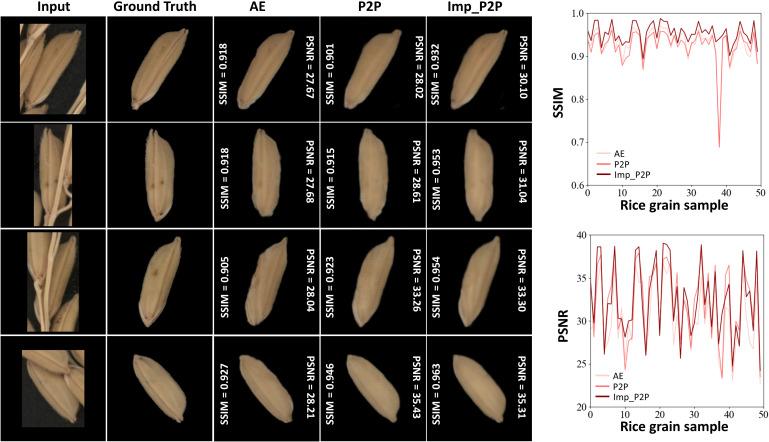
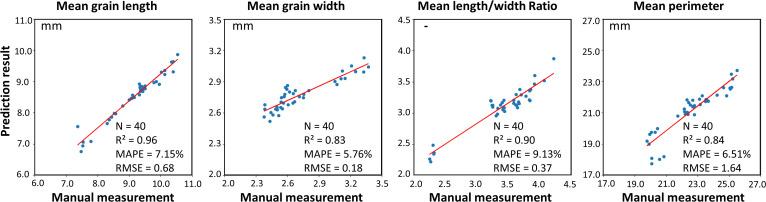
Rice is a vital food crop that feeds most of the global population. Cultivating high-yielding and superior-quality rice varieties has always been a critical research direction. Rice grain-related traits can be used as crucial phenotypic evidence to assess yield potential and quality. However, the analysis of rice grain traits is still mainly based on manual counting or various seed evaluation devices, which incur high costs in time and money. This study proposed a high-precision phenotyping method for rice panicles based on visible light scanning imaging and deep learning technology, which can achieve high-throughput extraction of critical traits of rice panicles without separating and threshing rice panicles. The imaging of rice panicles was realized through visible light scanning. The grains were detected and segmented using the Faster R-CNN-based model, and an improved Pix2Pix model cascaded with it was used to compensate for the information loss caused by the natural occlusion between the rice grains. An image processing pipeline was designed to calculate fifteen phenotypic traits of the on-panicle rice grains. Eight varieties of rice were used to verify the reliability of this method. The R values between the extraction by the method and manual measurements of the grain number, grain length, grain width, grain length/width ratio and grain perimeter were 0.99, 0.96, 0.83, 0.90 and 0.84, respectively. Their mean absolute percentage error (MAPE) values were 1.65%, 7.15%, 5.76%, 9.13% and 6.51%. The average imaging time of each rice panicle was about 60 seconds, and the total time of data processing and phenotyping traits extraction was less than 10 seconds. By randomly selecting one thousand grains from each of the eight varieties and analyzing traits, it was found that there were certain differences between varieties in the number distribution of thousand-grain length, thousand-grain width, and thousand-grain length/width ratio. The results show that this method is suitable for high-throughput, non-destructive, and high-precision extraction of on-panicle grains traits without separating. Low cost and robust performance make it easy to popularize. The research results will provide new ideas and methods for extracting panicle traits of rice and other crops.
水稻是养活全球大部分人口的重要粮食作物。培育高产优质水稻品种一直是关键的研究方向。水稻籽粒相关性状可作为评估产量潜力和品质的关键表型证据。然而,水稻籽粒性状分析仍主要基于人工计数或各种种子评价设备,这在时间和金钱上成本高昂。本研究提出了一种基于可见光扫描成像和深度学习技术的水稻穗高精度表型分析方法,该方法无需对水稻穗进行分离和脱粒,即可实现水稻穗关键性状的高通量提取。通过可见光扫描实现水稻穗成像。使用基于Faster R-CNN的模型对籽粒进行检测和分割,并与之级联一个改进的Pix2Pix模型来补偿水稻籽粒间自然遮挡造成的信息损失。设计了一个图像处理流程来计算穗上水稻籽粒的15个表型性状。使用8个水稻品种验证了该方法的可靠性。该方法提取的粒数、粒长、粒宽、粒长/宽比和粒周长与人工测量值之间的R值分别为0.99、0.96、0.83、0.90和0.84。它们的平均绝对百分比误差(MAPE)值分别为1.65%、7.15%、5.76%、9.13%和6.51%。每个水稻穗的平均成像时间约为60秒,数据处理和表型性状提取的总时间少于10秒。通过从8个品种中各随机选取1000粒进行性状分析,发现千粒长、千粒宽和千粒长/宽比的数量分布在品种间存在一定差异。结果表明,该方法适用于不分离穗上籽粒的高通量、无损、高精度提取。低成本和强大的性能使其易于推广。研究结果将为水稻及其他作物穗部性状提取提供新的思路和方法。




 Zotero 插件