Groen Kira, Steffens Reinhardt Luiza, Bourdon Jean-Christophe, Avery-Kiejda Kelly A
School of Biomedical Sciences and Pharmacy, College of Health, Medicine and Wellbeing, The University of Newcastle, Callaghan, NSW, Australia.
Hunter Medical Research Institute, Level 3 West, Lot 1 Kookaburra Circuit, New Lambton Heights, NSW, Australia.
Cancer Cell Int. 2023 Oct 4;23(1):228. doi: 10.1186/s12935-023-03083-6.
Melanoma is the deadliest type of skin cancer and despite improvements in treatment outcomes, melanoma claimed 57,043 lives in 2020. In most malignancies, p53 mutation rates are above 50% and provide prognostic indications. However, in melanoma where less than a quarter of cases harbour a p53 mutation, the significance of the tumour suppressor may be questioned. Instead, p53 isoforms, which modulate p53's canonical function, may be of greater clinical importance.
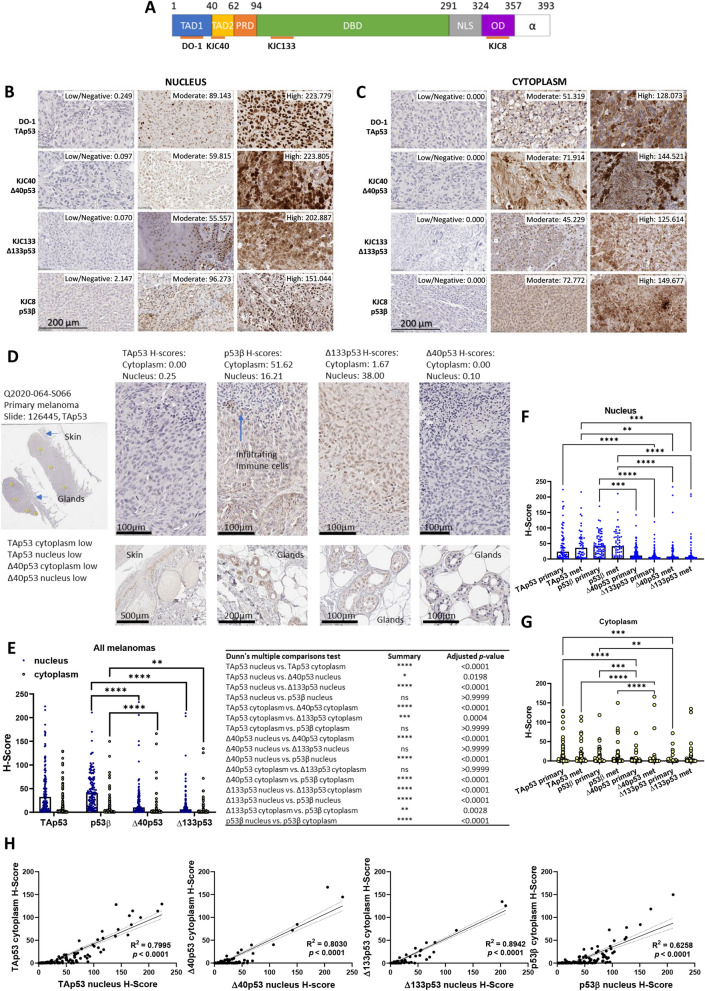
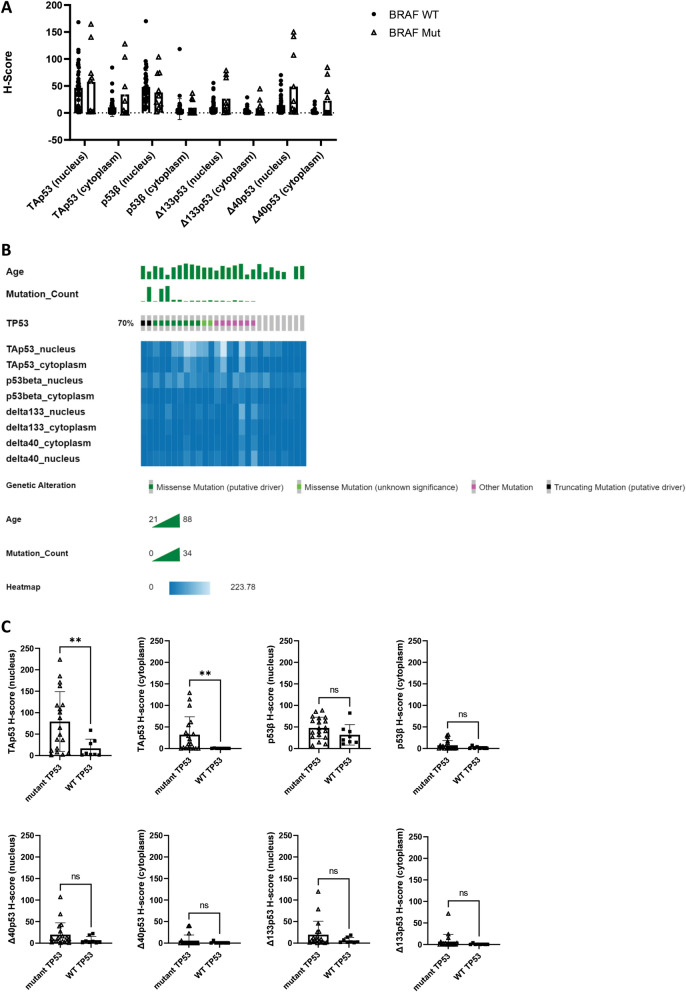
The expression of p53 isoforms was evaluated in 123 melanoma specimens by immunohistochemistry using p53 isoform-specific antibodies (DO-1, KJC8, KJC40, and KJC133). To determine whether TP53 mutations may be driving p53 isoform expression, TP53 was sequenced in 30 FFPE melanoma samples.
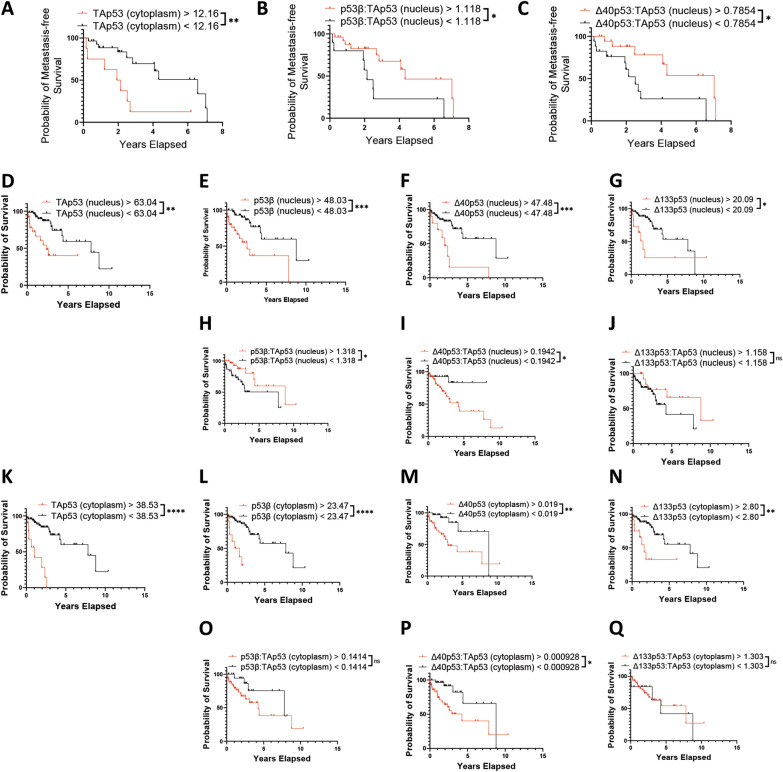
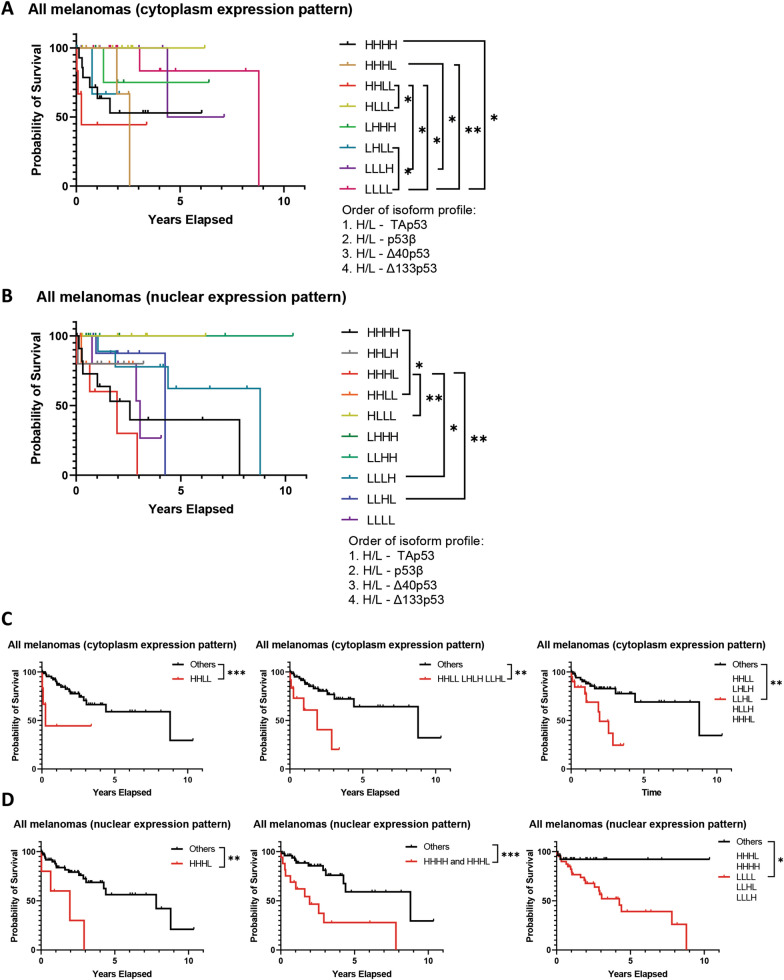
The C-terminally truncated p53β isoforms (KJC8) were found to be the most highly expressed p53 isoforms compared to all other isoforms. Further, elevated KJC8 staining was found to correlate with reduced probability of melanoma-specific survival, while KJC40 staining (Δ40p53) positively correlated with reduced melanoma thickness. TAp53 isoforms (p53 retaining both transactivation domains, DO-1), were the second highest p53 isoforms expressed across all samples. Elevated DO-1 staining was also associated with worse survival outcomes and more advanced stages of cancer. Given that the isoforms are likely to work in concert, composite isoform profiles were generated. Composite biomarker profiles revealed that elevated TAp53 (DO-1) and p53β (KJC8) expression, accompanied by low Δ40p53 (KJC40) and Δ133p53 (KJC133) expression was associated with the worst survival outcomes. Supporting the lack of predictive biomarker potential of TP53 in melanoma, no clinicopathological or p53 isoform expression associations could be linked to TP53 status.
Given the lack of prognostic biomarker potential derived from TP53 status, this study highlights how p53 isoform expression might progress this field and, pending further validation, may provide additional information to treating oncologists that might be factored into treatment decisions.
黑色素瘤是最致命的皮肤癌类型,尽管治疗效果有所改善,但2020年仍有57,043人死于黑色素瘤。在大多数恶性肿瘤中,p53突变率超过50%,并具有预后指示作用。然而,在黑色素瘤中,只有不到四分之一的病例存在p53突变,肿瘤抑制因子的重要性可能受到质疑。相反,调节p53经典功能的p53异构体可能具有更大的临床重要性。
使用p53异构体特异性抗体(DO-1、KJC8、KJC40和KJC133)通过免疫组织化学评估123例黑色素瘤标本中p53异构体的表达。为了确定TP53突变是否可能驱动p53异构体表达,对30例福尔马林固定石蜡包埋(FFPE)黑色素瘤样本进行了TP53测序。
与所有其他异构体相比,发现C末端截短的p53β异构体(KJC8)是表达最高的p53异构体。此外,发现KJC8染色升高与黑色素瘤特异性生存概率降低相关,而KJC40染色(Δ40p53)与黑色素瘤厚度降低呈正相关。TAp53异构体(保留两个反式激活结构域的p53,DO-1)是所有样本中表达第二高的p53异构体。DO-1染色升高也与较差的生存结果和更晚期的癌症相关。鉴于这些异构体可能协同发挥作用,生成了复合异构体图谱。复合生物标志物图谱显示,TAp53(DO-1)和p53β(KJC8)表达升高,同时Δ40p53(KJC40)和Δ133p53(KJC133)表达降低与最差的生存结果相关。支持TP53在黑色素瘤中缺乏预测生物标志物潜力的是,未发现临床病理或p53异构体表达与TP53状态之间存在关联。
鉴于TP53状态缺乏预后生物标志物潜力,本研究强调了p53异构体表达如何推动该领域的发展,并且在进一步验证之前,可能为治疗肿瘤学家提供额外信息,这些信息可能会被纳入治疗决策。