Erasmus MC, University Medical Center Rotterdam, Department of Hospital Pharmacy.
Erasmus MC, University Medical Center Rotterdam, Department of Internal Medicine, Rotterdam.
J Hypertens. 2024 Jan 1;42(1):169-178. doi: 10.1097/HJH.0000000000003585. Epub 2023 Oct 18.
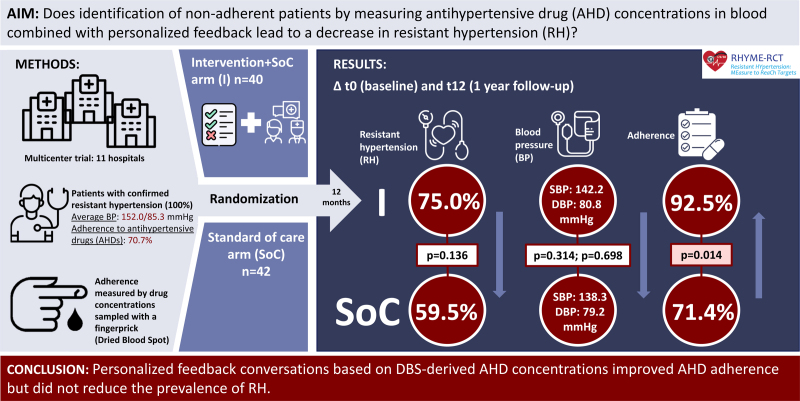
Adherence to antihypertensive drugs (AHDs) is crucial for controlling blood pressure (BP). We aimed to determine the effectiveness of measuring AHD concentrations using a dried blood spot (DBS) sampling method to identify nonadherence, combined with personalized feedback, in reducing resistant hypertension.
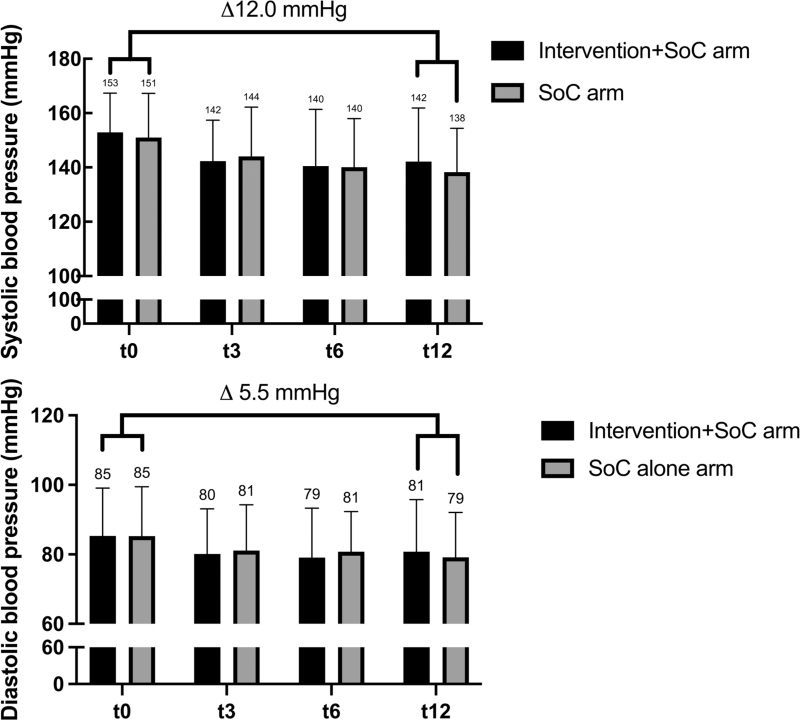
We conducted a multicenter, randomized, controlled trial (RHYME-RCT, ICTRP NTR6914) in patients with established resistant hypertension. Patients were randomized to receive either an intervention with standard of care (SoC) or SoC alone. SoC consisted of BP measurement and DBS sampling at baseline, 3 months (t3), 6 months (t6), and 12 months (t12); AHD concentrations were measured but not reported in this arm. In the intervention arm, results on AHD concentrations were discussed during a personalized feedback conversation at baseline and t3. Study endpoints included the proportion of patients with RH and AHD adherence at t12.
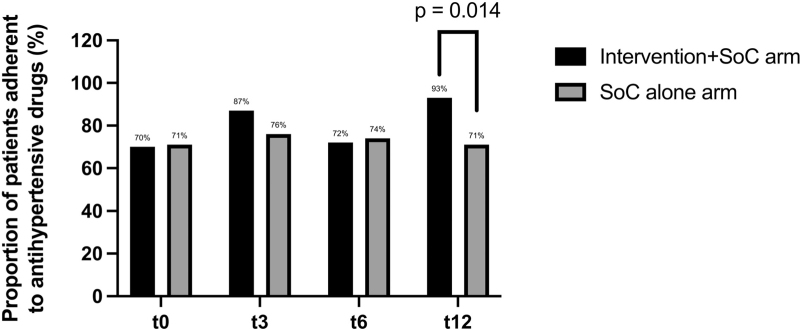
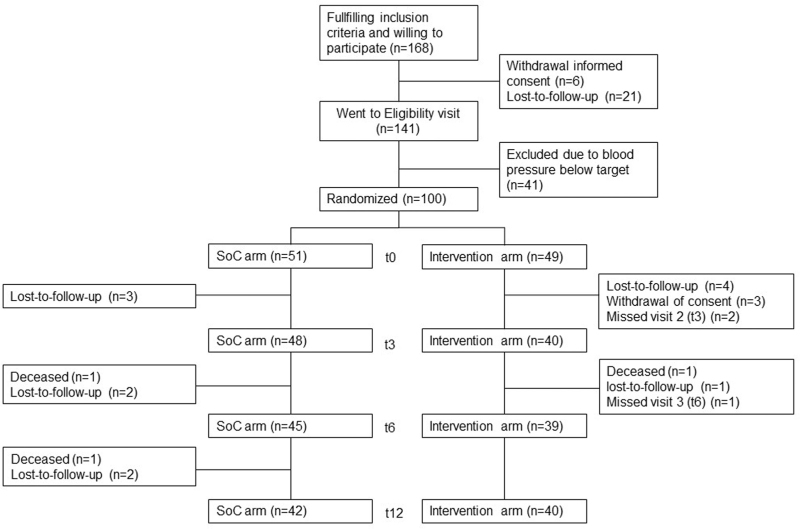
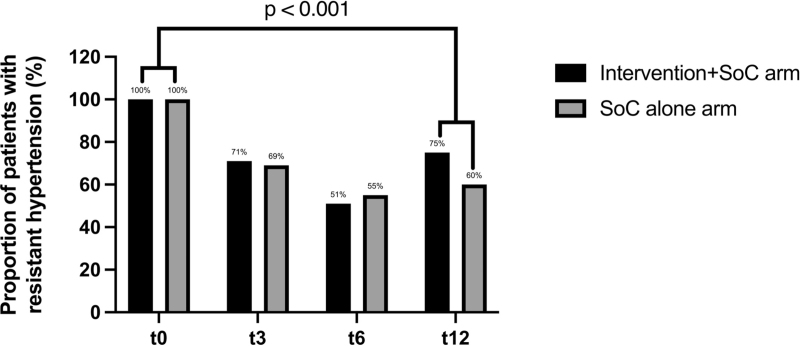
Forty-nine patients were randomized to receive the intervention+SoC, and 51 were randomized to receive SoC alone. The proportion of adherent patients improved from 70.0 to 92.5% in the intervention+SoC arm ( P = 0.008, n = 40) and remained the same in the SoC arm (71.4%, n = 42). The difference in adherence between the arms was statistically significant ( P = 0.014). The prevalence of resistant hypertension decreased to 75.0% in the intervention+SoC arm ( P < 0.001, n = 40) and 59.5% in the SoC arm ( P < 0.001, n = 42) at t12; the difference between the arms was statistically nonsignificant ( P = 0.14).
Personalized feedback conversations based on DBS-derived AHD concentrations improved AHD adherence but did not reduce the prevalence of RH.
抗高血压药物(AHDs)的依从性对于控制血压(BP)至关重要。我们旨在确定使用干血斑(DBS)采样方法测量 AHD 浓度以识别不依从性,并结合个性化反馈,从而降低难治性高血压的有效性。
我们在已确诊的难治性高血压患者中进行了一项多中心、随机、对照试验(RHYME-RCT,ICTRP NTR6914)。患者被随机分配接受标准治疗(SoC)加干预或仅接受 SoC。SoC 包括基线、3 个月(t3)、6 个月(t6)和 12 个月(t12)时的血压测量和 DBS 采样;在该臂中未报告 AHD 浓度的测量值。在干预臂中,在基线和 t3 时通过个性化反馈对话讨论 AHD 浓度的结果。研究终点包括 t12 时 RH 和 AHD 依从性的患者比例。
49 例患者被随机分配接受干预+SoC,51 例患者被随机分配接受单独的 SoC。在干预+SoC 臂中,依从性患者的比例从 70.0%提高到 92.5%(P=0.008,n=40),而 SoC 臂中则保持不变(71.4%,n=42)。臂间的依从性差异具有统计学意义(P=0.014)。在干预+SoC 臂中,难治性高血压的患病率下降至 75.0%(P<0.001,n=40),在 SoC 臂中下降至 59.5%(P<0.001,n=42);臂间差异无统计学意义(P=0.14)。
基于 DBS 衍生的 AHD 浓度的个性化反馈对话提高了 AHD 的依从性,但并未降低 RH 的患病率。