From the Department of Vascular Medicine (E.H.G., M.E.A.M.v.K., F.L.J.V., W.S.), University Medical Center Utrecht, Utrecht University, the Netherlands.
Julius Center for Health Sciences and Primary Care (M.L.B.), University Medical Center Utrecht, Utrecht University, the Netherlands.
Hypertension. 2021 Jan;77(1):85-93. doi: 10.1161/HYPERTENSIONAHA.120.16061. Epub 2020 Nov 30.
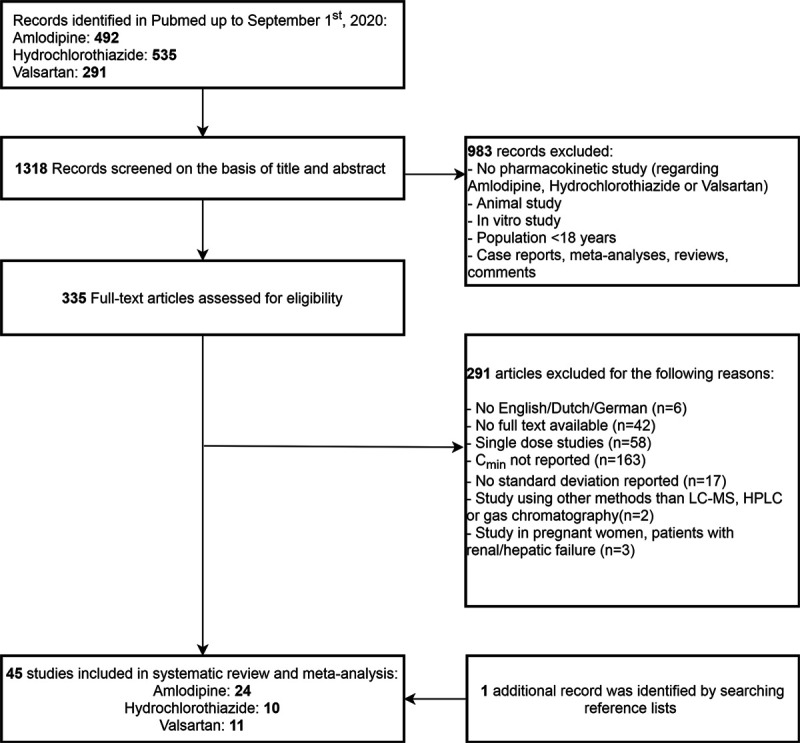
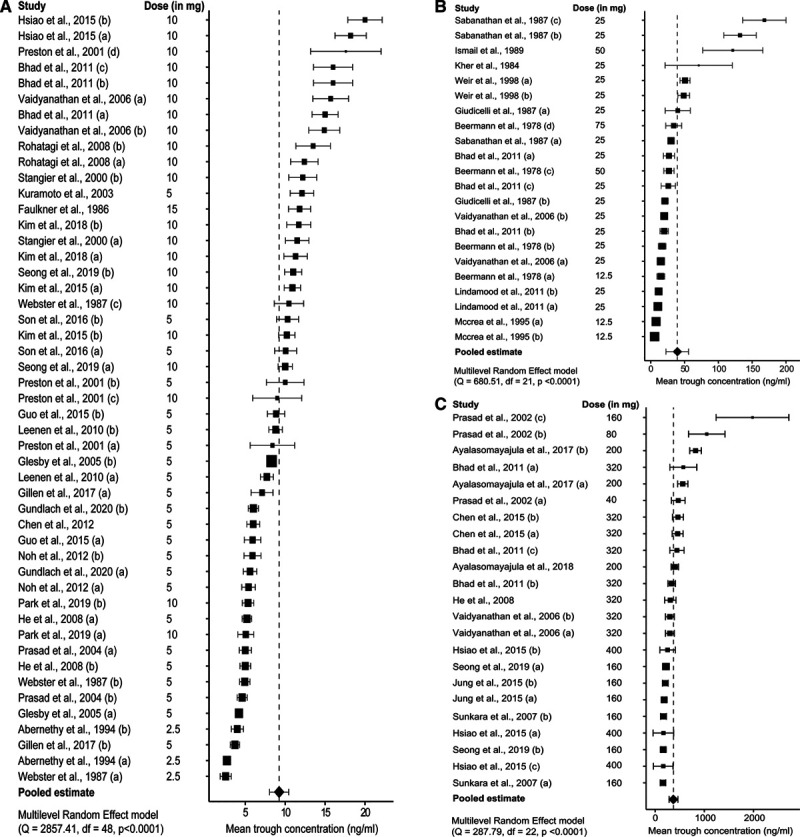
Biochemical drug screening by liquid chromatography-tandem mass spectrometry in plasma is an accurate method for the quantification of plasma concentrations of antihypertensive medications in patients with hypertension. Trough concentrations could possibly be used as drug-specific cutoff values in the biochemical assessment of (non-)adherence. We performed a literature review and meta-analysis of pharmacokinetic studies to determine plasma trough concentrations of amlodipine, hydrochlorothiazide, and valsartan. PubMed was searched for pharmacokinetic studies up to September 2020. Eligible studies reported steady-state mean trough concentration and their variance. Pooled trough concentrations were estimated using a three-level random effects meta-analytic model. Moderator analyses were performed to explore sources of heterogeneity. One thousand three hundred eighteen potentially relevant articles were identified of which 45 were eligible for inclusion. The pooled mean trough concentration was 9.2 ng/mL (95% CI, 7.5-10.8) for amlodipine, 41.0 ng/mL (95% CI, 17.4-64.7) for hydrochlorothiazide, and 352.9 ng/mL (95% CI, 243.5-462.3) for valsartan. Substantial heterogeneity was present for all 3 pooled estimates. Moderator analyses identified dosage as a significant moderator for the pooled trough concentration of amlodipine (β=0.9; <0.05), mean age, and mean body weight for the mean trough concentration of hydrochlorothiazide (β=2.2, <0.05, respectively, β=-4.0, <0.05) and no significant moderators for valsartan. Plasma trough concentrations of amlodipine, hydrochlorothiazide, and valsartan, measured with liquid chromatography-tandem mass spectrometry, are highly heterogeneous over the different studies. Use of the pooled trough concentration as a cutoff in the biochemical assessment of adherence can result in inaccurate diagnosis of (non-)adherence, which may seriously harm the patient-physician relationship, and is therefore not recommended.
通过液相色谱-串联质谱法在血浆中进行生化药物筛选是一种准确的方法,可用于定量测定高血压患者抗高血压药物的血浆浓度。谷浓度可能可用作生化评估(不)依从性的药物特异性截止值。我们对药代动力学研究进行了文献回顾和荟萃分析,以确定氨氯地平、氢氯噻嗪和缬沙坦的血浆谷浓度。截至 2020 年 9 月,在 PubMed 上搜索药代动力学研究。合格的研究报告了稳态平均谷浓度及其方差。使用三级随机效应荟萃分析模型估算了汇总的谷浓度。进行了调节分析以探索异质性的来源。确定了 1318 篇可能相关的文章,其中 45 篇符合纳入标准。汇总的平均谷浓度为氨氯地平 9.2ng/mL(95%CI,7.5-10.8),氢氯噻嗪 41.0ng/mL(95%CI,17.4-64.7),缬沙坦 352.9ng/mL(95%CI,243.5-462.3)。所有 3 个汇总估计均存在大量异质性。调节分析确定剂量是氨氯地平汇总谷浓度的重要调节因子(β=0.9;<0.05),平均年龄和平均体重是氢氯噻嗪平均谷浓度的重要调节因子(β=2.2,<0.05,β=-4.0,<0.05),缬沙坦则没有显著的调节因子。用液相色谱-串联质谱法测量的氨氯地平、氢氯噻嗪和缬沙坦的血浆谷浓度在不同研究中高度异质。将汇总谷浓度用作依从性生化评估的截止值可能导致(不)依从性的不准确诊断,这可能严重损害医患关系,因此不建议使用。