School of Health Sciences, Institute of Mental Health, University of Nottingham, Nottingham, United Kingdom.
Care Opinion, Sheffield, United Kingdom.
PLoS One. 2023 Oct 5;18(10):e0275045. doi: 10.1371/journal.pone.0275045. eCollection 2023.
Healthcare services regularly receive patient feedback, most of which is positive. Empirical studies suggest that health services can use positive feedback to create patient benefit. Our aim was to map all available empirical evidence for how positive patient feedback creates change in healthcare settings.
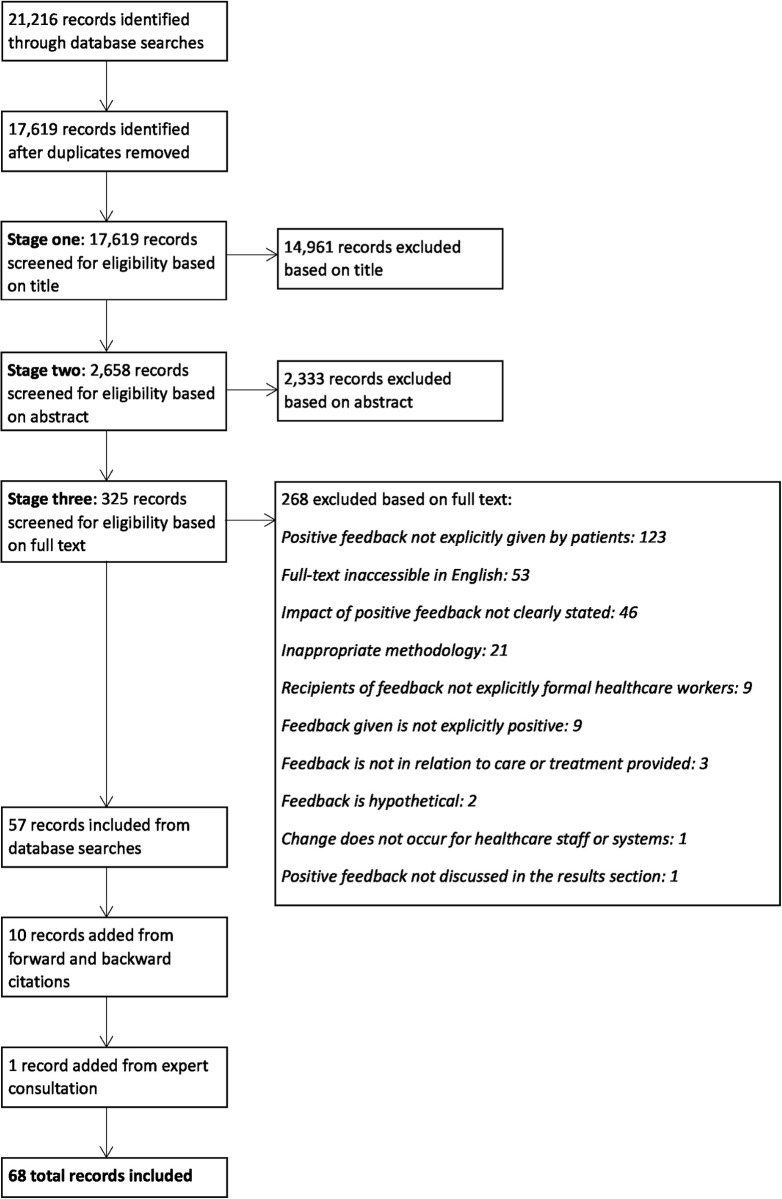
Empirical studies in English were systematically identified through database searches (ACM Digital Library, AMED, ASSIA, CINAHL, MEDLINE and PsycINFO), forwards and backwards citation, and expert consultation. We summarise the characteristics of included studies and the feedback they consider, present a thematic synthesis of qualitative findings, and provide narrative summaries of quantitative findings.
68 papers were included, describing research conducted across six continents, with qualitative (n = 51), quantitative (n = 10), and mixed (n = 7) methods. Only two studies were interventional. The most common settings were hospitals (n = 27) and community healthcare (n = 19). The most common recipients were nurses (n = 29). Most outcomes described were desirable. These were categorised as (a) short-term emotional change for healthcare workers (including feeling motivated and improved psychological wellbeing); (b) work-home interactional change for healthcare workers (such as improved home-life relationships); (c) work-related change for healthcare workers (such as improved performance and staff retention). Some undesirable outcomes were described, including envy when not receiving positive feedback. The impact of feedback may be moderated by characteristics of particular healthcare roles, such as night shift workers having less interaction time with patients. Some factors moderating the change created by feedback are modifiable.
Further interventional research is required to assess the effectiveness and cost-effectiveness of receiving positive feedback in creating specific forms of change such as increases in staff retention. Healthcare managers may wish to use positive feedback more regularly, and to address barriers to staff receiving feedback.
医疗服务机构经常收到患者的反馈,其中大部分是积极的。实证研究表明,卫生服务机构可以利用积极的反馈来为患者带来益处。我们的目的是绘制所有现有的实证证据,说明积极的患者反馈如何在医疗保健环境中产生变化。
通过数据库搜索(ACM 数字图书馆、AMED、ASSIA、CINAHL、MEDLINE 和 PsycINFO)、向前和向后引用以及专家咨询,系统地确定了英文实证研究。我们总结了纳入研究的特征以及他们所考虑的反馈,对定性结果进行主题综合,并对定量结果进行叙述性总结。
共纳入 68 篇论文,描述了跨越六大洲的研究,采用定性(n=51)、定量(n=10)和混合(n=7)方法。只有两项研究是干预性的。最常见的设置是医院(n=27)和社区医疗保健(n=19)。最常见的接受者是护士(n=29)。描述的大多数结果都是理想的。这些结果可以分为:(a)医护人员的短期情绪变化,包括感到有动力和改善心理健康;(b)医护人员的工作-家庭互动变化,例如改善家庭生活关系;(c)医护人员的工作相关变化,例如提高绩效和员工保留率。还描述了一些不理想的结果,包括当没有收到积极反馈时产生的嫉妒。反馈的影响可能会受到特定医疗角色特征的调节,例如夜班工作人员与患者的互动时间较少。一些调节反馈所产生变化的因素是可调节的。
需要进一步进行干预性研究,以评估接受积极反馈在创造特定形式的变化方面的有效性和成本效益,例如增加员工保留率。医疗保健管理人员可能希望更频繁地使用积极反馈,并解决员工接收反馈的障碍。