Woods Hole Oceanographic Institution, Woods Hole, MA, USA.
Department of Oceanography, Texas A&M University, College Station, TX, USA.
Nat Commun. 2023 Oct 5;14(1):6205. doi: 10.1038/s41467-023-41904-4.
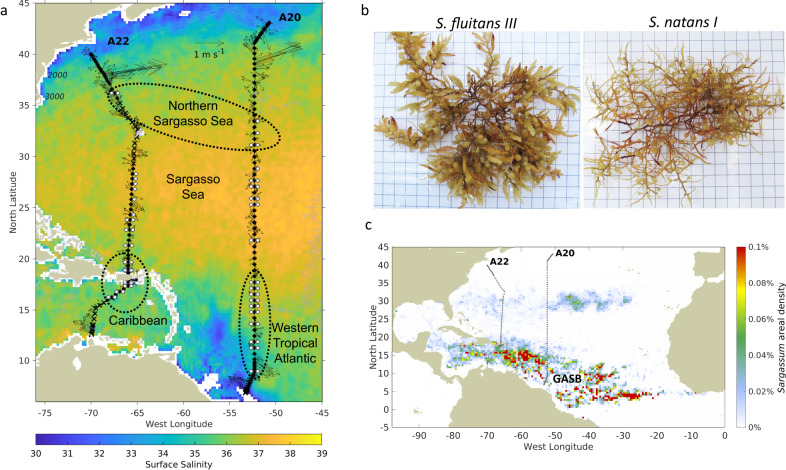
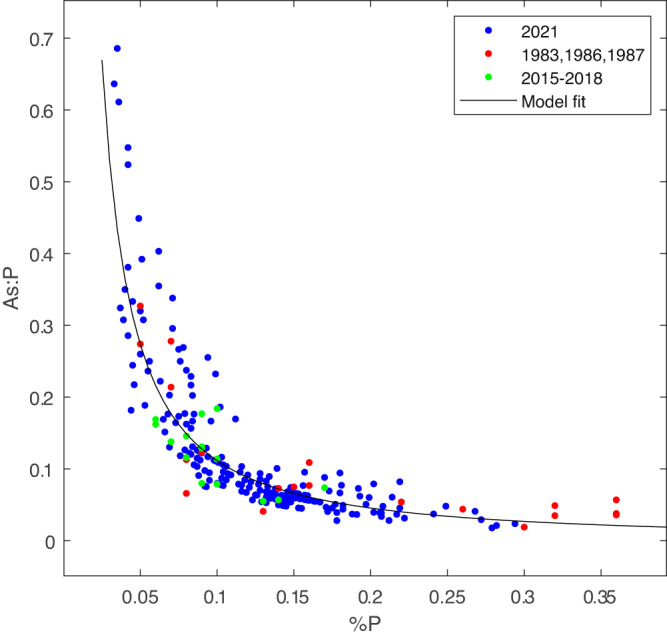
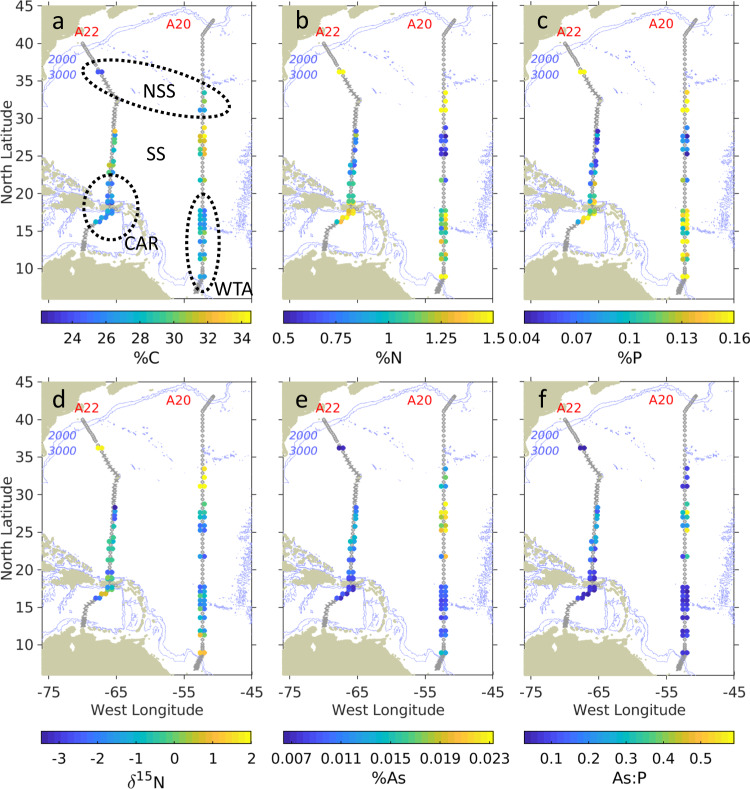
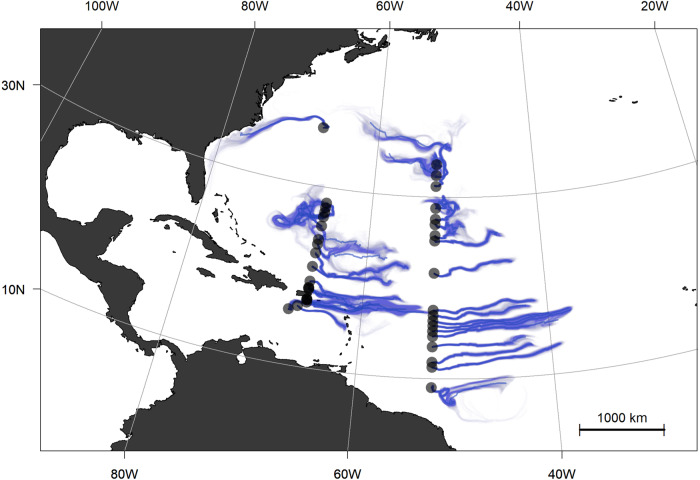
The oceanographic ecology of pelagic Sargassum, and the means by which these floating macroalgae thrive in the nutrient-poor waters of the open ocean, have been studied for decades. Beginning in 2011, the Great Atlantic Sargassum Belt (GASB) emerged, with Sargassum proliferating in the tropical Atlantic and Caribbean where it had not previously been abundant. Here we show that the nutritional status of Sargassum in the GASB is distinct, with higher nitrogen and phosphorus content than populations residing in its Sargasso Sea habitat. Moreover, we find that variations in arsenic content of Sargassum reflect phosphorus limitation, following a hyperbolic relationship predicted from Michaelis-Menten nutrient uptake kinetics. Although the sources of nutrients fueling the GASB are not yet clear, our results suggest that nitrogen and phosphorus content of Sargassum, together with its isotopic composition, can be used to identify those sources, whether they be atmospheric, oceanic, or riverine in origin.
几十年来,人们一直在研究大洋浮游马尾藻的海洋生态学,以及这些漂浮的大型藻类在营养贫瘠的开阔海域中茁壮成长的方式。从 2011 年开始,大大西洋马尾藻带(GASB)出现了,马尾藻在以前并不丰富的热带大西洋和加勒比海大量繁殖。在这里,我们表明 GASB 中的马尾藻的营养状况是不同的,其氮和磷含量高于其马尾藻海栖息地的种群。此外,我们发现,马尾藻中砷含量的变化反映了磷的限制,遵循米氏酶动力学预测的双曲线关系。尽管为 GASB 提供养分的来源尚不清楚,但我们的结果表明,马尾藻的氮和磷含量及其同位素组成可用于识别这些来源,无论它们是大气、海洋还是河流的来源。