Département de médecine, Université Laval, Quebec, QC, G1V 0A6, Canada.
Centre de recherche CERVO, Quebec, QC, G1J 2G3, Canada.
Sci Rep. 2023 Oct 5;13(1):16793. doi: 10.1038/s41598-023-43063-4.
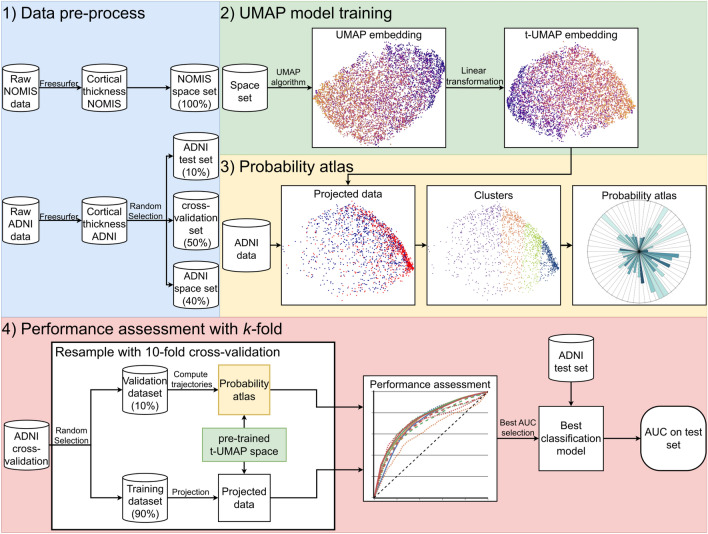
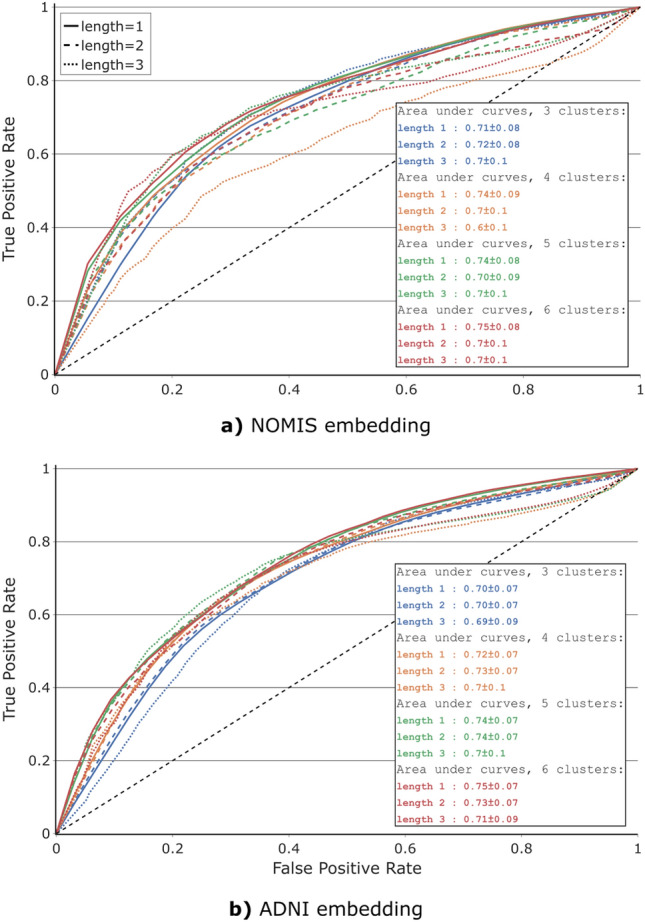
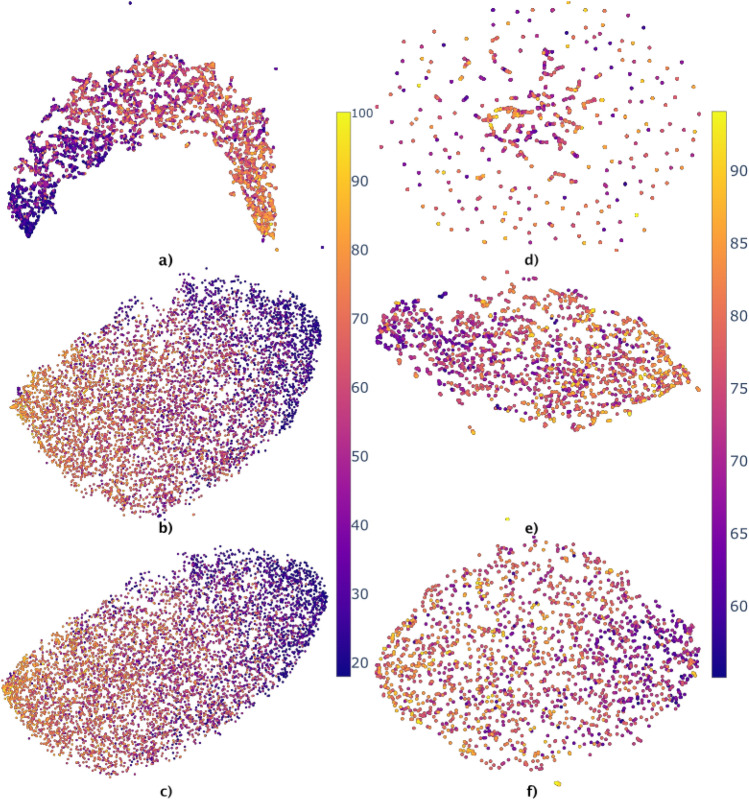
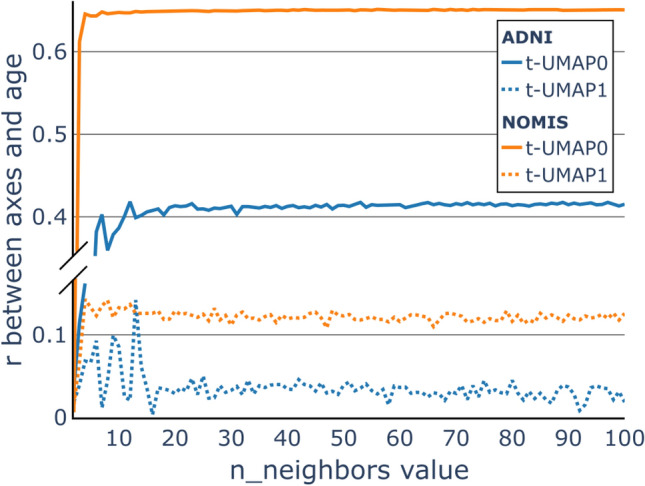
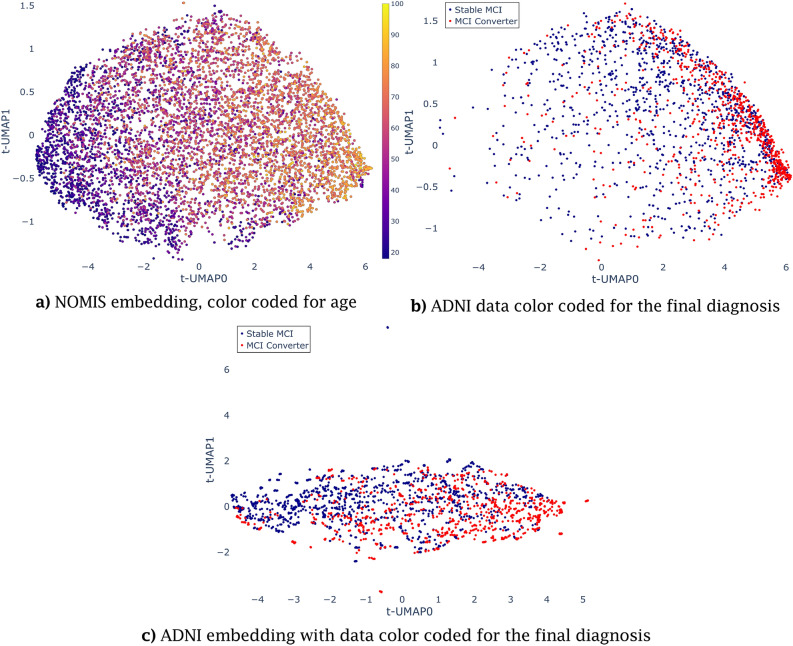
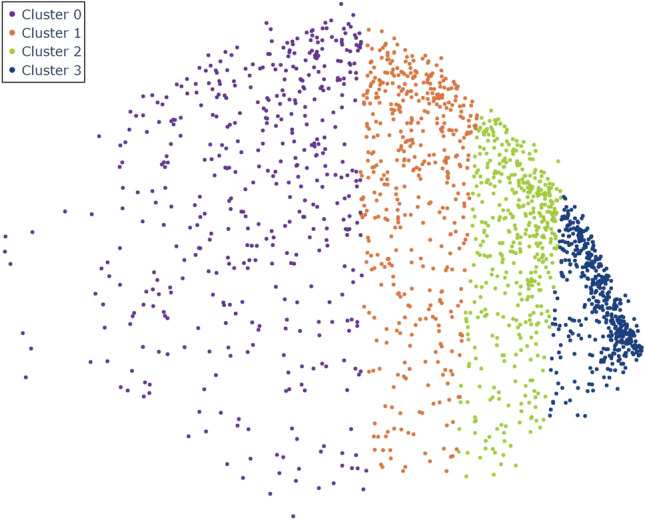
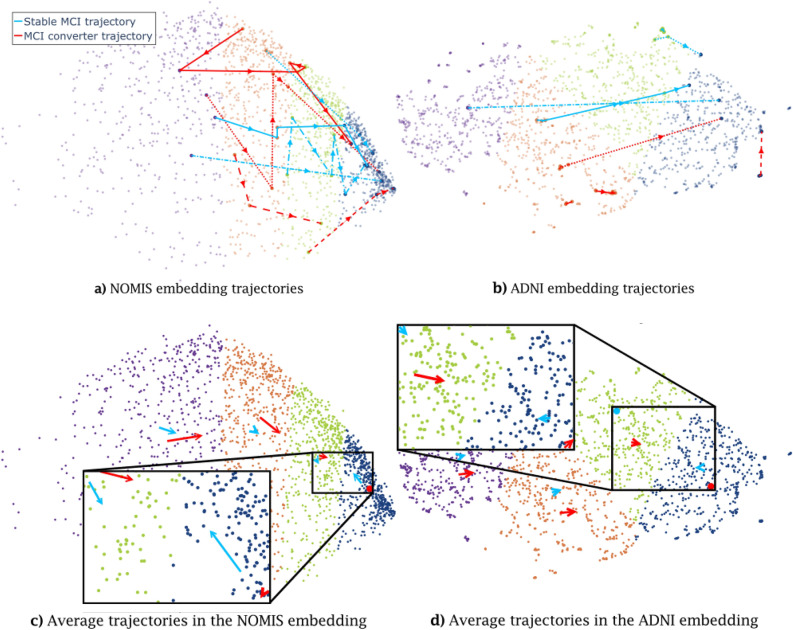
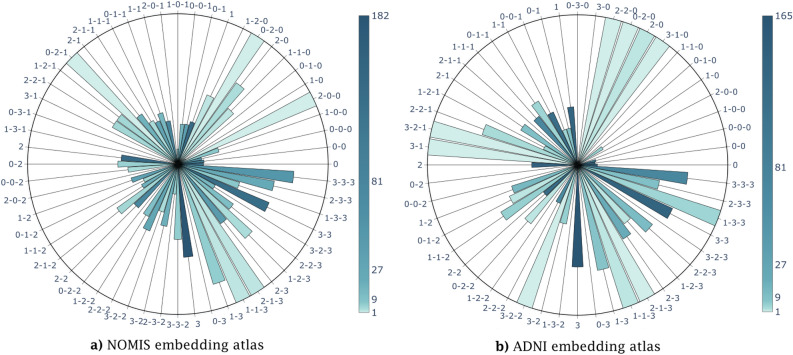
Identifying early signs of neurodegeneration due to Alzheimer's disease (AD) is a necessary first step towards preventing cognitive decline. Individual cortical thickness measures, available after processing anatomical magnetic resonance imaging (MRI), are sensitive markers of neurodegeneration. However, normal aging cortical decline and high inter-individual variability complicate the comparison and statistical determination of the impact of AD-related neurodegeneration on trajectories. In this paper, we computed trajectories in a 2D representation of a 62-dimensional manifold of individual cortical thickness measures. To compute this representation, we used a novel, nonlinear dimension reduction algorithm called Uniform Manifold Approximation and Projection (UMAP). We trained two embeddings, one on cortical thickness measurements of 6237 cognitively healthy participants aged 18-100 years old and the other on 233 mild cognitively impaired (MCI) and AD participants from the longitudinal database, the Alzheimer's Disease Neuroimaging Initiative database (ADNI). Each participant had multiple visits ([Formula: see text]), one year apart. The first embedding's principal axis was shown to be positively associated ([Formula: see text]) with participants' age. Data from ADNI is projected into these 2D spaces. After clustering the data, average trajectories between clusters were shown to be significantly different between MCI and AD subjects. Moreover, some clusters and trajectories between clusters were more prone to host AD subjects. This study was able to differentiate AD and MCI subjects based on their trajectory in a 2D space with an AUC of 0.80 with 10-fold cross-validation.
识别由于阿尔茨海默病(AD)导致的神经退行性变的早期迹象是预防认知能力下降的必要步骤。经过处理的解剖磁共振成像(MRI)后获得的个体皮质厚度测量值是神经退行性变的敏感标志物。然而,正常衰老的皮质下降和个体间的高度可变性使得比较和统计确定 AD 相关的神经退行性变对轨迹的影响变得复杂。在本文中,我们在个体皮质厚度测量值的 62 维流形的 2D 表示中计算了轨迹。为了计算这种表示,我们使用了一种称为统一流形逼近和投影(UMAP)的新颖的非线性降维算法。我们训练了两个嵌入,一个是基于 6237 名年龄在 18-100 岁之间的认知健康参与者的皮质厚度测量值,另一个是基于来自纵向数据库阿尔茨海默病神经影像学倡议数据库(ADNI)的 233 名轻度认知障碍(MCI)和 AD 参与者的皮质厚度测量值。每个参与者都有多次访问([Formula: see text]),相隔一年。第一个嵌入的主坐标轴被证明与参与者的年龄呈正相关([Formula: see text])。来自 ADNI 的数据被投影到这些 2D 空间中。对数据进行聚类后,显示簇之间的平均轨迹在 MCI 和 AD 受试者之间存在显著差异。此外,一些簇和簇之间的轨迹更倾向于容纳 AD 受试者。这项研究能够基于其在 2D 空间中的轨迹,使用 10 倍交叉验证的 AUC 为 0.80 来区分 AD 和 MCI 受试者。