Department of Ophthalmology, Peking University People's Hospital, Eye Diseases and Optometry Institute, Beijing, China.
Beijing Key Laboratory of Diagnosis and Therapy of Retinal and Choroid Diseases, Beijing, China.
Stem Cell Res Ther. 2023 Oct 5;14(1):286. doi: 10.1186/s13287-023-03526-x.
Stem cell therapy is a promising therapeutic approach for inherited retinal diseases (IRDs). This study aims to quantitatively examine the effectiveness and safety of stem cell therapy for patients with IRDs, including retinitis pigmentosa and Stargardt disease (STGD).
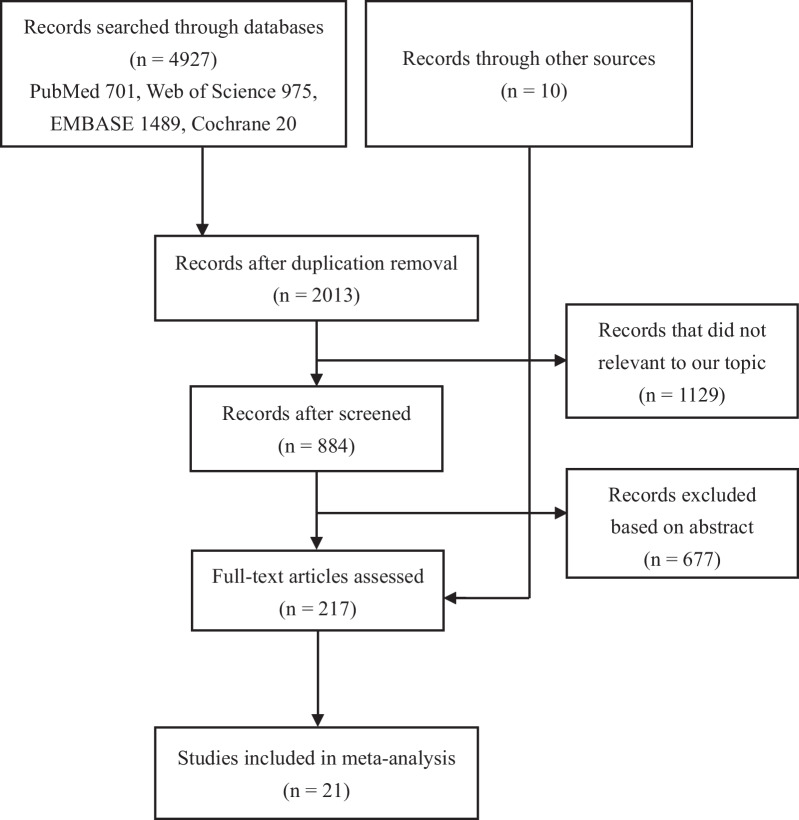
We searched PubMed, EMBASE, Web of Science, Cochrane Library databases, and the ClinicalTrials.gov website. The latest retrieval time was August 20, 2023. The primary outcomes were rates and mean difference (MD) of best-corrected visual acuity (BCVA) improvement. Subgroup analyses were conducted according to administration routes and stem cell types. This study was registered with PROSPERO (CRD42022349271).
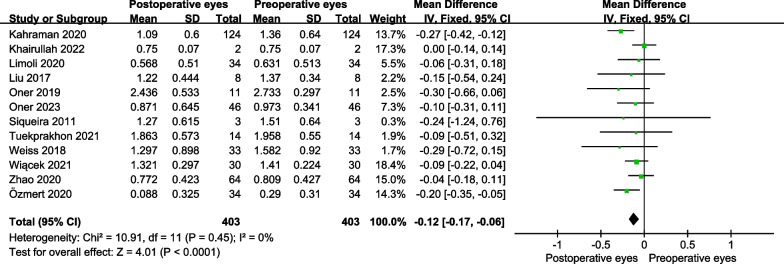
Twenty-one prospective studies, involving 496 eyes (404 RP and 92 STGD) of 382 patients (306 RP and 76 STGD), were included in this study. For RP, the rate of BCVA improvement was 49% and 30% at 6 months and 12 months, respectively, and the BCVA was significantly improved in the operative eyes at 6 months post-treatment (MD = - 0.12 logMAR, 95% CI .17 to - 0.06 logMAR; P < 0.001), while there was no significant difference at 12 months post-treatment (MD = -0.06 logMAR; 95% CI - 0.13 to 0.01 logMAR; P = 0.10). For STGD, the rate of BCVA improvement was 60% and 55% at 6 months and 12 months, respectively, and the BCVA was significantly improved in the operative eyes at 6 months (MD = - 0.14 logMAR, 95% CI - 0.22 to - 0.07 logMAR; P = 0.0002) and 12 months (MD = - 0.17 logMAR, 95% CI - 0.29 to - 0.04 logMAR; P = 0.01). Subgroup analyses showed suprachoroidal space injection of stem cells may be more efficient for RP. Eleven treated-related ocular adverse events from three studies and no related systemic adverse events were reported.
This study suggests stem cell therapy may be effective and safe for patients with RP or STGD. The long-term vision improvement may be limited for RP patients. Suprachoroidal space injection of stem cells may be a promising administration route for RP patients. Limited by the low grade of evidence, large sample size randomized clinical trials are required in the future.
干细胞疗法是一种有前途的遗传性视网膜疾病(IRDs)治疗方法。本研究旨在定量评估干细胞疗法对包括色素性视网膜炎和斯塔加特病(STGD)在内的 IRD 患者的疗效和安全性。
我们检索了 PubMed、EMBASE、Web of Science、Cochrane 图书馆数据库和 ClinicalTrials.gov 网站。最新检索时间为 2023 年 8 月 20 日。主要结局指标为最佳矫正视力(BCVA)改善的比例和均数差值(MD)。根据给药途径和干细胞类型进行亚组分析。本研究已在 PROSPERO(CRD42022349271)注册。
本研究纳入了 21 项前瞻性研究,涉及 382 例患者(306 例色素性视网膜炎和 76 例 STGD)的 496 只眼(404 只色素性视网膜炎和 92 只 STGD)。对于色素性视网膜炎,6 个月和 12 个月时 BCVA 改善的比例分别为 49%和 30%,治疗后 6 个月时手术眼的 BCVA 明显改善(MD=-0.12 logMAR,95%CI.17 至-0.06 logMAR;P<0.001),而 12 个月时无显著差异(MD=-0.06 logMAR;95%CI-0.13 至 0.01 logMAR;P=0.10)。对于 STGD,6 个月和 12 个月时 BCVA 改善的比例分别为 60%和 55%,治疗后 6 个月时手术眼的 BCVA 明显改善(MD=-0.14 logMAR,95%CI-0.22 至-0.07 logMAR;P=0.0002)和 12 个月时(MD=-0.17 logMAR,95%CI-0.29 至-0.04 logMAR;P=0.01)。亚组分析显示,干细胞的脉络膜上腔注射可能对色素性视网膜炎更有效。三项研究中有 11 例与治疗相关的眼部不良事件和无相关全身不良事件报告。
本研究表明,干细胞疗法可能对色素性视网膜炎或 STGD 患者有效且安全。色素性视网膜炎患者的长期视力改善可能有限。干细胞的脉络膜上腔注射可能是色素性视网膜炎患者有前途的给药途径。由于证据等级较低,未来需要进行大样本量的随机临床试验。