Independent researcher, Ternopil, Ukraine.
Global Health Medicines R&D., GlaxoSmithKline, Madrid, Spain.
PLoS Pathog. 2023 Oct 6;19(10):e1011711. doi: 10.1371/journal.ppat.1011711. eCollection 2023 Oct.
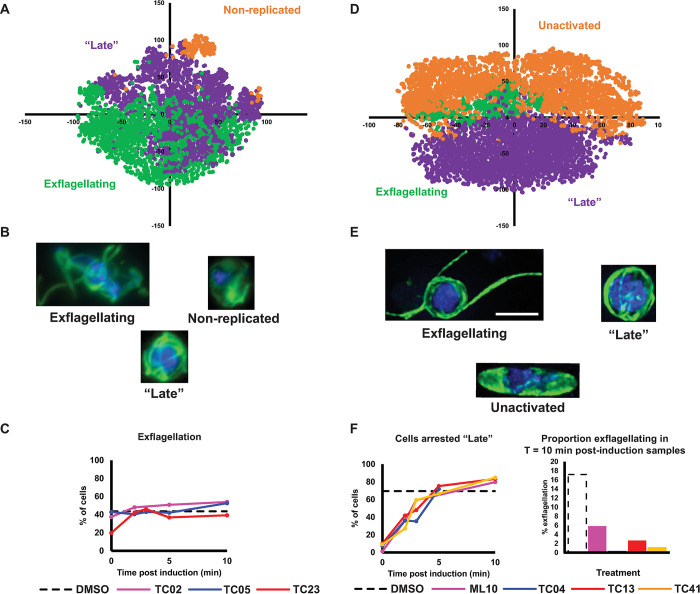
Preventing parasite transmission from humans to mosquitoes is recognised to be critical for achieving elimination and eradication of malaria. Consequently developing new antimalarial drugs with transmission-blocking properties is a priority. Large screening campaigns have identified many new transmission-blocking molecules, however little is known about how they target the mosquito-transmissible Plasmodium falciparum stage V gametocytes, or how they affect their underlying cell biology. To respond to this knowledge gap, we have developed a machine learning image analysis pipeline to characterise and compare the cellular phenotypes generated by transmission-blocking molecules during male gametogenesis. Using this approach, we studied 40 molecules, categorising their activity based upon timing of action and visual effects on the organisation of tubulin and DNA within the cell. Our data both proposes new modes of action and corroborates existing modes of action of identified transmission-blocking molecules. Furthermore, the characterised molecules provide a new armoury of tool compounds to probe gametocyte cell biology and the generated imaging dataset provides a new reference for researchers to correlate molecular target or gene deletion to specific cellular phenotype. Our analysis pipeline is not optimised for a specific organism and could be applied to any fluorescence microscopy dataset containing cells delineated by bounding boxes, and so is potentially extendible to any disease model.
防止寄生虫从人类传播到蚊子被认为是实现疟疾消除和根除的关键。因此,开发具有传播阻断特性的新抗疟药物是当务之急。大型筛选活动已经确定了许多新的传播阻断分子,但人们对它们如何针对蚊子可传播的恶性疟原虫阶段 V 配子,以及它们如何影响其潜在的细胞生物学知之甚少。为了应对这一知识空白,我们开发了一种机器学习图像分析管道,以描述和比较在雄性配子发生过程中阻断传播分子产生的细胞表型。使用这种方法,我们研究了 40 种分子,根据作用时间和对细胞内微管蛋白和 DNA 组织的视觉效果对其活性进行分类。我们的数据不仅提出了新的作用模式,而且证实了已识别的传播阻断分子的现有作用模式。此外,所描述的分子提供了一种新的工具化合物库,用于研究配子细胞生物学,生成的成像数据集为研究人员提供了一个新的参考,可将分子靶标或基因缺失与特定的细胞表型相关联。我们的分析管道不是针对特定生物体进行优化的,它可以应用于任何包含用边界框描绘的细胞的荧光显微镜数据集,因此具有潜在的可扩展性,可以应用于任何疾病模型。