
在一家肿瘤专科医院实施 I-PASS 以改善交接。
Improving handoff with the implementation of I-PASS at a tertiary oncology hospital.
机构信息
Department of Hospital Medicine, Internal Medicine Division, The University of Texas MD Anderson Cancer Center, Houston, Texas, USA.
Education & Training Division, The University of Texas MD Anderson Cancer Center, Houston, Texas, USA
出版信息
BMJ Open Qual. 2023 Oct;12(4). doi: 10.1136/bmjoq-2023-002481.
BACKGROUND
Lack of consistent and standardised handoffs is a leading cause of patient harm. With increased census in our hospital medicine (HM) service, failure to handoff using a standardised method has the potential to cause significant patient harm. We used a quality improvement methodology to standardise an existing and validated handoff tool within our HM team to improve handoff communication among providers and improve patient safety.
METHODS
A quality improvement team was charged with studying handoff communication among HM teams and between day and night shift providers at a tertiary oncology hospital. Multiple plan-do-study-act cycles were conducted, and process flow maps, root cause analysis and an affinity diagram were developed based on feedback from the HM team. The quality improvement team developed a plan to implement I-PASS (Illness severity, Patient summary, Action list, Situation awareness and contingency plan, and Synthesis by receiver) as the standardised handoff tool to be used among the providers in HM at the end of shift and for handoff to the nocturnal covering service. Rates of I-PASS use were collected before and after several educational interventions to encourage use of I-PASS and were displayed in a control chart. After the I-PASS interventions, HM providers were surveyed twice to evaluate the secondary outcomes: the tool's impact on workflow, perceptions of patient safety, ease of use and satisfaction with I-PASS. Survey results were compared using Fisher exact tests.
RESULTS
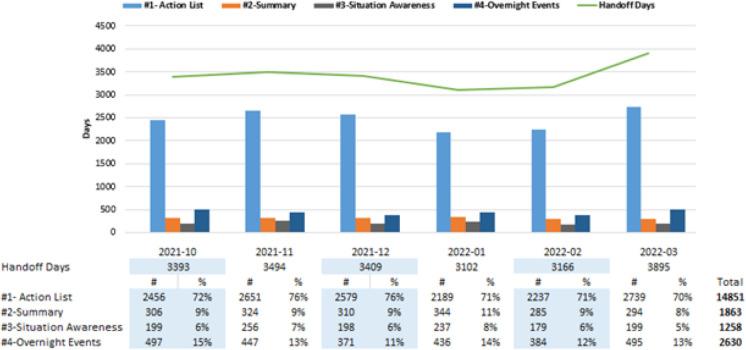
The HM team's rate of use of I-PASS handoffs increased from 23% to 72%, an improvement of 68%. By the end of the quality improvement project, I-PASS use had increased to 90%. No significant differences were detected in the reported duration of handoffs after I-PASS implementation (on average <5 min per patient, p=0.205). Provider perceptions of handoff quality, efficiency, communication errors and the I-PASS tool's effectiveness were satisfactory.
CONCLUSION
We used a quality improvement methodology to encourage the HM team's adoption of a validated handoff tool. Adherence to the standardised handoff tool significantly improved workflows and facilitated communication between the day and night shift teams.
背景
交接不规范、不标准是导致患者伤害的主要原因之一。由于我院医院医学(HM)服务的患者人数增加,如果不使用标准化方法进行交接,可能会对患者造成严重伤害。我们使用质量管理方法,在 HM 团队内部标准化现有的、经过验证的交接工具,以改善提供者之间的交接沟通并提高患者安全性。
方法
一个质量改进团队负责研究 HM 团队之间以及日班和夜班提供者之间的交接沟通,在一家肿瘤专科医院进行了多次计划-实施-研究-行动循环,并根据 HM 团队的反馈制定了流程流程图、根本原因分析和亲和图。质量改进团队制定了一项计划,即在 HM 结束时和夜间值班服务交接时,将 I-PASS(疾病严重程度、患者总结、行动计划、情境意识和应急计划以及接收者综合)作为标准交接工具在 HM 提供者中使用。在几次鼓励使用 I-PASS 的教育干预之前和之后,收集了 I-PASS 使用率,并在控制图中显示。在 I-PASS 干预后,HM 提供者进行了两次调查,以评估次要结果:该工具对工作流程的影响、对患者安全的看法、易用性和对 I-PASS 的满意度。使用 Fisher 精确检验比较调查结果。
结果
HM 团队使用 I-PASS 交接的比例从 23%增加到 72%,提高了 68%。在质量改进项目结束时,I-PASS 的使用率增加到 90%。实施 I-PASS 后,交接时间(平均每位患者<5 分钟,p=0.205)没有明显差异。提供者对交接质量、效率、沟通错误和 I-PASS 工具有效性的看法令人满意。
结论
我们使用质量管理方法鼓励 HM 团队采用经过验证的交接工具。遵守标准化交接工具显著改善了工作流程,并促进了日班和夜班团队之间的沟通。


 Zotero 插件