Altahan Mahmoud Fatehy, Ali Asmaa Galal, Hathoot Abla Ahmed, Azzem Magdi Abdel
Central Laboratory for Environmental Quality Monitoring, National Water Research Centre, El-Qanater El-Khairia, 13621, Egypt.
Electrochemistry Laboratory, Chemistry Department, Faculty of Science, Menoufia University, Shibin El-Kom, 32511, Egypt.
Sci Rep. 2023 Oct 6;13(1):16861. doi: 10.1038/s41598-023-43616-7.
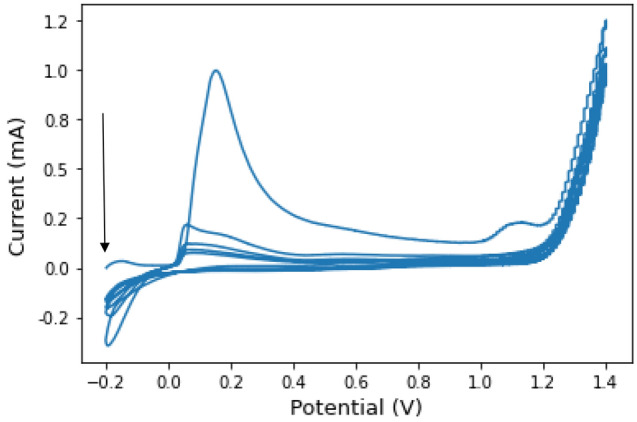
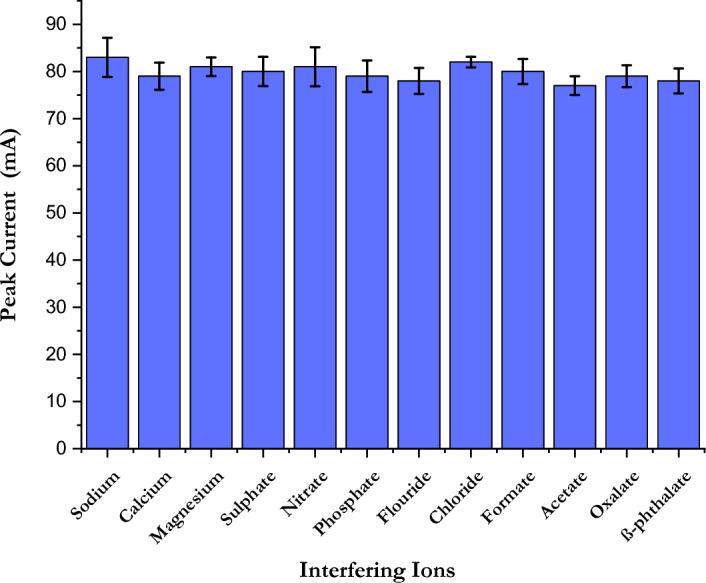
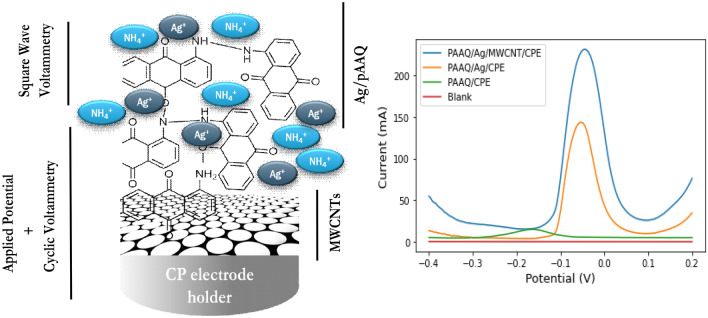
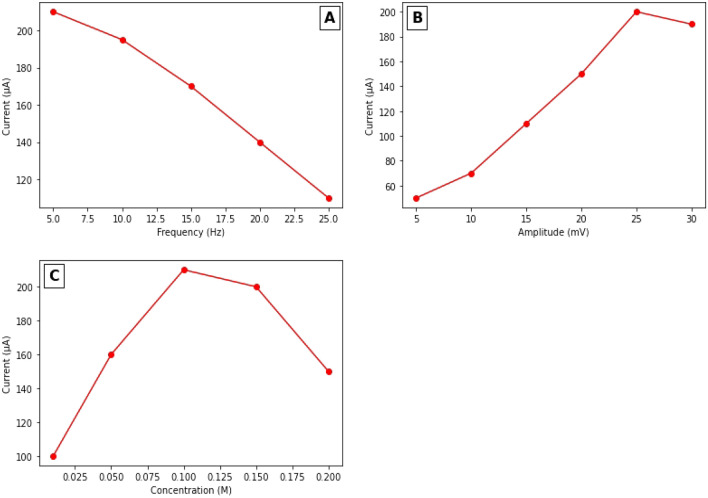
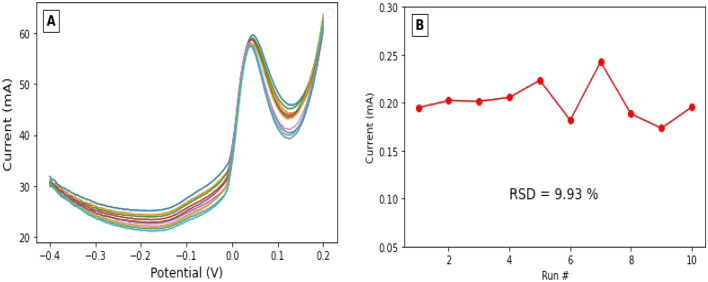
Ammonium is an essential component of the nitrogen cycle, which is essential for nitrogen cycling in ecosystems. On the other hand, ammonium pollution in water poses a great threat to the ecosystem and human health. Accurate and timely determination of ammonium content is of great importance for environmental management and ensuring the safety of water supply. Here we report a highly sensitive electrochemical sensor for ammonium in water samples. The modified electrode is based on the incorporation of silver nitrate (AgNO) into a carbon paste embedded with 1-aminoanthraquinone and supported by multi-walled carbon nanotubes, which are commercially available. A potential of 0.75 V is applied to the modified electrode, followed by activation in hydrochloric acid. The modified electrode was used for square wave voltammetry of ammonium in water in the potential range of - 0.4-0.2 V. The performance of ammonium analysis was determined in terms of square wave frequency, square wave amplitude and concentration of electrolyte solution (sodium sulphate). The calculation of the surface area according to the Randles-Sevcik equation resulted in the largest surface area for the Ag/pAAQ/MWCNTs/CPE. The modified electrode exhibited a linear range of 5-100 µM NH in 0.1 M NaSO with a detection limit of 0.03 µM NH (3σ). In addition, the modified electrode showed high precision with an RSD value of 9.93% for 10 repeated measurements. No interfering effect was observed at twofold and tenfold additive concentrations of foreign ions. Good recoveries were obtained in the analysis of tap and mineral water after spiking with a concentration of ammonium ions.
铵是氮循环的重要组成部分,对生态系统中的氮循环至关重要。另一方面,水中的铵污染对生态系统和人类健康构成了巨大威胁。准确及时地测定铵含量对于环境管理和确保供水安全至关重要。在此,我们报道了一种用于水样中铵的高灵敏度电化学传感器。修饰电极基于将硝酸银(AgNO)掺入嵌入1-氨基蒽醌并由多壁碳纳米管支撑的碳糊中,这些材料均可商购获得。将0.75 V的电位施加到修饰电极上,然后在盐酸中进行活化。修饰电极用于在-0.4 - 0.2 V的电位范围内对水中的铵进行方波伏安法测定。根据方波频率、方波幅度和电解质溶液(硫酸钠)浓度来确定铵分析的性能。根据Randles-Sevcik方程计算表面积,结果表明Ag/pAAQ/MWCNTs/CPE的表面积最大。修饰电极在0.1 M NaSO中对NH的线性范围为5 - 100 μM,检测限为0.03 μM NH(3σ)。此外,修饰电极表现出高精度,10次重复测量的RSD值为9.93%。在两倍和十倍添加浓度的外来离子存在下未观察到干扰效应。在对自来水和矿泉水加标铵离子浓度后进行分析时获得了良好的回收率。