Department of Anesthesiology and Critical Care Medicine, The Children's Hospital of Philadelphia, University of Pennsylvania, 3401 Civic Center Boulevard, Philadelphia, PA, 19104, USA.
Department of Pediatrics, University of Utah, Salt Lake City, UT, USA.
Crit Care. 2023 Oct 7;27(1):388. doi: 10.1186/s13054-023-04662-9.
Though early hypotension after pediatric in-hospital cardiac arrest (IHCA) is associated with inferior outcomes, ideal post-arrest blood pressure (BP) targets have not been established. We aimed to leverage prospectively collected BP data to explore the association of post-arrest BP thresholds with outcomes. We hypothesized that post-arrest systolic and diastolic BP thresholds would be higher than the currently recommended post-cardiopulmonary resuscitation BP targets and would be associated with higher rates of survival to hospital discharge.
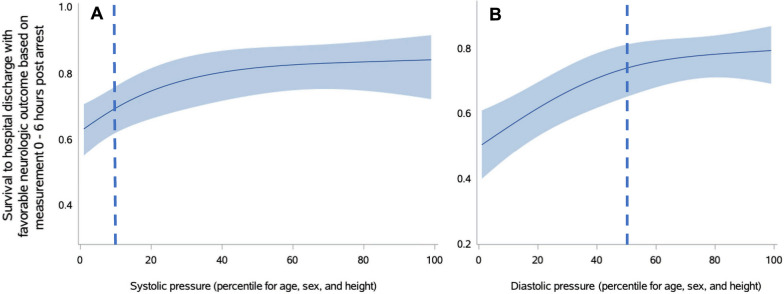
We performed a secondary analysis of prospectively collected BP data from the first 24 h following return of circulation from index IHCA events enrolled in the ICU-RESUScitation trial (NCT02837497). The lowest documented systolic BP (SBP) and diastolic BP (DBP) were percentile-adjusted for age, height and sex. Receiver operator characteristic curves and cubic spline analyses controlling for illness category and presence of pre-arrest hypotension were generated exploring the association of lowest post-arrest SBP and DBP with survival to hospital discharge and survival to hospital discharge with favorable neurologic outcome (Pediatric Cerebral Performance Category of 1-3 or no change from baseline). Optimal cutoffs for post-arrest BP thresholds were based on analysis of receiver operator characteristic curves and spline curves. Logistic regression models accounting for illness category and pre-arrest hypotension examined the associations of these thresholds with outcomes.
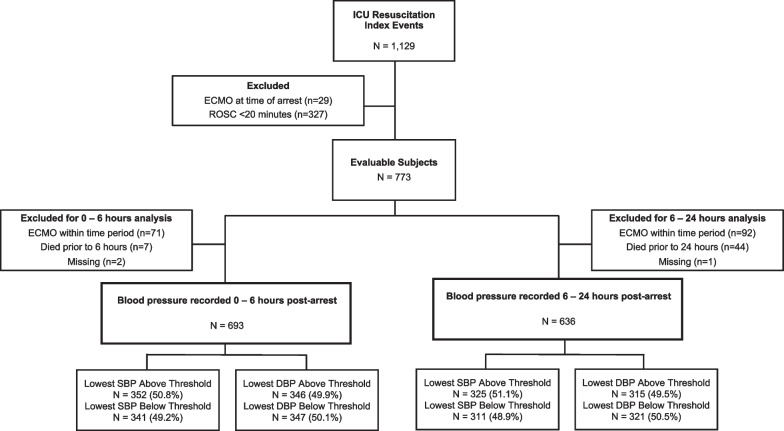
Among 693 index events with 0-6 h post-arrest BP data, identified thresholds were: SBP > 10th percentile and DBP > 50th percentile for age, sex and height. Fifty-one percent (n = 352) of subjects had lowest SBP above threshold and 50% (n = 346) had lowest DBP above threshold. SBP and DBP above thresholds were each associated with survival to hospital discharge (SBP: aRR 1.21 [95% CI 1.10, 1.33]; DBP: aRR 1.23 [1.12, 1.34]) and survival to hospital discharge with favorable neurologic outcome (SBP: aRR 1.22 [1.10, 1.35]; DBP: aRR 1.27 [1.15, 1.40]) (all p < 0.001).
Following pediatric IHCA, subjects had higher rates of survival to hospital discharge and survival to hospital discharge with favorable neurologic outcome when BP targets above a threshold of SBP > 10th percentile for age and DBP > 50th percentile for age during the first 6 h post-arrest.
尽管儿科院内心脏骤停(IHCA)后早期低血压与预后不良相关,但尚未确定理想的复苏后血压(BP)目标。我们旨在利用前瞻性收集的 BP 数据来探讨复苏后 BP 阈值与结局的关系。我们假设复苏后收缩压和舒张压阈值将高于目前推荐的心肺复苏后 BP 目标,并且与更高的存活率至出院相关。
我们对 ICU-RESUScitation 试验(NCT02837497)中首次记录到循环恢复后 24 小时内的前瞻性收集的 BP 数据进行了二次分析。最低记录的收缩压(SBP)和舒张压(DBP)按年龄、身高和性别进行了百分位调整。生成了接受者操作特征曲线和三次样条分析,以控制疾病类别和存在复苏前低血压,以探索复苏后最低 SBP 和 DBP 与存活率至出院和存活率至出院时神经功能良好(小儿脑功能分类 1-3 或与基线相比无变化)的关系。基于接受者操作特征曲线和样条曲线分析确定了复苏后 BP 阈值的最佳截断值。考虑到疾病类别和复苏前低血压,逻辑回归模型检验了这些阈值与结局的关系。
在 693 项具有 0-6 小时复苏后 BP 数据的索引事件中,确定的阈值为:SBP>第 10 百分位数和 DBP>第 50 百分位数,适用于年龄、性别和身高。51%(n=352)的患者最低 SBP 高于阈值,50%(n=346)的患者最低 DBP 高于阈值。SBP 和 DBP 高于阈值均与存活率至出院相关(SBP:调整后的比值比 1.21[95%置信区间 1.10, 1.33];DBP:调整后的比值比 1.23[1.12, 1.34])和存活率至出院时神经功能良好(SBP:调整后的比值比 1.22[1.10, 1.35];DBP:调整后的比值比 1.27[1.15, 1.40])(均 P<0.001)。
在儿科 IHCA 后,当复苏后 6 小时内 SBP 目标值高于年龄第 10 百分位,DBP 目标值高于年龄第 50 百分位时,患者的存活率至出院和存活率至出院时神经功能良好的发生率更高。