
利用PD1-TIGIT嵌合免疫检查点开关受体增强T细胞抗肿瘤疗效。
Enhancing T cell anti-tumor efficacy with a PD1-TIGIT chimeric immune-checkpoint switch receptor.
作者信息
Zhao Jingjing, Dong Jiebin, Deng Changwen, Zhang Qianjing, Sun Shicheng, Li Honggang, Bai Yun, Deng Hongkui
机构信息
Department of Cell Biology and MOE Engineering Research Center of Regenerative Medicine, School of Basic Medical Sciences, State Key Laboratory of Natural and Biomimetic Drugs, Peking University Health Science Center, Peking University, Hadian District, Beijing, China.
Department of Respiratory and Critical Care Medicine, Shanghai East Hospital, School of medicine, Tongji University, Shanghai, China.
出版信息
Oncoimmunology. 2023 Oct 5;12(1):2265703. doi: 10.1080/2162402X.2023.2265703. eCollection 2023.
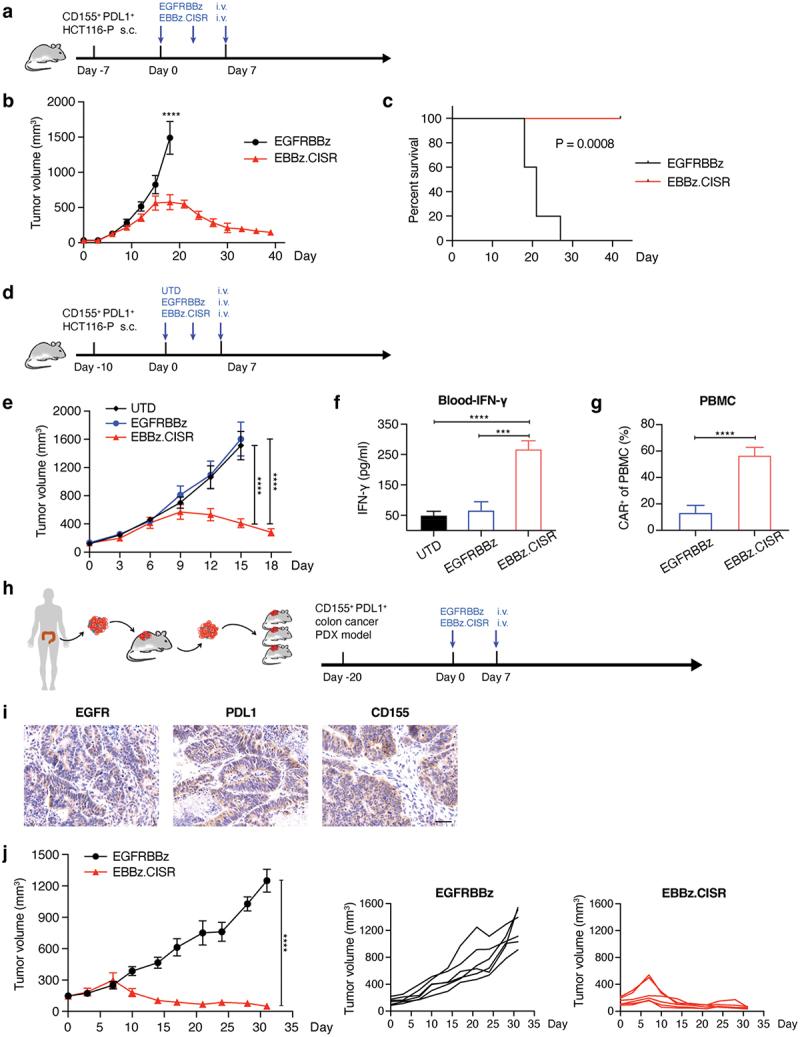
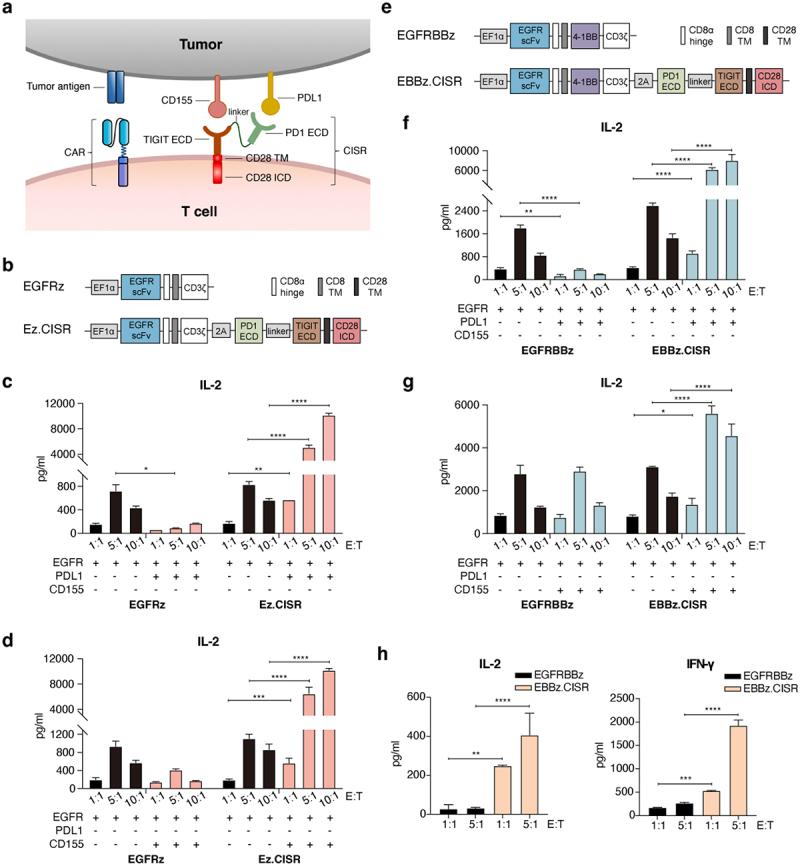
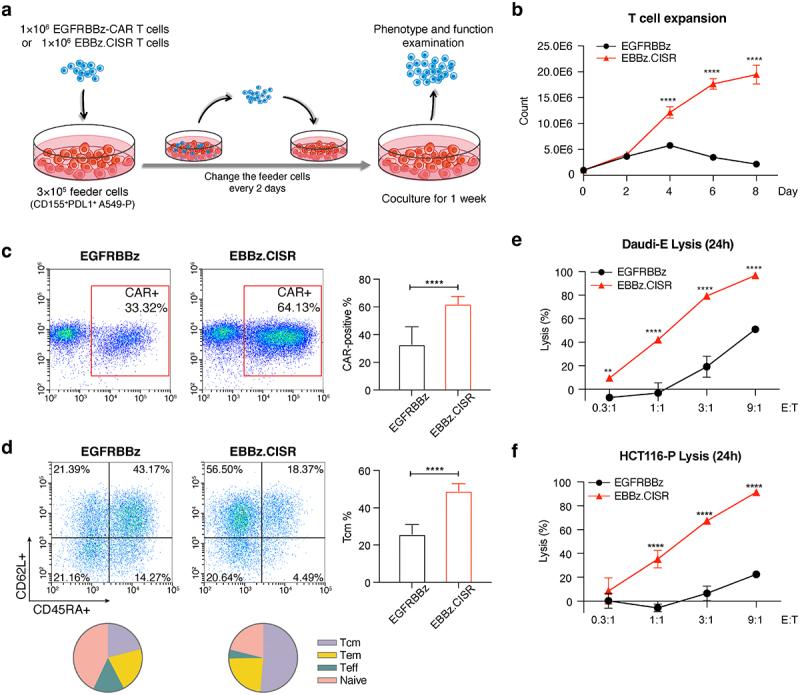
Chimeric antigen receptor (CAR) T cell immunotherapy has demonstrated success in the treatment of hematological malignancies; however, its efficacy and applications in solid tumors remain limited. Immunosuppressive factors, particularly inhibitory checkpoint molecules, restrict CAR T cell activity inside solid tumors. The modulation of checkpoint pathways has emerged as a promising approach to promote anti-tumor responses in CAR T cells. Programmed cell death protein 1 (PD1) and T cell immunoreceptor with Ig and ITIM domains (TIGIT) are two critical immune-checkpoint molecules that suppress anti-tumor activity in T cells. Simultaneous targeting of these two inhibitory molecules could be an efficient checkpoint modulation strategy. Here, we developed a PD1-TIGIT chimeric immune-checkpoint switch receptor (CISR) that enhances the efficacy of CAR T cell immunotherapy by reversing the inhibitory checkpoint signals of PD1/PDL1 and/or TIGIT/CD155. In addition to neutralizing PDL1 and CD155, this chimeric receptor is engineered with the transmembrane region and intracellular domain of CD28, thereby effectively enhancing T cell survival and tumor-targeting functions. Notably, under simultaneous stimulation of PDL1 and CD155, CISR-CAR T cells demonstrate superior performance in terms of cell survival, proliferation, cytokine release, and cytotoxicity , compared with conventional CAR T cells. Experiments utilizing both cell line- and patient-derived xenotransplantation tumor models showed that CISR-CAR T cells exhibit robust infiltration and anti-tumor efficiency . Our results highlight the potential for the CISR strategy to enhance T cell anti-tumor efficacy and provide an alternative approach for T cell-based immunotherapies.
嵌合抗原受体(CAR)T细胞免疫疗法已在血液系统恶性肿瘤的治疗中取得成功;然而,其在实体瘤中的疗效和应用仍然有限。免疫抑制因子,尤其是抑制性检查点分子,限制了CAR T细胞在实体瘤内的活性。调节检查点通路已成为促进CAR T细胞抗肿瘤反应的一种有前景的方法。程序性细胞死亡蛋白1(PD1)和具有Ig和ITIM结构域的T细胞免疫受体(TIGIT)是两种抑制T细胞抗肿瘤活性的关键免疫检查点分子。同时靶向这两种抑制性分子可能是一种有效的检查点调节策略。在此,我们开发了一种PD1-TIGIT嵌合免疫检查点开关受体(CISR),通过逆转PD1/PDL1和/或TIGIT/CD155的抑制性检查点信号来增强CAR T细胞免疫疗法的疗效。除了中和PDL1和CD155外,这种嵌合受体还采用CD28的跨膜区和胞内结构域进行工程改造,从而有效提高T细胞的存活和肿瘤靶向功能。值得注意的是,在PDL1和CD155的同时刺激下,与传统CAR T细胞相比,CISR-CAR T细胞在细胞存活、增殖、细胞因子释放和细胞毒性方面表现出卓越的性能。利用细胞系和患者来源的异种移植肿瘤模型进行的实验表明,CISR-CAR T细胞表现出强大的浸润和抗肿瘤效率。我们的结果突出了CISR策略增强T细胞抗肿瘤疗效的潜力,并为基于T细胞的免疫疗法提供了一种替代方法。
 Zotero 插件