Department of Global Health, University of Washington, Seattle, WA, United States.
Partners in Health and Research Development, Thika, Kenya.
Front Public Health. 2023 Sep 22;11:1209525. doi: 10.3389/fpubh.2023.1209525. eCollection 2023.
Kenyan adolescent girls and young women (AGYW) experience a dual burden of HIV and common mental disorders (CMD). HIV clinics are a key entry point for AGYW in need of integrated CMD and HIV care; however, rates of screening and referral for CMDs are low. Our objective was to test an evidence-based provider training strategy, simulated patient encounters (SPEs), on CMD service delivery for AGYW in a Kenyan HIV clinic.
This pilot study was conducted in a public HIV clinic in Thika, Kenya from January to November 2021. The simulated patient encounter (SPE) implementation strategy included case script development from prior qualitative work, patient actor training, and a three-day SPE training including four standardized mock clinical encounters followed by quantitative surveys assessing provider competencies for each encounter. We abstracted medical record data related to HIV and CMDs such as HIV status, reason for visit, CMD screening test performed, and counselling or referral information. We conducted an interrupted time series analysis using abstracted HIV and CMD screening rates from AGYW ages 16-25 years visiting the clinic 7 months before and 3 months after SPE training. We used generalized linear models to assess changes in CMD screening rates after training.
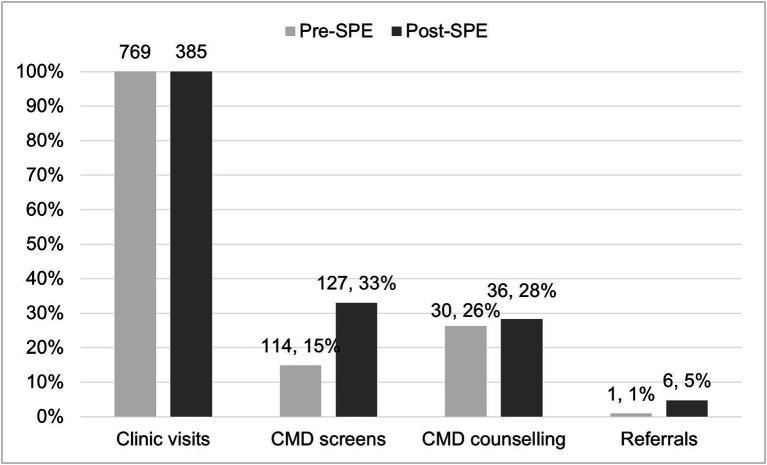
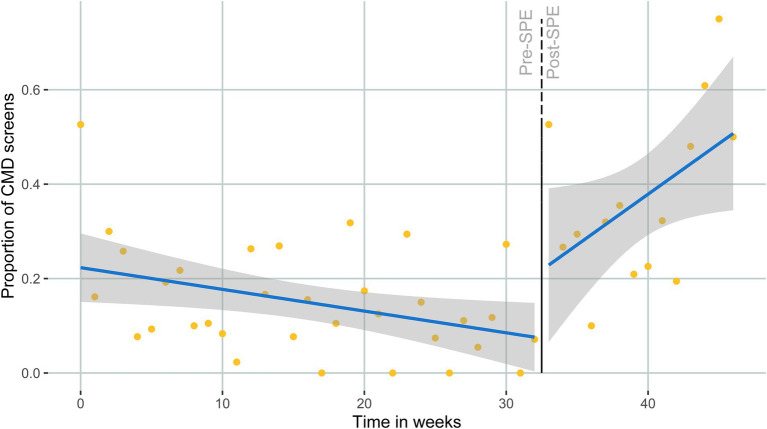
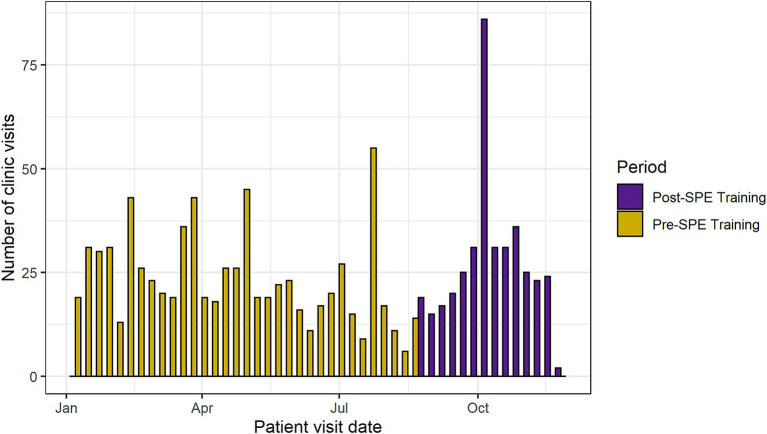
A total of 10 providers participated in the training. Competency ratings improved across four mock encounters (mean score from 8.1 to 13.7) between first and fourth encounters. We abstracted all medical records ( = 1,154) including from 888 (76%) AGYW seeking HIV treatment, 243 (21%) seeking prevention services, and 34 (3%) seeking other services. CMD screening rates increased immediately following training from 8 to 21% [relative risk (RR) = 2.57, 95% confidence interval (CI) = 1.34-4.90, < 0.01]. The 3 months following the SPE training resulted in an 11% relative increase in CMD screening proportion compared to the 7 months pre-SPE (RR: 1.11, 95% CI: 1.04-1.17, p < 0.01). Finally, 1% of all pre-SPE screens resulted in referral versus 5% of post-SPE screens ( = 0.07).
The SPE model is a promising implementation strategy for improving HIV provider competencies and CMD service delivery for adolescents in HIV clinics. Future research is needed to explore effects on adolescent clinical outcomes in larger trials.
肯尼亚少女和年轻女性(AGYW)同时面临艾滋病毒和常见精神障碍(CMD)的双重负担。艾滋病毒诊所是需要综合 CMD 和艾滋病毒护理的 AGYW 的关键切入点;然而,针对 CMD 的筛查和转介率却很低。我们的目标是在肯尼亚的一家艾滋病毒诊所中,测试一种基于证据的提供者培训策略,即模拟患者就诊(SPE),以改善 AGYW 的 CMD 服务提供。
本试点研究于 2021 年 1 月至 11 月在肯尼亚蒂卡的一家公立艾滋病毒诊所进行。模拟患者就诊(SPE)实施策略包括从先前的定性工作中开发病例脚本、患者演员培训以及为期三天的 SPE 培训,其中包括四个标准化模拟临床就诊,然后进行定量调查,评估每次就诊的提供者能力。我们从诊所就诊的年龄在 16-25 岁的 AGYW 中提取与艾滋病毒和 CMD 相关的医疗记录数据,如艾滋病毒状况、就诊原因、进行的 CMD 筛查测试以及咨询或转介信息。我们采用中断时间序列分析,使用 7 个月前和 SPE 培训后 3 个月期间诊所就诊的 16-25 岁 AGYW 的艾滋病毒和 CMD 筛查率进行分析。我们使用广义线性模型评估培训后 CMD 筛查率的变化。
共有 10 名提供者参加了培训。在四个模拟就诊中,能力评估得分从第一次到第四次就诊从 8.1 分提高到 13.7 分(平均得分)。我们提取了所有的医疗记录( = 1154),其中包括 888 名(76%)接受艾滋病毒治疗的 AGYW、243 名(21%)接受预防服务的 AGYW 和 34 名(3%)接受其他服务的 AGYW。培训后,CMD 筛查率立即从 8%增加到 21%[相对风险(RR)=2.57,95%置信区间(CI)=1.34-4.90, < 0.01]。与 SPE 前的 7 个月相比,SPE 后 3 个月 CMD 筛查比例相对增加了 11%(RR:1.11,95%CI:1.04-1.17, < 0.01)。最后,SPE 前的筛查中有 1%导致转介,而 SPE 后的筛查中有 5%导致转介( = 0.07)。
SPE 模型是一种有前途的实施策略,可以提高艾滋病毒提供者的能力,并为艾滋病毒诊所中的青少年提供 CMD 服务。未来的研究需要在更大的试验中探索对青少年临床结局的影响。