Xu Chunhua, Wu Fenfang, Du Lailing, Dong Yeping, Lin Shan
Shulan International Medical School, Zhejiang Shuren University, Hangzhou, China.
Department of Central Laboratory, Shenzhen Hospital, Beijing University of Chinese Medicine, Shenzhen, Guangdong, China.
Front Immunol. 2023 Sep 21;14:1211399. doi: 10.3389/fimmu.2023.1211399. eCollection 2023.
Whether neutrophil-lymphocyte ratio (NLR) is an applicative predictor of poor prognosis in patients with hepatocellular carcinoma (HCC) remains controversial. In response to the current conflicting data, this meta-analysis was conducted to gain a comprehensive and systematic understanding of prognostic value of NLR in HCC.
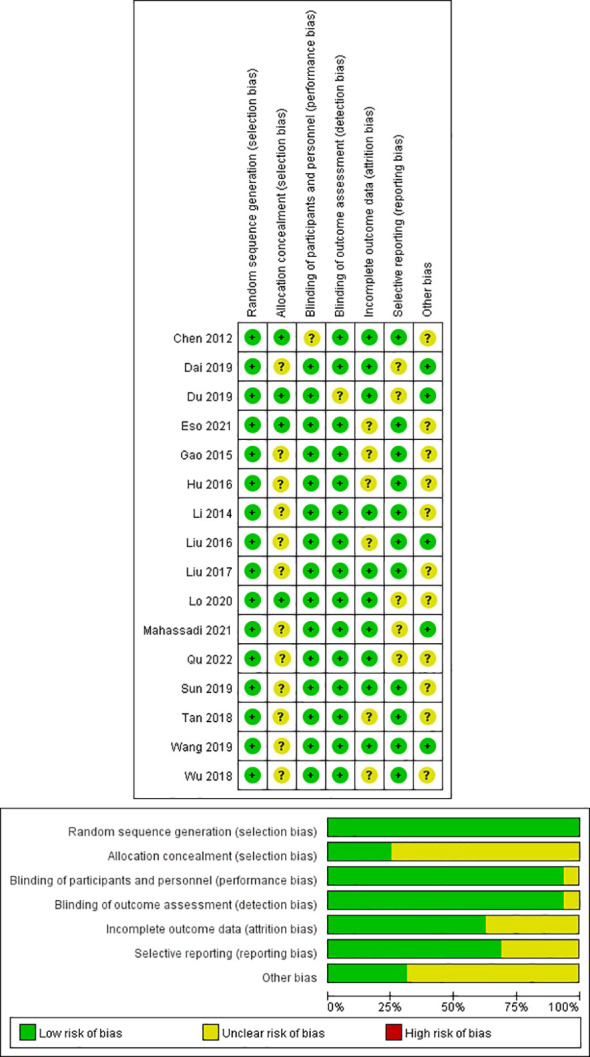
Several English databases, including PubMed, EMBASE, and the Cochrane Library, with an update date of February 25, 2023, were systematically searched. We set the inclusion criteria to include randomized controlled trial (RCT) studies that reported the prognostic value of serum NLR levels in patients with HCC receiving treatment. Both the combined ratio (OR) and the diagnosis ratio (DOR) were used to assess the prognostic performance of NLR. Additionally, we completed the risk of bias assessment by Cochrane Risk of Bias Assessment Tool.
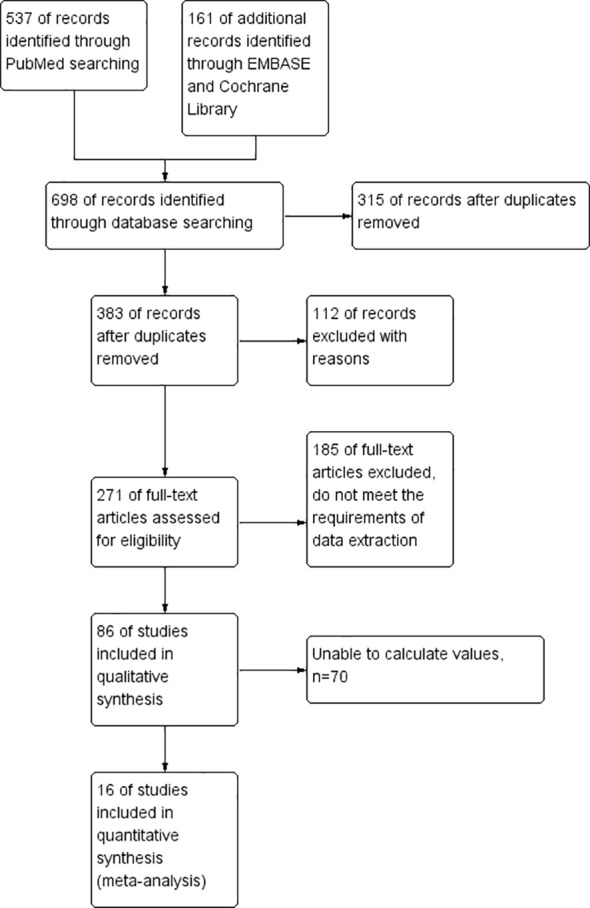
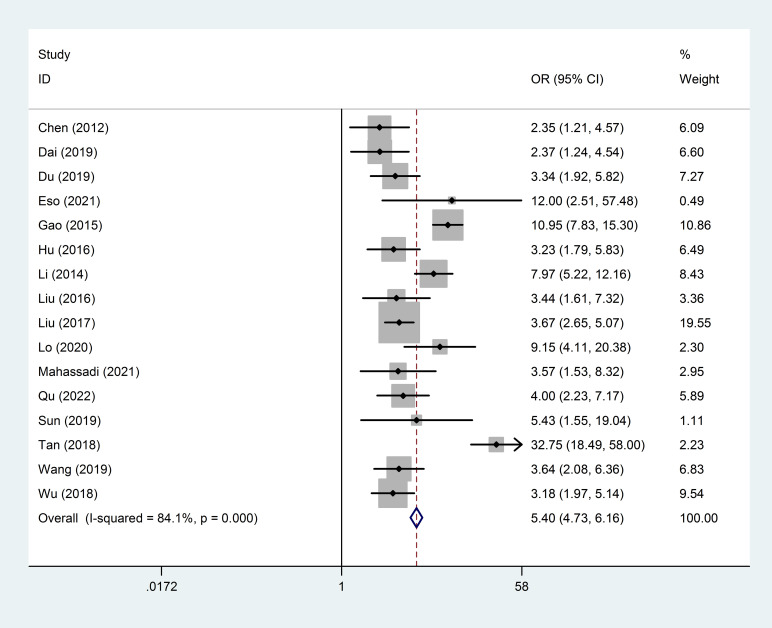
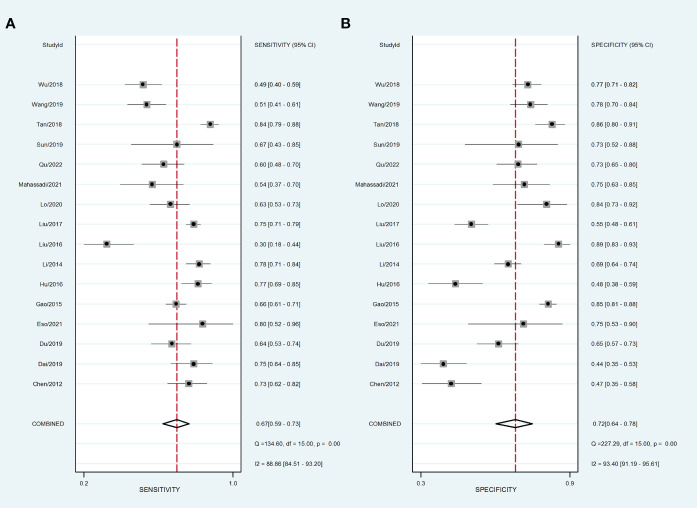
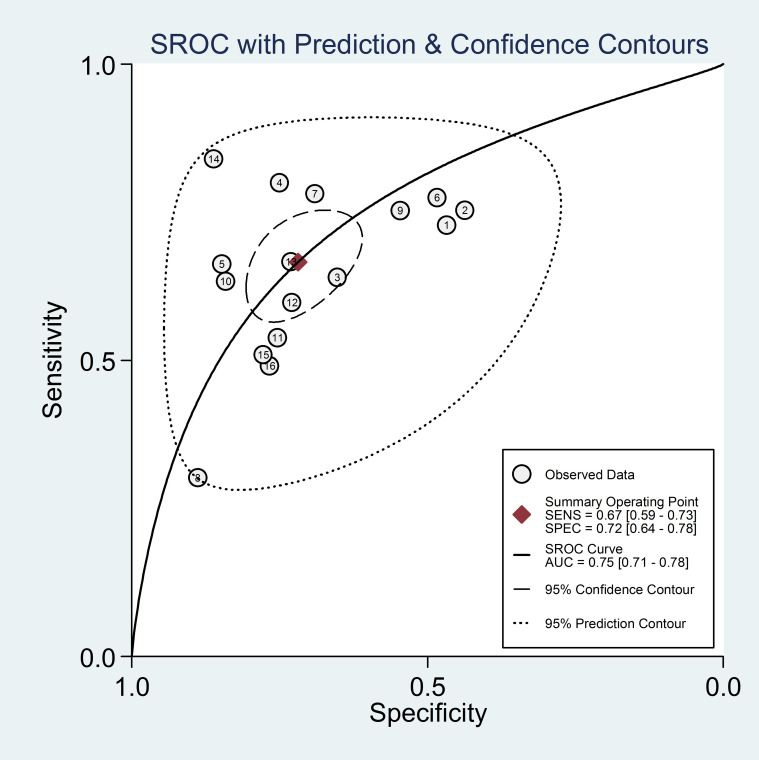
This meta-analysis ultimately included 16 studies with a total of 4654 patients with HCC. The results showed that high baseline NLR was significantly associated with poor prognosis or recurrence of HCC. The sensitivity of 0.67 (95% confidence interval [CI]. 0.59-0.73); specificity of 0.723 (95% CI: 0.64-0.78) and DOR of 5.0 (95% CI: 4.0-7.0) were pooled estimated from patient-based analyses. Subsequently, the combined positive likelihood ratio (PLR) and negative likelihood ratio (NLHR) were calculated with the results of 2.4 (95% CI: 1.9-3.0) and 0.46 (95% CI: 0.39-0.56), respectively. In addition, area under the curve (AUC) of the summary receiver operating characteristic (SROC) reflecting prognostic accuracy was calculated to be 0.75 (95% CI: 0.71-0.78). The results of subgroup analysis suggested that high NLR was an effective predictive factor of poor prognosis in HCC in mainland China as well as in the northern region.
Our findings suggest that high baseline NLR is an excellent predictor of poor prognosis or relapse in patients with HCC, especially those from high-incidence East Asian populations.
https://www.crd.york.ac.uk/prospero/#recordDetails, identifier CRD42023440640.
中性粒细胞与淋巴细胞比值(NLR)是否为肝细胞癌(HCC)患者预后不良的实用预测指标仍存在争议。针对当前相互矛盾的数据,进行了这项荟萃分析,以全面、系统地了解NLR在HCC中的预后价值。
系统检索了包括PubMed、EMBASE和Cochrane图书馆在内的多个英文数据库,更新日期为2023年2月25日。我们设定纳入标准,纳入报告接受治疗的HCC患者血清NLR水平预后价值的随机对照试验(RCT)研究。采用合并比值(OR)和诊断比值(DOR)评估NLR的预后性能。此外,我们通过Cochrane偏倚风险评估工具完成了偏倚风险评估。
这项荟萃分析最终纳入了16项研究,共4654例HCC患者。结果表明,高基线NLR与HCC患者预后不良或复发显著相关。基于患者分析汇总估计的敏感性为0.67(95%置信区间[CI]:0.59 - 0.73);特异性为0.723(95%CI:0.64 - 0.78),DOR为5.0(95%CI:4.0 - 7.0)。随后,计算合并阳性似然比(PLR)和阴性似然比(NLHR),结果分别为2.4(95%CI:1.9 - 3.0)和0.46(95%CI:0.39 - 0.56)。此外,反映预后准确性的汇总受试者工作特征曲线(SROC)下面积(AUC)计算为0.75(95%CI:0.71 - 0.78)。亚组分析结果表明,高NLR是中国大陆以及北方地区HCC患者预后不良的有效预测因素。
我们的研究结果表明,高基线NLR是HCC患者预后不良或复发的良好预测指标,尤其是来自东亚高发病率人群的患者。
https://www.crd.york.ac.uk/prospero/#recordDetails,标识符CRD42023440640。