Asghar Adeel, Abdul Hussain Ratlamwala Tahir, Kamal Khurram, Alkahtani Mohammed, Mohammad Emad, Mathavan Senthan
National University of Sciences and Technology (NUST), Karachi, Pakistan.
Department of Industrial Engineering, College of Engineering, King Saud University, P.O. Box 800 , Riyadh 11421, Saudi Arabia.
Heliyon. 2023 Aug 28;9(9):e19562. doi: 10.1016/j.heliyon.2023.e19562. eCollection 2023 Sep.
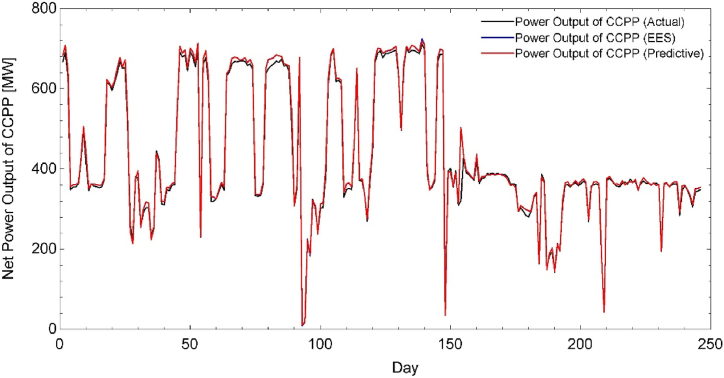
Combined Cycle Power Plants (CCPP) are an effective method for Power generation due to their high thermal efficiency, low fuel consumption, and low greenhouse emissions. However, investing millions into building a power plant without knowledge of the power generation capacity seems unproductive. With the help of AI, we have tried to eliminate this conundrum. The present study focuses on the prediction of power produced by a 747 MW Combined Cycle Power Plant (CCPP) using a Back Propagation Neural Network (BPNN) and compares its results with the actual data from CCPP. BPNN is a regression-based prediction technique that is utilized in this study to develop a predictive model and train it using the following input features: Ambient Temperature, Ambient Pressure, Mass Flow rate of fuel in Gas Turbine 1, and Mass Flow rate of fuel in Gas Turbine 2. The Predictive Model with 10 neurons in the hidden layer was found to be most effective with Mean Squared Error (MSE) value, for the validation dataset, of 0.0063237. CCPP is also analyzed through a thermodynamic model, developed using EES. A detailed energy analysis is carried out and the results were compared with predicted and actual data. It was found that the thermal efficiency and total power generation of actual, predicted, and simulated models were 27.541% & 667.32 MW, 28.238% & 683.48 MW and 28.201% & 683.16 MW, respectively. A parametric study was further carried out to investigate the significance of operating parameters on power output and it was concluded that the temperatures across the Gas turbines have a significant impact on the performance of CCPP. Finally, Methane was replaced by 3 different fuels, one by one, and the effect of each fuel was investigated thermodynamically. It was found that the Lower Heating Value (LHV) of fuel was an important parameter in achieving a higher power output. It can be summarized from this research work that predictive models do have accuracy and such data science techniques can be used as a substitute for extensive thermodynamic calculations.
联合循环发电厂(CCPP)因其高热效率、低燃料消耗和低温室气体排放,是一种有效的发电方式。然而,在不了解发电能力的情况下投资数百万建设发电厂似乎是徒劳的。借助人工智能,我们试图解决这一难题。本研究聚焦于使用反向传播神经网络(BPNN)预测一座747兆瓦联合循环发电厂(CCPP)的发电量,并将其结果与该联合循环发电厂的实际数据进行比较。BPNN是一种基于回归的预测技术,本研究利用它来开发预测模型,并使用以下输入特征对其进行训练:环境温度、环境压力、燃气轮机1中的燃料质量流量以及燃气轮机2中的燃料质量流量。对于验证数据集,发现隐藏层有10个神经元的预测模型最为有效,其均方误差(MSE)值为0.0063237。还通过使用EES开发的热力学模型对联合循环发电厂进行了分析。进行了详细的能量分析,并将结果与预测数据和实际数据进行了比较。结果发现,实际、预测和模拟模型的热效率和总发电量分别为27.541%和667.32兆瓦、28.238%和683.48兆瓦以及28.201%和683.16兆瓦。进一步开展了参数研究,以调查运行参数对功率输出的重要性,得出的结论是燃气轮机两端的温度对联合循环发电厂的性能有重大影响。最后,依次用3种不同燃料替代甲烷,并对每种燃料的效果进行了热力学研究。结果发现,燃料的低热值(LHV)是实现更高功率输出的一个重要参数。从这项研究工作可以总结出,预测模型确实具有准确性,并且这种数据科学技术可以用作广泛的热力学计算的替代方法。