Lin Xixi, Hessenow Razan, Yang Siling, Ma Dongjie, Yang Sijie
Division of Experimental Radiation Biology, Department of Radiation Therapy, University Hospital Essen, University of Duisburg-Essen, 45122 Essen, Germany.
West German Proton Therapy Center Essen (WPE), University of Duisburg-Essen, 45147 Essen, Germany.
Heliyon. 2023 Sep 19;9(9):e20234. doi: 10.1016/j.heliyon.2023.e20234. eCollection 2023 Sep.
Skin cutaneous melanoma is characterized by high malignancy and prognostic heterogeneity. Immune cell networks are critical to the biological progression of melanoma through the tumor microenvironment. Thus, identifying effective biomarkers for skin cutaneous melanoma from the perspective of the tumor microenvironment may offer strategies for precise prognosis prediction and treatment selection.
A total of 470 cases from The Cancer Genome Atlas and 214 from the Gene Expression Omnibus were systematically evaluated to construct an optimal independent immune cell risk model with predictive value using weighted gene co-expression network analysis, Cox regression, and least absolute shrinkage and selection operator assay. The predictive power of the developed model was estimated through receiver operating characteristic curves and Kaplan-Meier analysis. The association of the model with tumor microenvironment status, immune checkpoints, and mutation burden was assessed using multiple algorithms. Additionally, the sensitivity of immune and chemotherapeutics was evaluated using the ImmunophenScore and pRRophetic algorithm. Furthermore, the expression profiles of risk genes were validated using gene expression profiling interactive analysis and Human Protein Atlas resources.
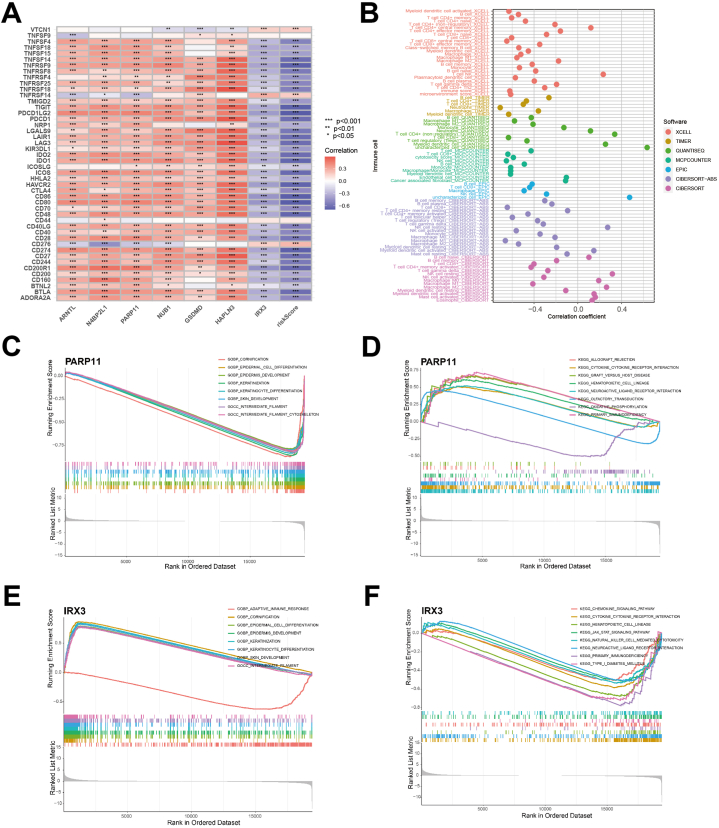
The risk model integrated seven immune-related genes: ARNTL, N4BP2L1, PARP11, NUB1, GSDMD, HAPLN3, and IRX3. The model demonstrated considerable predictive ability and was positively associated with clinical and molecular characteristics. It can be utilized as a prognostic factor for skin cutaneous melanoma, where a high-risk score was linked to a poor prognosis and indicated an immunosuppressive microenvironment. Furthermore, the model revealed several potential target checkpoints and predicted the therapeutic benefits of multiple clinically used drugs.
Our findings provide a comprehensive landscape of the tumor immune microenvironment in skin cutaneous melanoma and identify prognostic markers that may serve as efficient clinical diagnosis and treatment selection tools.
皮肤黑色素瘤具有高恶性和预后异质性的特点。免疫细胞网络通过肿瘤微环境对黑色素瘤的生物学进展至关重要。因此,从肿瘤微环境的角度识别皮肤黑色素瘤的有效生物标志物可能为精确的预后预测和治疗选择提供策略。
系统评估了来自癌症基因组图谱的470例病例和来自基因表达综合数据库的214例病例,使用加权基因共表达网络分析、Cox回归和最小绝对收缩和选择算子分析构建具有预测价值的最佳独立免疫细胞风险模型。通过受试者工作特征曲线和Kaplan-Meier分析评估所开发模型的预测能力。使用多种算法评估模型与肿瘤微环境状态、免疫检查点和突变负荷的关联。此外,使用免疫表型评分和pRRophetic算法评估免疫疗法和化疗的敏感性。此外,使用基因表达谱交互式分析和人类蛋白质图谱资源验证风险基因的表达谱。
风险模型整合了七个免疫相关基因:ARNTL、N4BP2L1、PARP11、NUB1、GSDMD、HAPLN3和IRX3。该模型显示出相当的预测能力,并且与临床和分子特征呈正相关。它可作为皮肤黑色素瘤的预后因素,其中高风险评分与预后不良相关,并表明存在免疫抑制微环境。此外,该模型揭示了几个潜在的靶点检查点,并预测了多种临床使用药物的治疗益处。
我们的研究结果提供了皮肤黑色素瘤肿瘤免疫微环境的全面概况,并确定了可作为有效临床诊断和治疗选择工具的预后标志物。