
使用基于无人机的RGB图像对小样本树种进行分类时更合适的密集连接网络(DenseNetBL)分类器。
More appropriate DenseNetBL classifier for small sample tree species classification using UAV-based RGB imagery.
作者信息
Wang Ni, Pu Tao, Zhang Yali, Liu Yuchan, Zhang Zeyu
机构信息
School of Geographic Information and Tourism, Chuzhou University, Chuzhou, 23900, China.
School of Geomatics, Anhui University of Science and Technology, Huainan, 232001, China.
出版信息
Heliyon. 2023 Sep 26;9(10):e20467. doi: 10.1016/j.heliyon.2023.e20467. eCollection 2023 Oct.
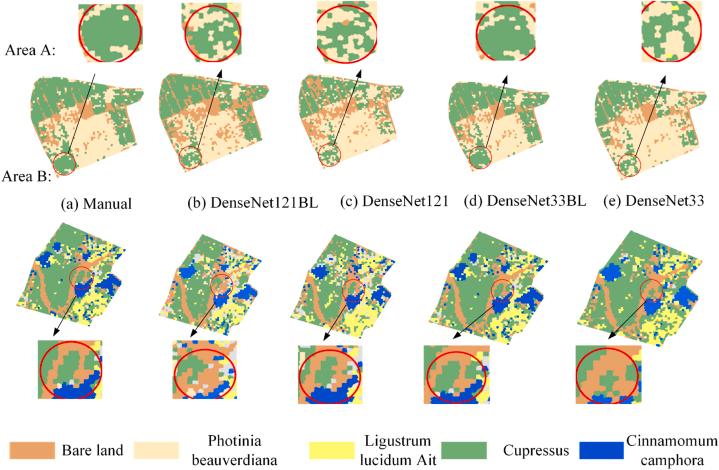
To effectively classify tree species within datasets characterized by limited samples, we introduced a novel approach named DenseNetBL, founded upon the fusion of the DenseNet architecture and a pivotal bottleneck layer. This bottleneck layer, encompassing a compact convolutional component, played a central role in our methodology. The evaluation of DenseNetBL was conducted under varying conditions, encompassing small-sample tree species data, extensive remote sensing datasets, and state-of-the-art classifiers. Furthermore, a quantitative assessment was executed to extract tree species areas. This was achieved by quantifying pixel areas within manually delineated tree species maps and classifier-generated counterparts. The findings of our study indicated that, in scenarios devoid of pre-trained weights, DenseNetBL consistently outperformed its DenseNet counterpart with equivalent layer numbers. In the realm of small-sample situations, both the Swin Transformer and Vision Transformer exhibited inferior performance when juxtaposed with DenseNet and DenseNetBL. Remarkably, among the shallow architectures, DenseNet33BL showcased superior aptitude for small-sample tree species classification, culminating in the most commendable results (Overall Accuracy (OA) = 0.901, Kappa = 0.892). Conversely, the Vision Transformer yielded the least favorable classification outcomes (OA = 0.767, Kappa = 0.708). The amalgamation of DenseNet33BL and simple linear iterative clustering emerged as the optimal strategy for attaining robust tree species area extraction results across two prototypical forests. In contrast, DenseNet121 exhibited suboptimal performance in the same forests, attaining the least satisfactory tree species area extraction results. These comprehensive findings underscore the efficacy of our DenseNetBL approach in addressing the challenges associated with small-sample tree species classification and accurate tree species area extraction.
为了在样本有限的数据集内有效地对树种进行分类,我们引入了一种名为DenseNetBL的新方法,该方法基于DenseNet架构与一个关键瓶颈层的融合。这个瓶颈层包含一个紧凑的卷积组件,在我们的方法中起着核心作用。DenseNetBL的评估是在不同条件下进行的,包括小样本树种数据、大量遥感数据集和先进的分类器。此外,还进行了定量评估以提取树种面积。这是通过量化手动绘制的树种地图和分类器生成的地图中的像素面积来实现的。我们的研究结果表明,在没有预训练权重的情况下,DenseNetBL在层数相同的情况下始终优于其DenseNet对应模型。在小样本情况下,与DenseNet和DenseNetBL相比,Swin Transformer和Vision Transformer的性能均较差。值得注意的是,在浅层架构中,DenseNet33BL在小样本树种分类方面表现出卓越的能力,最终取得了最值得称赞的结果(总体准确率(OA)=0.901,卡帕系数(Kappa)=0.892)。相反,Vision Transformer产生的分类结果最不理想(OA=0.767,Kappa=0.708)。DenseNet33BL与简单线性迭代聚类相结合,成为在两个典型森林中获得稳健树种面积提取结果的最佳策略。相比之下,DenseNet121在相同森林中的表现欠佳,获得了最不理想的树种面积提取结果。这些全面的研究结果强调了我们的DenseNetBL方法在应对小样本树种分类和准确树种面积提取相关挑战方面的有效性。



 Zotero 插件