Molecular Oncology Laboratory, Department of Biological Sciences and Bioengineering, Indian Institute of Technology Kanpur, Kanpur, Uttar Pradesh, India.
Division of Cancer Biology, CSIR-Central Drug Research Institute, Lucknow, Uttar Pradesh, India.
Cancer Res Commun. 2023 Oct 9;3(10):2044-2061. doi: 10.1158/2767-9764.CRC-23-0089.
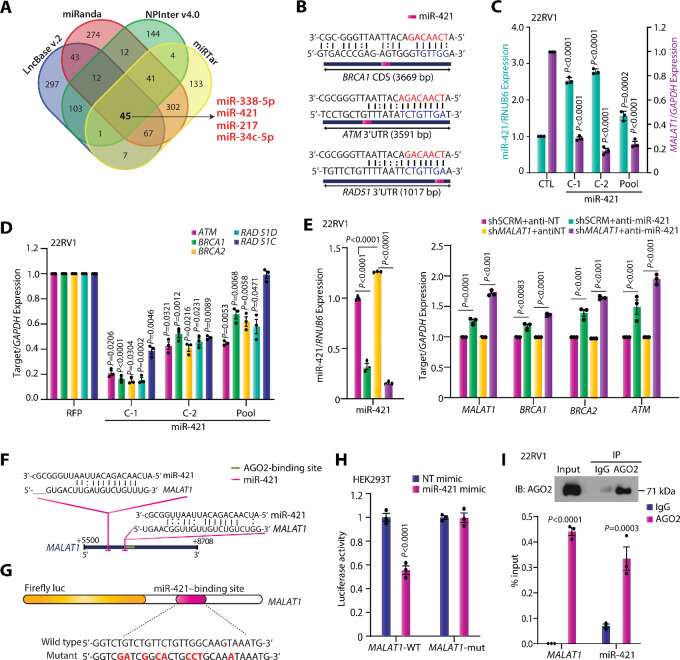
PARP inhibitors (PARPi) have emerged as a promising targeted therapeutic intervention for metastatic castrate-resistant prostate cancer (mCRPC). However, the clinical utility of PARPi is limited to a subset of patients who harbor aberrations in the genes associated with the homologous recombination (HR) pathway. Here, we report that targeting metastasis-associated lung adenocarcinoma transcript 1 (MALAT1), an oncogenic long noncoding RNA (lncRNA), contrives a BRCAness-like phenotype, and augments sensitivity to PARPi. Mechanistically, we show that MALAT1 silencing reprograms the homologous recombination (HR) transcriptome and makes prostate cancer cells more vulnerable to PARPi. Particularly, coinhibition of MALAT1 and PARP1 exhibits a decline in clonogenic survival, delays resolution of γH2AX foci, and reduces tumor burden in mice xenograft model. Moreover, we show that miR-421, a tumor suppressor miRNA, negatively regulates the expression of HR genes, while in aggressive prostate cancer cases, miR-421 is sequestered by MALAT1, leading to increased expression of HR genes. Conclusively, our findings suggest that MALAT1 ablation confers sensitivity to PARPi, thus highlighting an alternative therapeutic strategy for patients with castration-resistant prostate cancer (CRPC), irrespective of the alterations in HR genes.
PARPi are clinically approved for patients with metastatic CRPC carrying mutations in HR genes, but are ineffective for HR-proficient prostate cancer. Herein, we show that oncogenic lncRNA, MALAT1 is frequently overexpressed in advanced stage prostate cancer and plays a crucial role in maintaining genomic integrity. Importantly, we propose a novel therapeutic strategy that emphasizes MALAT1 inhibition, leading to HR dysfunction in both HR-deficient and -proficient prostate cancer, consequently augmenting their susceptibility to PARPi.
聚腺苷二磷酸核糖聚合酶(PARP)抑制剂(PARPi)已成为转移性去势抵抗性前列腺癌(mCRPC)的一种有前途的靶向治疗干预手段。然而,PARPi 的临床应用仅限于携带与同源重组(HR)途径相关基因异常的患者亚群。在这里,我们报告靶向转移相关肺腺癌转录本 1(MALAT1),一种致癌的长链非编码 RNA(lncRNA),可以引起 BRCA 样表型,并增强对 PARPi 的敏感性。从机制上讲,我们表明 MALAT1 的沉默会重新编程同源重组(HR)转录组,使前列腺癌细胞更容易受到 PARPi 的影响。特别是,MALAT1 和 PARP1 的双重抑制会导致集落形成存活能力下降,γH2AX 焦点的解决延迟,并减少小鼠异种移植模型中的肿瘤负担。此外,我们表明肿瘤抑制 miRNA miR-421 负调控 HR 基因的表达,而在侵袭性前列腺癌病例中,miR-421 被 MALAT1 隔离,导致 HR 基因的表达增加。总之,我们的研究结果表明,MALAT1 的缺失赋予了对 PARPi 的敏感性,从而为去势抵抗性前列腺癌(CRPC)患者提供了一种替代的治疗策略,而与 HR 基因的改变无关。
PARPi 已被批准用于携带 HR 基因突变的转移性 CRPC 患者,但对 HR 阳性前列腺癌无效。在此,我们表明致癌的长链非编码 RNA MALAT1 在晚期前列腺癌中过度表达,在维持基因组完整性方面发挥着关键作用。重要的是,我们提出了一种新的治疗策略,强调 MALAT1 抑制,导致 HR 功能障碍在 HR 缺陷和 HR 阳性前列腺癌中,从而增加它们对 PARPi 的敏感性。