Department of Health and Sport Sciences, TUM School of Medicine and Health, Technical University of Munich, Munich, Germany.
Pennington Biomedical Research Center, Baton Rouge, LA, USA.
Nat Commun. 2023 Oct 9;14(1):6321. doi: 10.1038/s41467-023-41969-1.
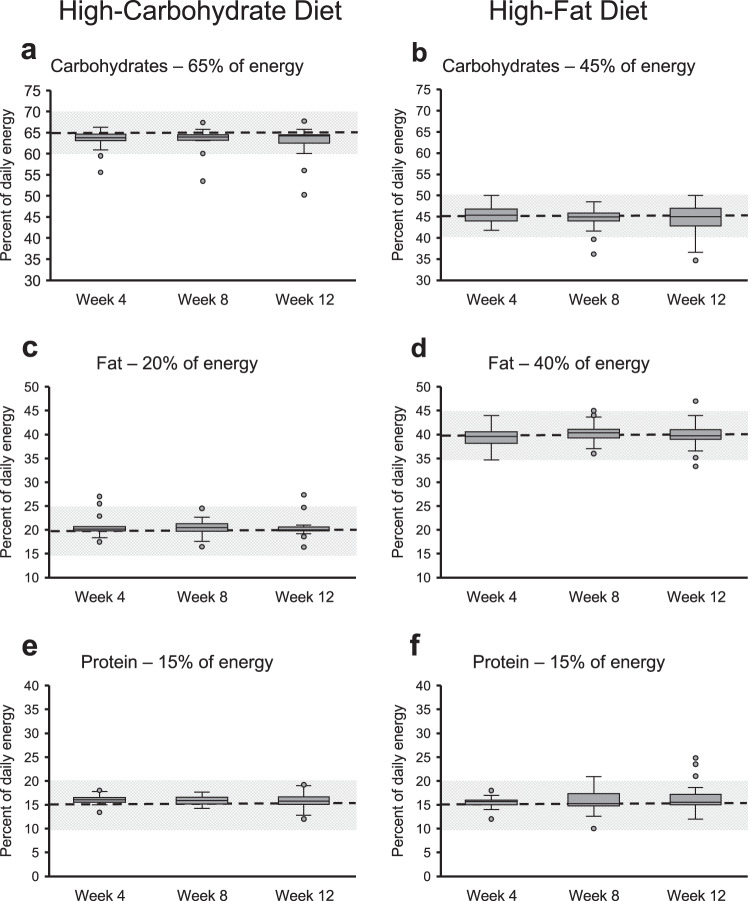
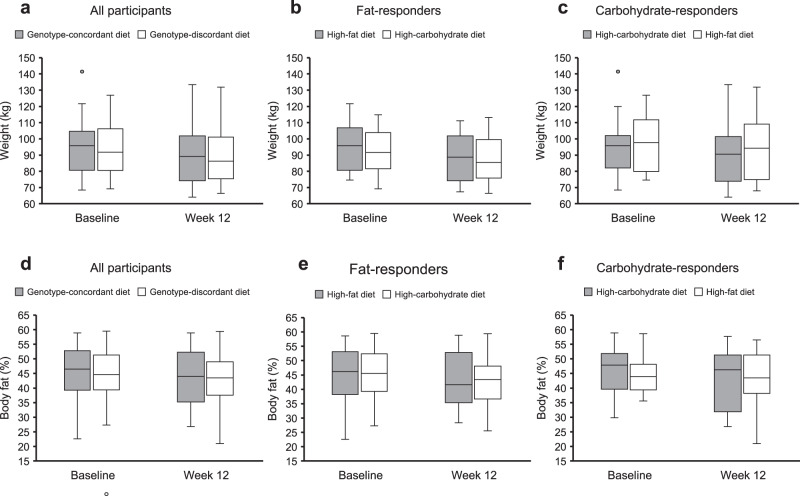
Weight loss (WL) differences between isocaloric high-carbohydrate and high-fat diets are generally small; however, individual WL varies within diet groups. Genotype patterns may modify diet effects, with carbohydrate-responsive genotypes losing more weight on high-carbohydrate diets (and vice versa for fat-responsive genotypes). We investigated whether 12-week WL (kg, primary outcome) differs between genotype-concordant and genotype-discordant diets. In this 12-week single-center WL trial, 145 participants with overweight/obesity were identified a priori as fat-responders or carbohydrate-responders based on their combined genotypes at ten genetic variants and randomized to a high-fat (n = 73) or high-carbohydrate diet (n = 72), yielding 4 groups: (1) fat-responders receiving high-fat diet, (2) fat-responders receiving high-carbohydrate diet, (3) carbohydrate-responders receiving high-fat diet, (4) carbohydrate-responders receiving high-carbohydrate diet. Dietitians delivered the WL intervention via 12 weekly diet-specific small group sessions. Outcome assessors were blind to diet assignment and genotype patterns. We included 122 participants (54.4 [SD:13.2] years, BMI 34.9 [SD:5.1] kg/m, 84% women) in the analyses. Twelve-week WL did not differ between the genotype-concordant (-5.3 kg [SD:1.0]) and genotype-discordant diets (-4.8 kg [SD:1.1]; adjusted difference: -0.6 kg [95% CI: -2.1,0.9], p = 0.50). With the current ability to genotype participants as fat- or carbohydrate-responders, evidence does not support greater WL on genotype-concordant diets. ClinicalTrials identifier: NCT04145466.
体重减轻(WL)在等热量高碳水化合物和高脂肪饮食之间的差异通常很小;然而,个体在饮食组内的 WL 存在差异。基因型模式可能会改变饮食的影响,碳水化合物反应型基因型在高碳水化合物饮食中减轻更多体重(反之亦然,脂肪反应型基因型)。我们研究了 12 周 WL(kg,主要结果)是否在基因型一致和基因型不一致的饮食之间存在差异。在这项为期 12 周的单一中心 WL 试验中,根据十个遗传变异的综合基因型,145 名超重/肥胖参与者被预先确定为脂肪反应者或碳水化合物反应者,并随机分配到高脂肪(n=73)或高碳水化合物饮食(n=72),产生 4 组:(1)脂肪反应者接受高脂肪饮食,(2)脂肪反应者接受高碳水化合物饮食,(3)碳水化合物反应者接受高脂肪饮食,(4)碳水化合物反应者接受高碳水化合物饮食。营养师通过 12 次每周的特定饮食小组会议提供 WL 干预。结果评估者对饮食分配和基因型模式不知情。我们纳入了 122 名参与者(54.4 [SD:13.2] 岁,BMI 34.9 [SD:5.1] kg/m,84%女性)进行分析。基因型一致(-5.3kg [SD:1.0])和基因型不一致饮食(-4.8kg [SD:1.1])之间的 12 周 WL 无差异(调整差异:-0.6kg [95%CI:-2.1,0.9],p=0.50)。根据当前对参与者进行脂肪或碳水化合物反应者的基因分型能力,没有证据表明基因型一致的饮食能带来更大的 WL。临床试验标识符:NCT04145466。