Hangzhou Cancer Hospital, Hangzhou, 310000, ZJ, China.
Department of Oncology, Affilited Hangzhou First People's Hospital, Zhejiang University School of Medicine, Hangzhou, 310006, ZJ, China.
Eur J Med Res. 2023 Oct 10;28(1):413. doi: 10.1186/s40001-023-01345-7.
This research aimed to investigate the prognostic factors of oral squamous cell carcinoma (OSCC), especially the role of age.
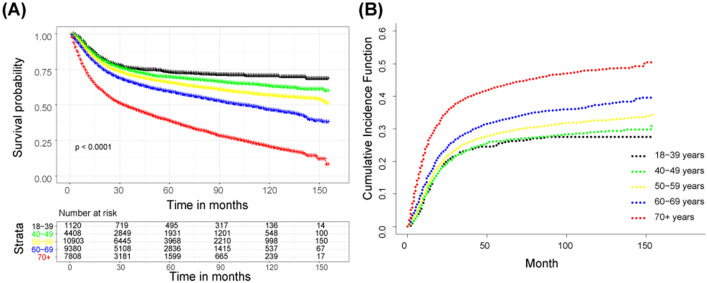
A total of 33,619 cases of OSCC were received from the Surveillance, Epidemiology, and End Results (SEER) database during 2005-2015. Kaplan-Meier curves of 5-year overall survival rates and 5-year cancer-specific survival rates were performed, and univariate and multivariate Cox regression analyses as well as competing risk model were used to help understand the relationship between various factors and mortality of OSCC.
Compared to 18-39-year-old group, the older age was an important predictor of worse prognosis. The multivariate analysis of overall survival (OS) was 50-59 years (HR, 1.32; 95% CI 1.17-1.48; p ≤ .001), 60-69 years (HR, 1.66; 95% CI 1.42-1.87; p ≤ .001) and 70 + years (HR, 3.21; 95% CI 2.86-3.62; p ≤ .001), respectively, while the specific value of competing risk model was 60-69 years (HR, 1.21; 95% CI 1.07-1.38; p = .002) and 70 + years (HR, 1.85; 95% CI 1.63-2.10; p ≤ .001). In addition, female gender, unmarried, Blacks, tumor in floor of mouth, size and higher Tumor Node Metastasis (TNM) classification were also other predictors that signify significant clinically deterioration of OS/cancer-specific survival (CSS).
Our research revealed that age was an important factor in explaining the difference of survival in the whole process of OSCC. It is suggested that we should pay attention to the influence of age on diagnosis, treatment and prognosis in the clinical process.
本研究旨在探讨口腔鳞状细胞癌(OSCC)的预后因素,特别是年龄的作用。
本研究从 2005 年至 2015 年期间从监测、流行病学和最终结果(SEER)数据库中收集了 33619 例 OSCC 病例。通过 Kaplan-Meier 曲线计算了 5 年总生存率和 5 年癌症特异性生存率,并进行了单因素和多因素 Cox 回归分析以及竞争风险模型,以帮助了解各种因素与 OSCC 死亡率之间的关系。
与 18-39 岁年龄组相比,年龄较大是预后不良的重要预测因素。总生存(OS)的多因素分析结果显示,50-59 岁(HR,1.32;95%CI,1.17-1.48;p≤0.001)、60-69 岁(HR,1.66;95%CI,1.42-1.87;p≤0.001)和 70 岁及以上(HR,3.21;95%CI,2.86-3.62;p≤0.001)年龄组的 OS 预后较差,而竞争风险模型的特定值为 60-69 岁(HR,1.21;95%CI,1.07-1.38;p=0.002)和 70 岁及以上(HR,1.85;95%CI,1.63-2.10;p≤0.001)年龄组的 OS 预后较差。此外,女性、未婚、黑人、口底肿瘤、肿瘤大小和更高的肿瘤淋巴结转移(TNM)分期也是预示 OS/癌症特异性生存(CSS)临床恶化的其他预测因素。
本研究表明,年龄是解释 OSCC 整个生存过程中生存差异的重要因素。建议在临床过程中注意年龄对诊断、治疗和预后的影响。