Department of Neurology, University Medical Center, Göttingen, Germany.
Department of Medical Statistics, University Medical Center, Göttingen, Germany.
BMC Neurol. 2023 Oct 10;23(1):366. doi: 10.1186/s12883-023-03406-0.
Myasthenia gravis (MG) affects individuals as a chronic autoimmune disease for many years. Commonly, chronic diseases significantly reduce the patients' quality of life. Aiming to improve the future quality of life in MG, this study assessed the factors impacting quality of life. As gender-specific medicine is becoming increasingly important, this study also focused on understanding gender differences in the outcome of MG.
The study is a combined monocentric, retrospective and prospective database analysis of patient records based on 2,370 presentations of 165 patients with clinically, serologically and/or electrophysiologically confirmed MG over an observation period of up to 47 years. The data collection included the following parameters: antibody status, disease severity, age, medication use, gender, and disease duration. In addition, a prospective survey was conducted on the quality of life using the Myasthenia gravis-specific 15-item Quality of Life scale (MG-QoL15) and on the activities of daily living using the MG-specific Activities of Daily Living scale (MG-ADL).
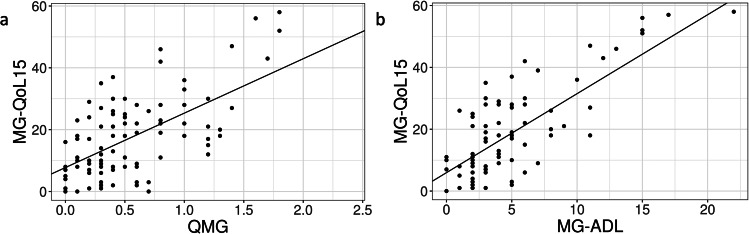
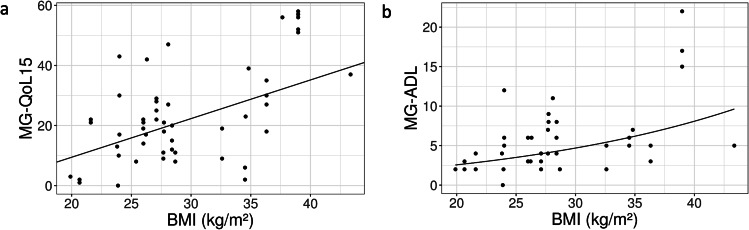
Of the 165 patients, 85 were male (51.5%) and 80 were female (48.5%). The remaining baseline characteristics (e.g. age and antibody status) were consistent with other myasthenia gravis cohorts. A high body mass index (BMI) (p = 0.005) and a high disease severity (p < 0.001) were significantly associated with lower disease-specific quality of life. Additionally, the quality of life in women with MG was significantly reduced compared to male patients (19.7 vs. 13.0 points in the MG-QoL15, p = 0.024). Gender differences were also observable in terms of the period between initial manifestation and initial diagnosis and women were significantly more impaired in their activities of daily living (MG-ADL) than men (4.8 vs. 3.0 points, p = 0.032).
Women with MG had significantly poorer disease specific quality of life compared to men as well as patients with a higher BMI. In order to improve the quality of life, gender-specific medicine and further investigation regarding a modification of the quality of life by lowering the BMI are essential and necessary.
Study approval by the Ethics Committee of the University Medical Center Göttingen was granted (number 6/5/18).
重症肌无力 (MG) 是一种慢性自身免疫性疾病,可影响患者多年。通常,慢性病会显著降低患者的生活质量。为了提高 MG 患者未来的生活质量,本研究评估了影响生活质量的因素。由于性别医学变得越来越重要,本研究还侧重于了解 MG 结局的性别差异。
本研究是一项基于 2370 例 165 例经临床、血清学和/或电生理学证实的 MG 患者的记录进行的单中心、回顾性和前瞻性数据库分析,观察期长达 47 年。数据收集包括以下参数:抗体状态、疾病严重程度、年龄、药物使用、性别和疾病持续时间。此外,还使用重症肌无力特异性 15 项生活质量量表 (MG-QoL15) 对生活质量进行了前瞻性调查,使用重症肌无力日常生活活动量表 (MG-ADL) 对日常生活活动进行了前瞻性调查。
在 165 例患者中,85 例为男性(51.5%),80 例为女性(48.5%)。其他基线特征(如年龄和抗体状态)与其他重症肌无力队列一致。较高的体质指数 (BMI)(p=0.005)和较高的疾病严重程度(p<0.001)与疾病特异性生活质量降低显著相关。此外,MG 女性的生活质量明显低于男性患者(MG-QoL15 为 19.7 分与 13.0 分,p=0.024)。在初始表现与初始诊断之间的时间间隔以及女性的日常生活活动(MG-ADL)受损程度方面,性别差异也很明显,女性比男性分别高出 4.8 分和 3.0 分(p=0.032)。
与男性和 BMI 较高的患者相比,MG 女性的疾病特异性生活质量明显较差。为了提高生活质量,需要进行性别医学研究,并进一步探讨通过降低 BMI 来改善生活质量。
哥廷根大学医学中心伦理委员会批准(编号 6/5/18)。