University of Ottawa Institute of Mental Health Research at The Royal, 1145 Carling Ave, Ottawa, ON, K1Z 7K4, Canada.
Department of Neuroscience, Carleton University, 1125 Colonel By Drive, Ottawa, ON, K1S 5B6, Canada.
BMC Psychiatry. 2023 Oct 10;23(1):739. doi: 10.1186/s12888-023-05243-4.
Major depressive disorder (MDD) is a prevalent mental health condition affecting millions worldwide, leading to disability and reduced quality of life. MDD poses a global health priority due to its early onset and association with other disabling conditions. Available treatments for MDD exhibit varying effectiveness, and a substantial portion of individuals remain resistant to treatment. Repetitive transcranial magnetic stimulation (rTMS), applied to the left and/or right dorsolateral prefrontal cortex (DLPFC), is an alternative treatment strategy for those experiencing treatment-resistant MDD. The objective of this study is to investigate whether this newer form of rTMS, namely theta burst stimulation (TBS), when performed unilaterally or bilaterally, is efficacious in treatment-resistant MDD.
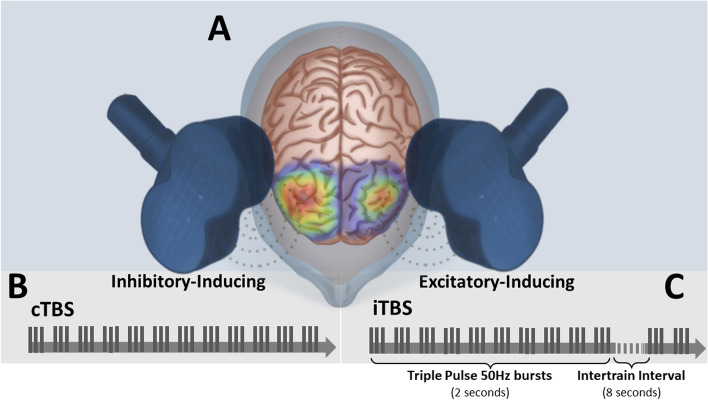
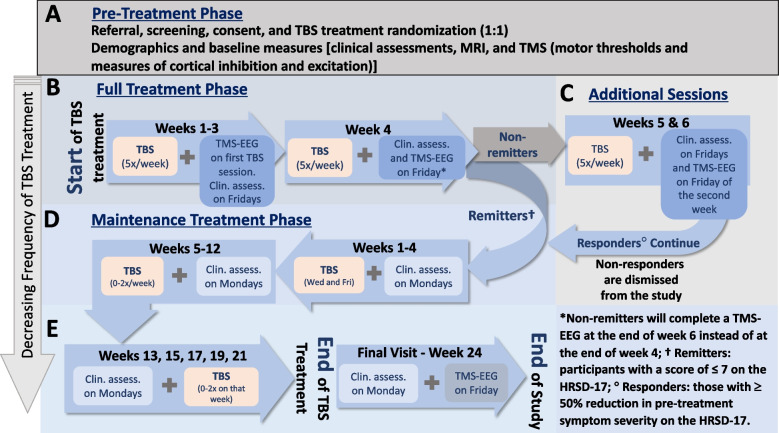
In this naturalistic, randomized double-blinded non-inferiority trial, participants with a major depressive episode will be randomized to receive either unilateral (i.e., continuous TBS [cTBS] to the right and sham TBS to the left DLPFC) or bilateral sequential TBS (i.e., cTBS to the right and intermittent TBS [iTBS] to the left DLPFC) delivered 5 days a week for 4-6 weeks. Responders will move onto a 6-month flexible maintenance phase where TBS treatment will be delivered at a decreasing frequency depending on degree of symptom mitigation. Several clinical assessments and neuroimaging and neurophysiological biomarkers will be collected to investigate treatment response and potential associated biomarkers. A non-inferiority analysis will investigate whether bilateral sequential TBS is non-inferior to unilateral TBS and regression analyses will investigate biomarkers of treatment response. We expect to recruit a maximal of 256 participants. This trial is approved by the Research Ethics Board of The Royal's Institute of Mental Health Research (REB# 2,019,071) and will follow the Declaration of Helsinki. Findings will be published in peer-reviewed journals.
Comprehensive assessment of symptoms and neurophysiological biomarkers will contribute to understanding the differential efficacy of the tested treatment protocols, identifying biomarkers for treatment response, and shedding light into underlying mechanisms of TBS. Our findings will inform future clinical trials and aid in personalizing treatment selection and scheduling for individuals with MDD.
The trial is registered on https://clinicaltrials.gov/ct2/home (#NCT04142996).
重度抑郁症(MDD)是一种普遍存在的精神健康疾病,影响着全球数百万人,导致残疾和生活质量下降。由于 MDD 发病早且与其他致残疾病相关,因此它是全球卫生的一个重点。MDD 的现有治疗方法效果不一,相当一部分人对治疗有抵抗力。重复经颅磁刺激(rTMS)应用于左侧和/或右侧背外侧前额叶皮层(DLPFC),是治疗抗药性 MDD 的另一种治疗策略。本研究的目的是探讨这种新形式的 rTMS,即 theta 爆发刺激(TBS),单侧或双侧应用是否对治疗抵抗性 MDD 有效。
在这项自然、随机、双盲非劣效性试验中,患有重度抑郁发作的参与者将被随机分为单侧组(即右连续 TBS[cTBS]和左 DLPFC 假 TBS)或双侧序贯 TBS 组(即右 cTBS 和左 DLPFC 间 TBS[iTBS]),每周 5 天,持续 4-6 周。反应者将进入 6 个月的灵活维持阶段,根据症状缓解程度,TBS 治疗的频率会逐渐降低。将收集多项临床评估和神经影像学及神经生理学生物标志物,以研究治疗反应和潜在的相关生物标志物。非劣效性分析将研究双侧序贯 TBS 是否不如单侧 TBS,回归分析将研究治疗反应的生物标志物。我们预计最多可招募 256 名参与者。该试验得到了 The Royal's Institute of Mental Health Research 伦理委员会的批准(REB#2,019,071),并遵循赫尔辛基宣言。研究结果将发表在同行评议的期刊上。
对症状和神经生理学生物标志物的综合评估将有助于了解所测试治疗方案的差异疗效,确定治疗反应的生物标志物,并深入了解 TBS 的潜在机制。我们的研究结果将为未来的临床试验提供信息,并有助于为 MDD 患者个性化选择和安排治疗。