Department of Medicine, School of Clinical Medicine, LKS Faculty of Medicine, The University of Hong Kong, Hong Kong, People's Republic of China.
Department of Pharmacology and Pharmacy, LKS Faculty of Medicine, The University of Hong Kong, Hong Kong, People's Republic of China.
BMJ Open. 2023 Oct 12;13(10):e069681. doi: 10.1136/bmjopen-2022-069681.
To investigate factors concerning patients regarding biological/target synthetic disease-modifying antirheumatic drugs (b/ts DMARDs) in treating inflammatory arthritis (IA).
This study consists of a systematic review and a cross-sectional survey in Hong Kong. A systematic review of literature following Preferred Reporting Items for Systematic Reviews and Meta-Analyses was conducted on PubMed, Web of Science, Cochrane and Embase between 1 January 2000 and 1 January 2022. Content analysis was conducted to summarise factors grouped by four themes-social aspects (SA), clinical aspects (CA), medicine characteristics (MC) and financial aspects (FA) in the decision-making process. One cross-sectional survey among Hong Kong patients with IA was conducted to add to global evidence.
A systematic review of global evidence and a patient-based survey in Hong Kong to complement scarce evidence in Asia regions.
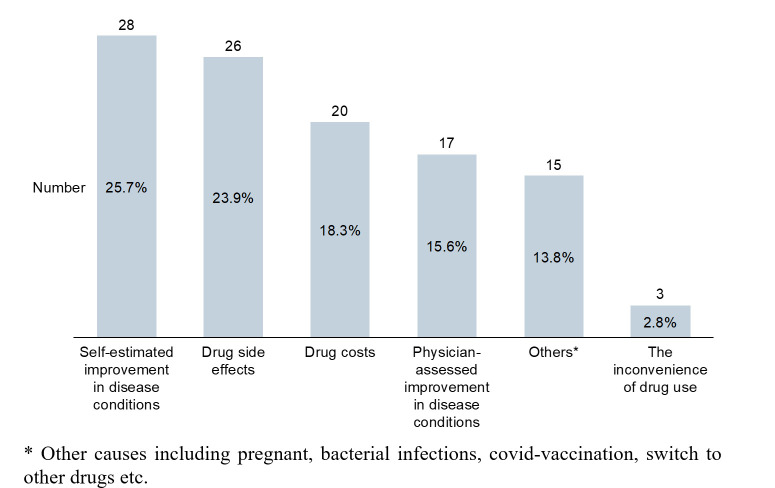
The systematic review resulted in 34 studies. The four themes were presented in descending order consistently but varied with frequency throughout decision-making processes. During decision-making involving medication initiation, preference and discontinuation, MC (reported frequency: 83%, 86%, 78%), SA (56%, 43%, 78%) and FA (39%, 33%, 56%) were the three most frequently reported factors, whereas CA was less studied. Local survey also revealed that MC factors such as treatment efficacy and the probability of severe adverse events, and SA factors such as the availability of government or charity subsidy, influenced patients' initiation and preference for b/ts DMARDs. Meanwhile, self-estimated improvement in disease conditions (SA), drug side effects (MC) and drug costs (FA) were associated with treatment discontinuation.
Global and local evidence consistently indicate that MC and SA are important considerations in patients' decisions regarding novel DMARDs. Health policies that reduce patients' financial burden and enhances healthcare professionals' engagement in decision-making and treatment delivery should be in place with an efficient healthcare system for managing IA optimistically.
调查患者在使用生物/靶向合成的疾病修正抗风湿药物(b/ts DMARDs)治疗炎症性关节炎(IA)方面的相关因素。
本研究包括香港的系统评价和横断面调查。我们在 PubMed、Web of Science、Cochrane 和 Embase 数据库中对 2000 年 1 月 1 日至 2022 年 1 月 1 日期间发表的文献进行了系统评价,检索词为“inflammatory arthritis”“biological synthetic DMARDs”“targeted synthetic DMARDs”“treatment decision”。采用内容分析法对四个主题(社会方面、临床方面、药物特性和经济方面)的决策过程中的相关因素进行了总结。我们还在香港开展了一项针对 IA 患者的横断面调查,以补充亚洲地区稀缺的证据。
全球证据的系统评价和香港的患者调查,以补充亚洲地区的证据。
系统评价共纳入 34 项研究。四个主题按照降序排列,但在决策过程中频率不同。在药物起始、偏好和停药的决策过程中,药物特性(报道频率:83%、86%、78%)、社会方面(56%、43%、78%)和经济方面(39%、33%、56%)是三个最常被报道的因素,而临床方面的因素研究较少。本地调查还显示,药物特性因素(如治疗效果和严重不良事件的概率)和社会方面因素(如政府或慈善机构的补贴可用性)影响患者对 b/ts DMARDs 的起始和偏好。同时,患者对疾病状况改善的自我评估(社会方面)、药物副作用(药物特性)和药物费用(经济方面)与治疗停药有关。
全球和本地证据一致表明,药物特性和社会方面是患者对新型 DMARDs 决策的重要考虑因素。应制定降低患者经济负担的卫生政策,并加强医疗保健专业人员在决策和治疗实施方面的参与,以建立一个高效的卫生系统,乐观地管理 IA。