Arnaboldi Serena, Salinas Gerardo, Bichon Sabrina, Gounel Sebastien, Mano Nicolas, Kuhn Alexander
Dip. Di Chimica, Univ. degli Studi di Milano, Milan, Italy.
University Bordeaux, CNRS, Bordeaux INP, ISM, UMR 5255, F-33607, Pessac, France.
Nat Commun. 2023 Oct 12;14(1):6390. doi: 10.1038/s41467-023-42153-1.
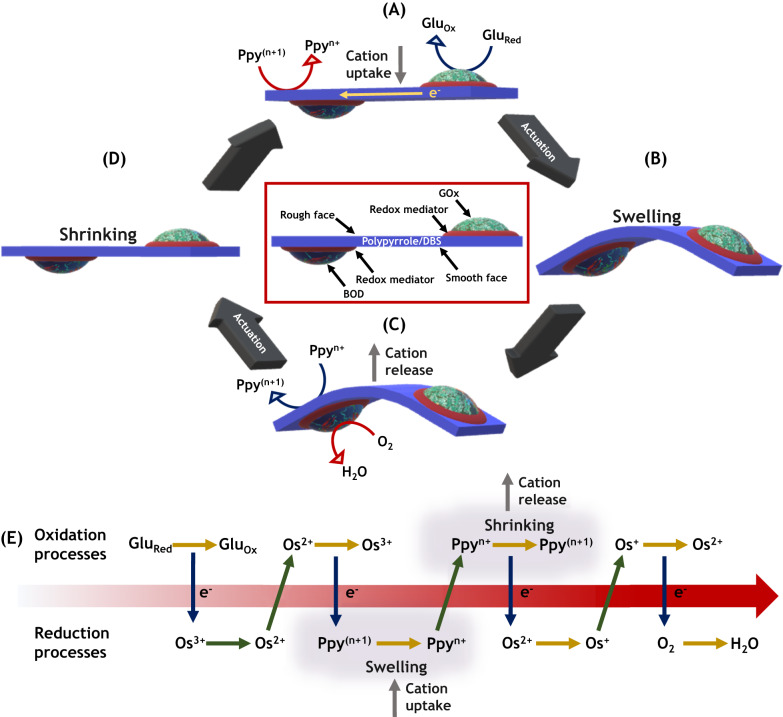
Artificial actuators have been extensively studied due to their wide range of applications from soft robotics to biomedicine. Herein we introduce an autonomous bi-enzymatic system where reversible motion is triggered by the spontaneous oxidation and reduction of glucose and oxygen, respectively. This chemo-mechanical actuation is completely autonomous and does not require any external trigger to induce self-sustained motion. The device takes advantage of the asymmetric uptake and release of ions on the anisotropic surface of a conducting polymer strip, occurring during the operation of the enzymes glucose oxidase and bilirubin oxidase immobilized on its surface. Both enzymes are connected via a redox polymer at each extremity of the strip, but at the opposite faces of the polymer film. The time-asymmetric consumption of both fuels by the enzymatic reactions produces a double break of symmetry of the film, leading to autonomous actuation. An additional break of symmetry, introduced by the irreversible overoxidation of one extremity of the polymer film, leads to a crawling-type motion of the free-standing polymer film. These reactions occur in a virtually unlimited continuous loop, causing long-term autonomous actuation of the device.
由于人工致动器在从软体机器人到生物医学等广泛领域的应用,其已得到广泛研究。在此,我们介绍一种自主双酶系统,其中可逆运动分别由葡萄糖和氧气的自发氧化和还原触发。这种化学机械致动是完全自主的,不需要任何外部触发来诱导自持运动。该装置利用了固定在导电聚合物条带各向异性表面上的葡萄糖氧化酶和胆红素氧化酶运行过程中离子的不对称吸收和释放。两种酶通过氧化还原聚合物连接在条带的每个末端,但位于聚合物膜的相对面。酶促反应对两种燃料的时间不对称消耗导致膜的对称性双重破坏,从而实现自主致动。聚合物膜一端的不可逆过氧化引入的额外对称性破坏,导致独立聚合物膜的爬行式运动。这些反应以几乎无限的连续循环发生,从而使装置实现长期自主致动。