Webb Sara, Drake Connor, Coffman Cynthia J, Sullivan Caitlin, Sperber Nina, Tucker Matthew, Zullig Leah L, Hughes Jaime M, Kaufman Brystana G, Pura John A, Anderson Livia, Hastings Susan N, Van Houtven Courtney H, Abbate Lauren M, Hoenig Helen, Ballengee Lindsay A, Wang Virginia, Allen Kelli D
Center of Innovation to Accelerate Discovery and Practice Transformation, Durham VA Health Care System, Durham, NC, USA.
Department of Population Health Sciences, Duke University School of Medicine, Durham, NC, USA.
Implement Sci Commun. 2023 Oct 12;4(1):125. doi: 10.1186/s43058-023-00502-7.
Knee osteoarthritis (OA) is a leading cause of chronic pain and disability and one of the most common conditions treated in outpatient physical therapy (PT). Because of the high and growing prevalence of knee OA, there is a need for efficient approaches for delivering exercise-based PT to patients with knee OA. A prior randomized controlled trial (RCT) showed that a 6-session Group Physical Therapy Program for Knee OA (Group PT) yields equivalent or greater improvements in pain and functional outcomes compared with traditional individual PT, while requiring fewer clinician hours per patient to deliver. This manuscript describes the protocol for a hybrid type III effectiveness-implementation trial comparing two implementation packages to support delivery of Group PT.
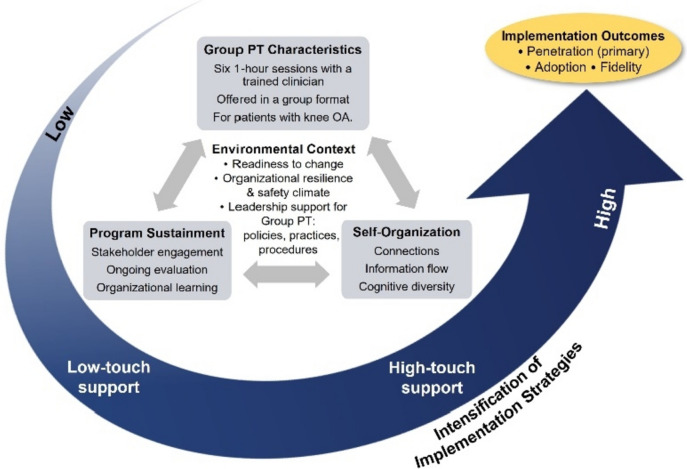
In this 12-month embedded trial, a minimum of 16 Veterans Affairs Medical Centers (VAMCs) will be randomized to receive one of two implementation support packages for their Group PT programs: a standard, low-touch support based on Replicating Effective Programs (REP) versus enhanced REP (enREP), which adds tailored, high-touch support if sites do not meet Group PT adoption and sustainment benchmarks at 6 and 9 months following launch. Implementation outcomes, including penetration (primary), adoption, and fidelity, will be assessed at 6 and 12 months (primary assessment time point). Additional analyses will include patient-level effectiveness outcomes (pain, function, satisfaction) and staffing and labor costs. A robust qualitative evaluation of site implementation context and experience, as well as site-led adaptations to the Group PT program, will be conducted.
To our knowledge, this study is the first to evaluate the impact of tailored, high-touch implementation support on implementation outcomes when compared to standardized, low-touch support for delivering a PT-based intervention. The Group PT program has strong potential to become a standard offering for PT, improving function and pain-related outcomes for patients with knee OA. Results will provide information regarding the effectiveness and value of this implementation approach and a deeper understanding of how healthcare systems can support wide-scale adoption of Group PT.
This study was registered on March 7, 2022 at ClinicalTrials.gov (identifier NCT05282927 ).
膝关节骨关节炎(OA)是慢性疼痛和残疾的主要原因之一,也是门诊物理治疗(PT)中最常见的治疗病症之一。由于膝关节OA的患病率居高不下且不断上升,因此需要为膝关节OA患者提供基于运动的PT的有效方法。先前的一项随机对照试验(RCT)表明,与传统的个体PT相比,为期6节的膝关节OA团体物理治疗计划(团体PT)在疼痛和功能结局方面产生了同等或更大的改善,同时每位患者所需的临床医生时间更少。本手稿描述了一项III型混合有效性-实施试验的方案,该试验比较了两种实施包以支持团体PT的实施。
在这项为期12个月的嵌入式试验中,至少16个退伍军人事务医疗中心(VAMC)将被随机分配,以接受其团体PT计划的两种实施支持包之一:一种基于复制有效计划(REP)的标准、低接触支持,与强化REP(enREP)相比,如果各站点在启动后6个月和9个月未达到团体PT采用和维持基准,则强化REP会增加量身定制的高接触支持。将在6个月和12个月(主要评估时间点)评估实施结果,包括渗透率(主要)、采用率和保真度。额外的分析将包括患者层面的有效性结果(疼痛、功能、满意度)以及人员配备和劳动力成本。将对站点实施背景和经验以及站点主导的团体PT计划调整进行全面的定性评估。
据我们所知,与提供基于PT的干预措施的标准化、低接触支持相比,本研究是首个评估量身定制的高接触实施支持对实施结果影响的研究。团体PT计划有很大潜力成为PT的标准服务,改善膝关节OA患者的功能和与疼痛相关的结局。结果将提供有关这种实施方法的有效性和价值的信息,并更深入地了解医疗保健系统如何支持团体PT的广泛采用。
本研究于2022年3月7日在ClinicalTrials.gov注册(标识符NCT05282927)。