Neurological Institute, Cleveland Clinic, Las Vegas, NV, USA.
Department of Biostatistics, University of Florida, Gainesville, FL, USA.
Alzheimers Res Ther. 2023 Oct 12;15(1):173. doi: 10.1186/s13195-023-01310-w.
It is unknown if fluid biomarkers reflective of brain pathologies are useful in detecting and following a neurodegenerative process in individuals exposed to repetitive head impacts. This study explores the relationship between blood biomarkers and longitudinal change in cognitive function and regional brain volumes in a cohort of professional fighters.
Participants are drawn from a convenience sample of active and retired professional boxers and Mixed Martial Arts fighters and a control group with no prior exposure to head impacts. 3 T MRI brain imaging, plasma samples, and computerized cognitive testing were obtained at baseline and, for a subset, annually. MRI regional volumes were extracted, along with plasma levels of neurofilament light chain (NfL), glial fibrillary acidic protein (GFAP), p-tau231, and N-terminal tau (NTA). Statistical analyses were performed to assess the relationship between plasma levels and regional brain volumes and cognitive performance at baseline and longitudinally.
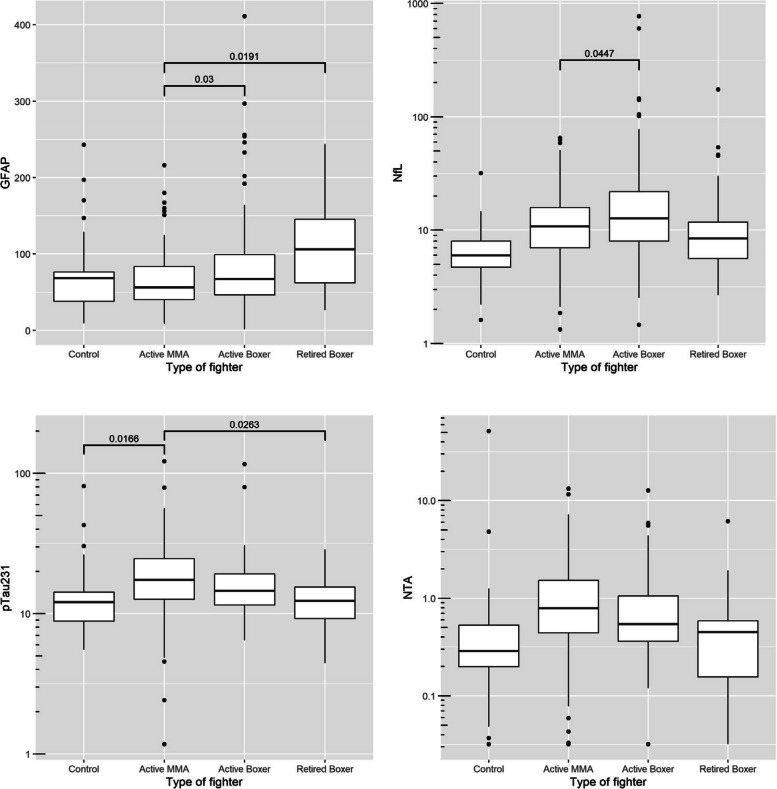
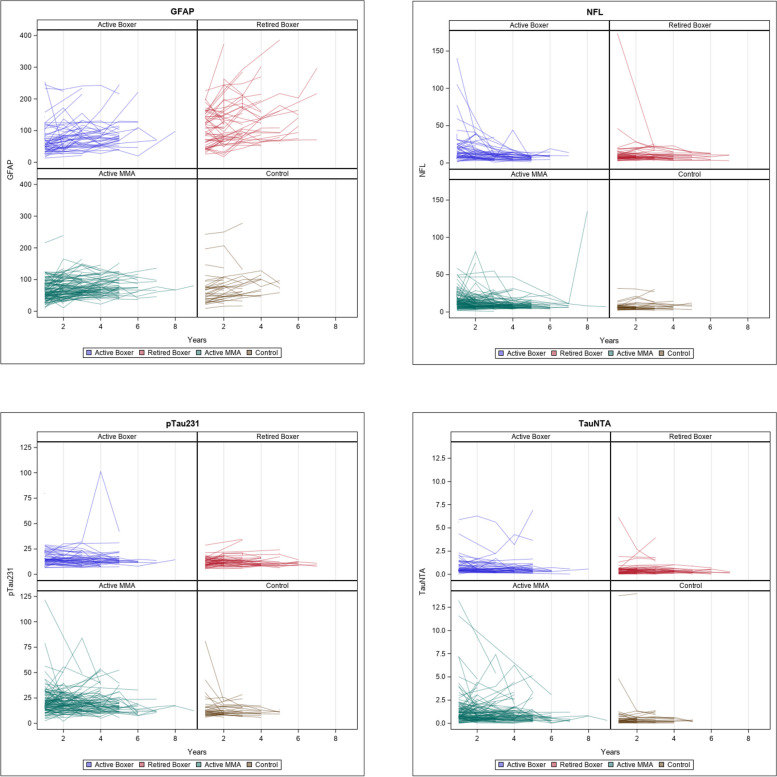
One hundred forty active boxers (mean age: 31 with standard deviation (SD) of 8), 211 active MMA (mean age of 30 with SD of 5), 69 retired boxers (mean age 49 with SD of 9), and 52 control participants (mean age 36 with SD of 12) were included in the analyses. Baseline GFAP levels were highest in the retired boxers (retired boxers v. active MMA: p = 0.0191), whereas active boxers had higher levels of NfL (active boxers v. MMA: p = 0.047). GFAP showed an increase longitudinally in retired boxers that was associated with decreasing volumes of multiple cortical and subcortical structures (e.g., hippocampus: B = - 1.25, 95% CI, - 1.65 to - 0.85) and increase in lateral ventricle size (B = 1.75, 95% CI, 1.46 to 2.04). Furthermore, performance on cognitive domains including memory, processing speed, psychomotor speed, and reaction time declined over time with increasing GFAP (e.g., processing speed: B = - 0.04, 95% CI, - 0.07 to - 0.02; reaction time: B = 0.52, 95% CI, 0.28 to 0.76). Among active fighters, increasing levels of GFAP were correlated with lower thalamic (B = - 1.42, 95% CI, - 2.34 to -0.49) and corpus callosum volumes, along with worsening scores on psychomotor speed (B = 0.14, 95% CI, 0.01 to 0.27).
Longitudinal plasma GFAP levels may have a role in identifying individuals exposed to repetitive head impacts who are at risk of showing progressive regional atrophy and cognitive decline.
目前尚不清楚反映脑部病变的液体生物标志物是否可用于检测和跟踪接触重复性头部撞击的个体中的神经退行性过程。本研究探讨了血液生物标志物与认知功能的纵向变化以及职业拳击手队列中大脑区域体积之间的关系。
参与者来自于活跃和退役职业拳击手和混合武术格斗者的便利样本,以及没有头部撞击既往史的对照组。在基线时和部分参与者每年进行 3T MRI 脑部成像、血浆样本和计算机认知测试。提取 MRI 区域体积,以及神经丝轻链 (NfL)、胶质纤维酸性蛋白 (GFAP)、p-tau231 和 N 端 tau (NTA) 的血浆水平。进行统计分析以评估基线和纵向时血浆水平与大脑区域体积和认知表现之间的关系。
在分析中纳入了 140 名活跃的拳击手(平均年龄 31 岁,标准差 (SD) 为 8)、211 名活跃的 MMA(平均年龄 30 岁,SD 为 5)、69 名退役的拳击手(平均年龄 49 岁,SD 为 9)和 52 名对照组参与者(平均年龄 36 岁,SD 为 12)。基线时 GFAP 水平在退役拳击手中最高(退役拳击手 v. 活跃 MMA:p = 0.0191),而活跃的拳击手的 NfL 水平较高(活跃的拳击手 v. MMA:p = 0.047)。退役拳击手的 GFAP 水平呈纵向升高,与多个皮质和皮质下结构的体积减小相关(例如海马体:B = -1.25,95%CI,-1.65 至-0.85),侧脑室体积增大(B = 1.75,95%CI,1.46 至 2.04)。此外,随着 GFAP 的增加,记忆、处理速度、精神运动速度和反应时间等认知域的表现随时间推移而下降(例如处理速度:B = -0.04,95%CI,-0.07 至-0.02;反应时间:B = 0.52,95%CI,0.28 至 0.76)。在活跃的格斗者中,GFAP 水平的升高与丘脑(B = -1.42,95%CI,-2.34 至-0.49)和胼胝体体积的降低以及精神运动速度评分的恶化相关(B = 0.14,95%CI,0.01 至 0.27)。
纵向血浆 GFAP 水平可能在识别接触重复性头部撞击的个体中发挥作用,这些个体有出现进行性区域性萎缩和认知能力下降的风险。