Boral Baris, Togay Alper
Immunology, University of Health Sciences, Dr. Abdurrahman Yurtarslan Oncology Training and Research Hospital, Ankara, TUR.
Medical Microbiology and Immunology, Health Science University İzmir Tepecik Training and Research Hospital, İzmir, TUR.
Cureus. 2023 Sep 11;15(9):e45008. doi: 10.7759/cureus.45008. eCollection 2023 Sep.
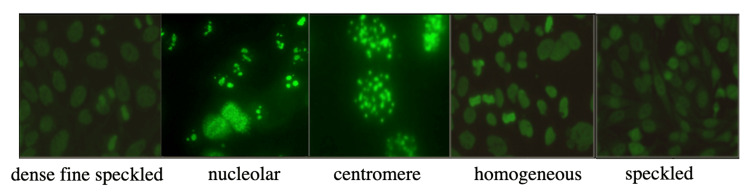
Antinuclear antibodies (ANA) are important diagnostic markers in many autoimmune rheumatological diseases. The indirect immunofluorescence assay applied on human epithelial cells generates images that are used in the detection of ANA. The classification of these images for different ANA patterns requires human experts. It is time-consuming and subjective as different experts may label the same image differently. Therefore, there is an interest in machine learning-based automatic classification of ANA patterns. In our study, to build an application for the automatic classification of ANA patterns, we construct a dataset and learn a deep neural network with a transfer learning approach. We show that even in the existence of a limited number of labeled data, high accuracies can be achieved on the unseen test samples. Our study shows that deep learning-based software can be built for this task to save expert time.
抗核抗体(ANA)是许多自身免疫性风湿性疾病中的重要诊断标志物。应用于人类上皮细胞的间接免疫荧光测定法会生成用于检测ANA的图像。对这些不同ANA模式的图像进行分类需要人类专家。这既耗时又主观,因为不同的专家可能会对同一图像给出不同的标注。因此,人们对基于机器学习的ANA模式自动分类产生了兴趣。在我们的研究中,为了构建一个用于ANA模式自动分类的应用程序,我们构建了一个数据集,并采用迁移学习方法学习了一个深度神经网络。我们表明,即使存在数量有限的标注数据,也能在未见过的测试样本上实现高精度。我们的研究表明,可以为此任务构建基于深度学习的软件,以节省专家时间。