Moreno Rodríguez Rosa M, Solas Gómez Beatriz, Gallego Marcuello Laura, Diaz Martinez Maria Del Carmen, Fernández Del Palacio Encarnacion, Santiago-Sáez Andrés
Nursing Department, Hospital Clínico San Carlos, 28040 Madrid, Spain.
Geriatric Service, Hospital Clínico San Carlos, 28040 Madrid, Spain.
Healthcare (Basel). 2023 Sep 22;11(19):2605. doi: 10.3390/healthcare11192605.
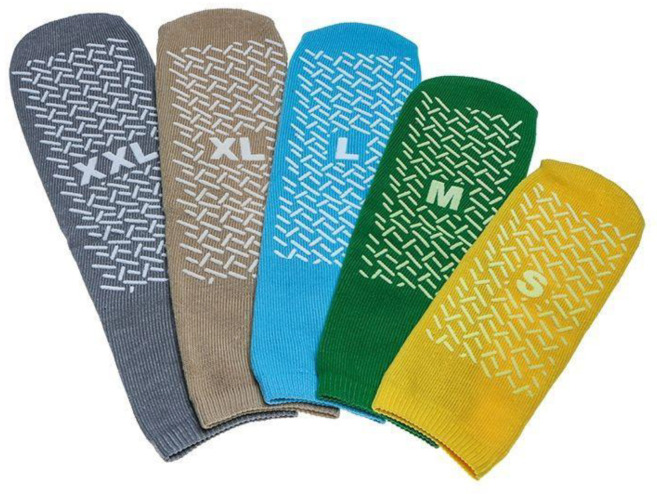
Fall prevention is an important indicator of the quality of patient care. Prevention includes the use of adequate footwear. Our objective is to determine the differences in the number of falls between patients with "adequate footwear" and "non slip socks", and their associated consequences, to support their use in the prevention of falls among hospitalized patients.
This is an observational prospective study on inpatient falls. Patient characteristics, fall circumstances, and injuries were collected through Clinical Report Forms, a review of fall reports, and medical records. Admitted patients over 18 years old were recruited from Geriatric and Internal Medicine Units over a brief period of 3 months.
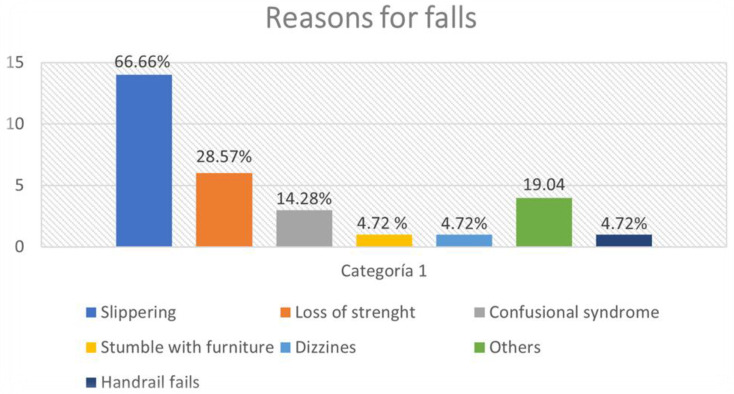
A total of 158 hospitalized patients were recruited. In total, 77 patients (48.73%) were assigned to the non-slip socks group, and 81 (51.27%) were assigned to the adequate footwear group. There were 21 falls during the study period, all of which were experienced by the adequate footwear group ( < 0.0001). The mean age of the patients who fell was 83.14 (range 60-100) years old. The most frequent reasons for admission among the patients who fell were COVID-19 infection (19%) and oncological complications (19%). Overall, 61.9% of patients had a high risk of falling. Most falls (76.1%) occurred in patient rooms, and most of these occurred while wandering around. The most frequent reason for falls was slipping (14/21). For 16 of 21 patients, falls did not have immediate consequences, while 5 had contusions and 1 suffered a wound. Nobody needed to be admitted to the ER or suffered external hemorrhages or loss of consciousness.
Non-slip socks represent an adequate alternative to well-fitting rubber-soled footwear. It seems that non-slip socks could prevent falls among hospitalized patients; nevertheless, further studies are necessary to clarify their role in preventing hospital falls and reducing injury rates.
预防跌倒为患者护理质量的一项重要指标。预防措施包括使用合适的鞋类。我们的目标是确定穿着“合适的鞋类”与“防滑袜”的患者之间跌倒次数的差异及其相关后果,以支持在住院患者跌倒预防中使用它们。
这是一项关于住院患者跌倒的前瞻性观察研究。通过临床报告表、跌倒报告回顾及病历收集患者特征、跌倒情况和损伤情况。在短短3个月内,从老年医学科和内科病房招募18岁以上的住院患者。
共招募了158名住院患者。总体而言,77名患者(48.73%)被分配到防滑袜组,81名(51.27%)被分配到合适鞋类组。研究期间共发生21次跌倒,均发生在合适鞋类组(<0.0001)。跌倒患者的平均年龄为83.14岁(范围60 - 100岁)。跌倒患者中最常见的入院原因是新冠病毒感染(19%)和肿瘤并发症(19%)。总体而言,61.9%的患者有高跌倒风险。大多数跌倒(76.1%)发生在病房,且大多数发生在四处走动时。跌倒最常见的原因是滑倒(14/21)。21名患者中有16名跌倒没有直接后果,5名有瘀伤,1名有伤口。无人需要入住急诊室,也无人出现外出血或意识丧失情况。
防滑袜是合脚的橡胶底鞋类的合适替代品。防滑袜似乎可以预防住院患者跌倒;然而,需要进一步研究以阐明其在预防医院跌倒和降低受伤率方面的作用。