Flores Araceli, Hoffman Hunter G, Navarro-Haro Maria Vicenta, Garcia-Palacios Azucena, Atzori Barbara, Le May Sylvie, Alhalabi Wadee, Sampaio Mariana, Fontenot Miles R, Mason Keira P
Ben Taub Hospital Psychiatry and Behavioral Sciences, Baylor College of Medicine, Houston, TX 77030, USA.
William Beaumont Army Medical Center, Fort Bliss, TX 79918, USA.
Healthcare (Basel). 2023 Oct 9;11(19):2697. doi: 10.3390/healthcare11192697.
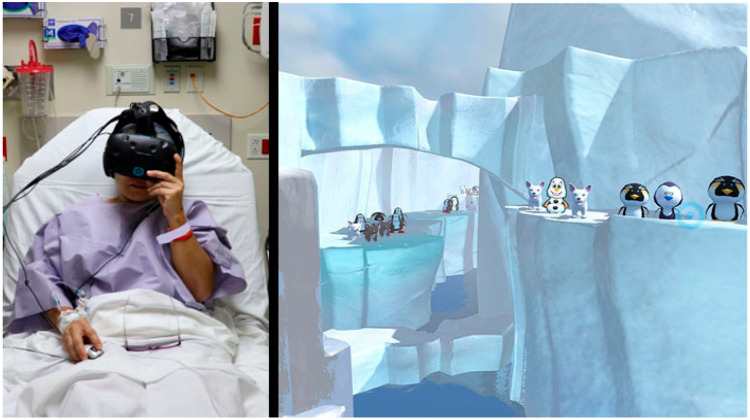
Presurgical anxiety is very common and is often treated with sedatives. Minimizing or avoiding sedation reduces the risk of sedation-related adverse events. Reducing sedation can increase early cognitive recovery and reduce time to discharge after surgery. The current case study is the first to explore the use of interactive eye-tracked VR as a nonpharmacologic anxiolytic customized for physically immobilized presurgery patients. Method: A 44-year-old female patient presenting for gallbladder surgery participated. Using a within-subject repeated measures design (treatment order randomized), the participant received no VR during one portion of her preoperative wait and interactive eye-tracked virtual reality during an equivalent portion of time in the presurgery room. After each condition (no VR vs. VR), the participant provided subjective 0-10 ratings and state-trait short form Y anxiety measures of the amount of anxiety and fear she experienced during that condition. Results: As predicted, compared to treatment as usual (no VR), the patient reported having 67% lower presurgical anxiety during VR. She also experienced "strong fear" (8 out of 10) during no VR vs. "no fear" (0 out of 10) during VR. She reported a strong sense of presence during VR and zero nausea. She liked VR, she had fun during VR, and she recommended VR to future patients during pre-op. Interactive VR distraction with eye tracking was an effective nonpharmacologic technique for reducing anticipatory fear and anxiety prior to surgery. The results add to existing evidence that supports the use of VR in perioperative settings. VR technology has recently become affordable and more user friendly, increasing the potential for widespread dissemination into medical practice. Although case studies are scientifically inconclusive by nature, they help identify new directions for future larger, carefully controlled studies. VR sedation is a promising non-drug fear and anxiety management technique meriting further investigation.
术前焦虑非常普遍,通常使用镇静剂进行治疗。尽量减少或避免使用镇静剂可降低与镇静相关的不良事件风险。减少镇静可加快早期认知恢复并缩短术后出院时间。当前的案例研究首次探索了使用交互式眼动追踪虚拟现实技术作为一种为身体固定的术前患者定制的非药物抗焦虑方法。方法:一名44岁准备接受胆囊手术的女性患者参与了研究。采用受试者内重复测量设计(治疗顺序随机),该参与者在术前等待的一部分时间内未接受虚拟现实,而在术前室的相同时间段内接受交互式眼动追踪虚拟现实。在每种情况(无虚拟现实与虚拟现实)之后,参与者对她在该情况下所经历的焦虑和恐惧程度提供0至10的主观评分以及状态-特质焦虑简表测量。结果:正如预期的那样,与常规治疗(无虚拟现实)相比,患者报告在虚拟现实期间术前焦虑降低了67%。她在无虚拟现实期间还经历了“强烈恐惧”(10分中的8分),而在虚拟现实期间为“无恐惧”(10分中的0分)。她报告在虚拟现实期间有强烈的临场感且无恶心感。她喜欢虚拟现实,在虚拟现实期间很开心,并且在术前向未来的患者推荐了虚拟现实。带有眼动追踪的交互式虚拟现实分心技术是一种有效的非药物技术,可减少手术前的预期恐惧和焦虑。这些结果补充了现有证据,支持在围手术期使用虚拟现实。虚拟现实技术最近变得价格亲民且更便于用户使用,增加了在医疗实践中广泛传播的潜力。尽管案例研究本质上在科学上没有定论,但它们有助于为未来更大规模、精心控制的研究确定新方向。虚拟现实镇静是一种有前景的非药物恐惧和焦虑管理技术,值得进一步研究。