Dept. of Pediatrics, Erasmus MC Sophia Children's Hospital, Dr. Molewaterplein 40, 3015 GD, Rotterdam, The Netherlands.
ENCORE Expertise Center for Neurodevelopmental Disorders, Erasmus MC, Rotterdam, The Netherlands.
Eur J Pediatr. 2024 Jan;183(1):103-111. doi: 10.1007/s00431-023-05231-6. Epub 2023 Oct 13.
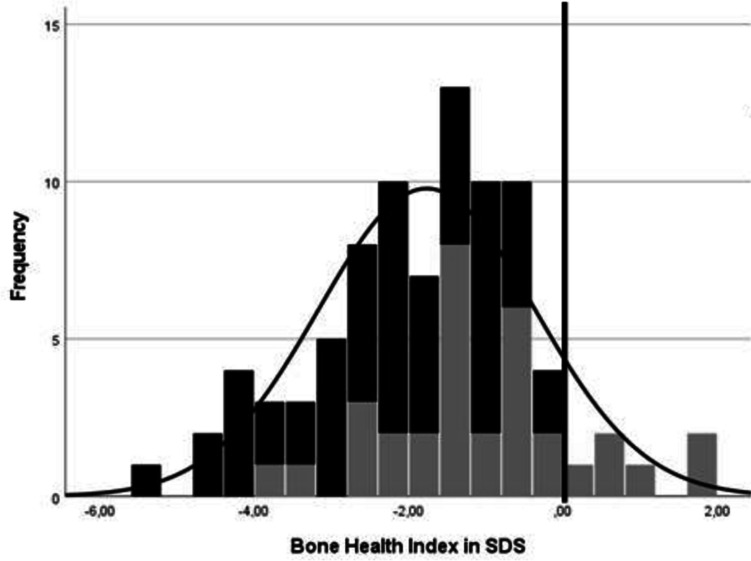
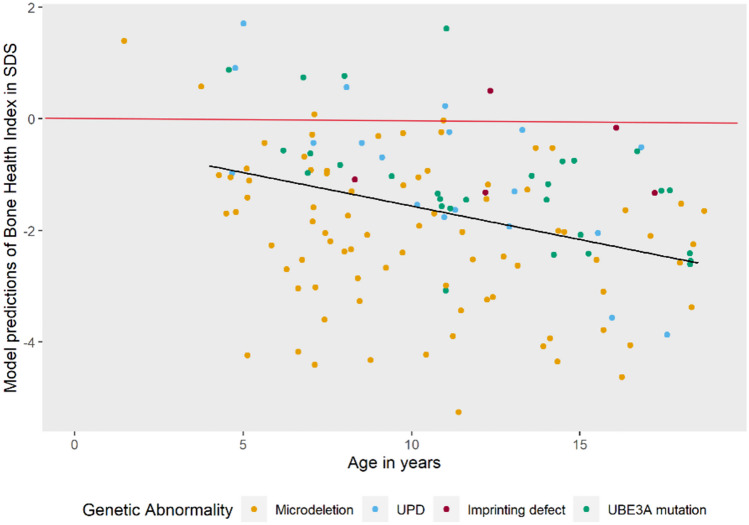
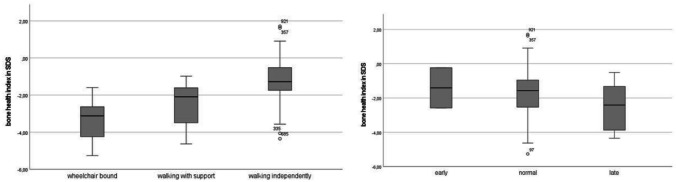
Angelman syndrome (AS) is a rare genetic disorder due to lack of UBE3A function on chromosome 15q11.2q13 caused by a deletion, uniparental paternal disomy (UPD), imprinting center disorder (ICD), or pathological variant of the UBE3A gene. AS is characterized by developmental delay, epilepsy, and lack of speech. Although fractures are observed frequently in our clinical practice, there are few studies on bone health in AS. The aim of this study is to investigate bone health in children with AS. In this prospective cohort study, we describe bone health in 91 children with AS visiting the ENCORE Expertise Center for AS between April 2010 and December 2021. Bone health was assessed with the bone health index (BHI) in standard deviation score (SDS) measured by digital radiogrammetry of the left hand using BoneXpert software. Risk factors analyzed were age, sex, genetic subtype, epilepsy, anti-seizure medication use, mobility, body mass index (BMI), and onset of puberty. Children with AS had a mean BHI of -1.77 SDS (SD 1.4). A significantly lower BHI was found in children with a deletion (-2.24 SDS) versus non-deletion (-1.02 SDS). Other factors associated with reduced BHI-SDS were inability to walk and late onset of puberty. Children with a history of one or more fractures (22%) had a significantly lower BHI than children without fractures (-2.60 vs -1.56 SDS). Longitudinal analysis showed a significant decrease in BHI-SDS with age in all genetic subtypes. Conclusions: Children with AS have a reduced bone health. Risk factors are deletion genotype, no independent walking, and late onset of puberty. Bone health decreased significantly with age. What is Known: • Children with neurological disorders often have a low bone health and higher risk of fractures. • Little is known about bone health in children with Angelman syndrome (AS). What is New: • Children with AS showed a reduced bone health and this was significantly associated with having a deletion, not being able to walk independently, and late onset of puberty. • Longitudinal analysis showed a significant decrease in bone health as children got older.
安琪曼综合征(AS)是一种罕见的遗传性疾病,由于 15q11.2q13 染色体上 UBE3A 功能缺失,导致缺失、单亲二倍体(UPD)、印记中心紊乱(ICD)或 UBE3A 基因突变。AS 的特征是发育迟缓、癫痫和语言缺失。尽管在我们的临床实践中经常观察到骨折,但关于 AS 患者的骨骼健康的研究很少。本研究旨在探讨 AS 患儿的骨骼健康情况。在这项前瞻性队列研究中,我们描述了 2010 年 4 月至 2021 年 12 月期间在 ENCORE 安琪曼综合征专业中心就诊的 91 名 AS 患儿的骨骼健康状况。通过 BoneXpert 软件对手部左掌的数字射线照相术进行测量,采用骨健康指数(BHI)评估骨健康,以标准偏差评分(SDS)表示。分析的危险因素包括年龄、性别、遗传亚型、癫痫、抗癫痫药物使用、活动能力、体重指数(BMI)和青春期开始。AS 患儿的平均 BHI 为-1.77 SDS(SD 为 1.4)。与非缺失组(-1.02 SDS)相比,缺失组的 BHI 明显更低(-2.24 SDS)。与 BHI-SDS 降低相关的其他因素包括无法行走和青春期开始较晚。有一次或多次骨折史的患儿(22%)的 BHI 明显低于无骨折患儿(-2.60 与-1.56 SDS)。所有遗传亚型的纵向分析均显示 BHI-SDS 随年龄显著下降。结论:AS 患儿的骨骼健康状况较差。危险因素是缺失基因型、无法独立行走和青春期开始较晚。骨骼健康随年龄显著下降。已知情况:• 患有神经发育障碍的儿童骨骼健康状况通常较差,骨折风险较高。• 关于安琪曼综合征(AS)患儿的骨骼健康状况知之甚少。新发现:• AS 患儿的骨骼健康状况较差,这与缺失、无法独立行走和青春期开始较晚显著相关。• 纵向分析显示,随着儿童年龄的增长,骨骼健康状况显著下降。