Environmental Health Sciences Division, School of Public Health, University of California, Berkeley, California, United States of America.
Instituto de Microbiología, Colegio de Ciencias Biológicas y Ambientales, Universidad San Francisco de Quito, Quito, Ecuador.
PLoS Med. 2023 Oct 13;20(10):e1004299. doi: 10.1371/journal.pmed.1004299. eCollection 2023 Oct.
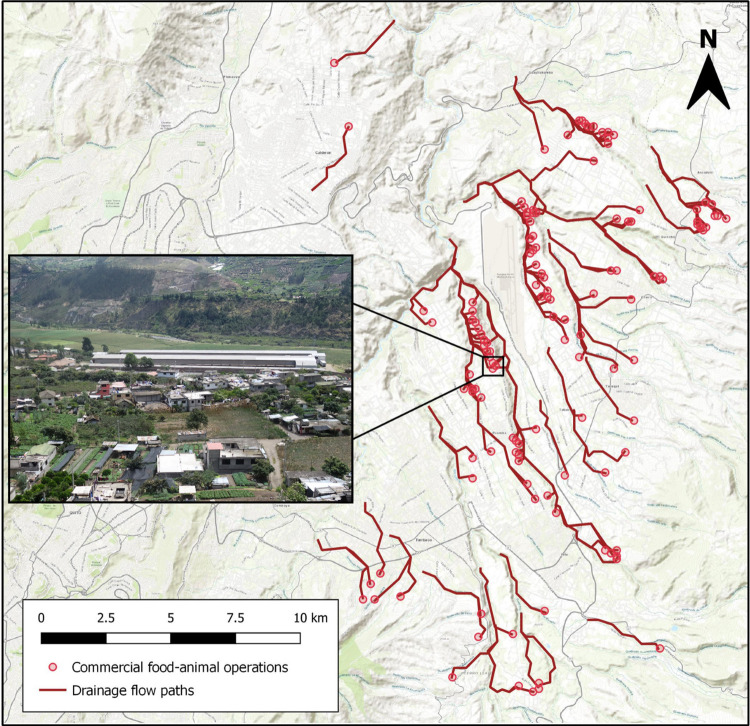
The spread of antibiotic-resistant bacteria may be driven by human-animal-environment interactions, especially in regions with limited restrictions on antibiotic use, widespread food animal production, and free-roaming domestic animals. In this study, we aimed to identify risk factors related to commercial food animal production, small-scale or "backyard" food animal production, domestic animal ownership, and practices related to animal handling, waste disposal, and antibiotic use in Ecuadorian communities.
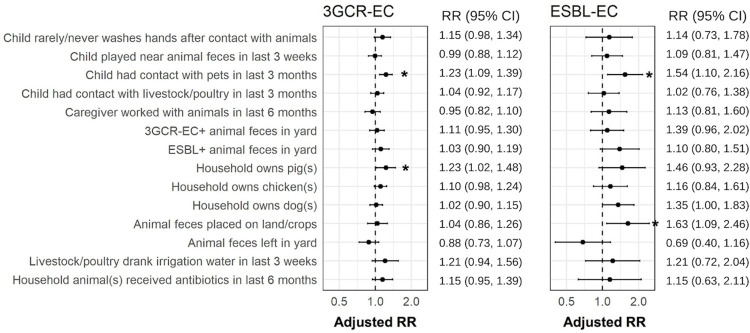
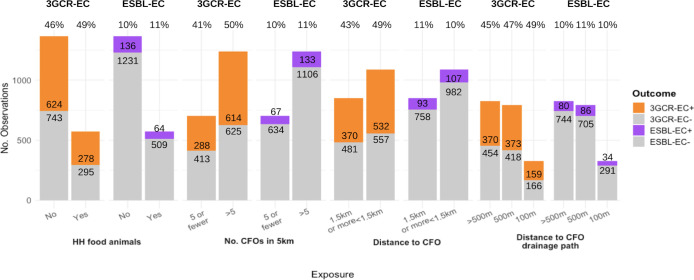
We conducted a repeated measures study from 2018 to 2021 in 7 semirural parishes of Quito, Ecuador to identify determinants of third-generation cephalosporin-resistant E. coli (3GCR-EC) and extended-spectrum beta-lactamase E. coli (ESBL-EC) in children. We collected 1,699 fecal samples from 600 children and 1,871 domestic animal fecal samples from 376 of the same households at up to 5 time points per household over the 3-year study period. We used multivariable log-binomial regression models to estimate relative risks (RR) of 3GCR-EC and ESBL-EC carriage, adjusting for child sex and age, caregiver education, household wealth, and recent child antibiotic use. Risk factors for 3GCR-EC included living within 5 km of more than 5 commercial food animal operations (RR: 1.26; 95% confidence interval (CI): 1.10, 1.45; p-value: 0.001), household pig ownership (RR: 1.23; 95% CI: 1.02, 1.48; p-value: 0.030) and child pet contact (RR: 1.23; 95% CI: 1.09, 1.39; p-value: 0.001). Risk factors for ESBL-EC were dog ownership (RR: 1.35; 95% CI: 1.00, 1.83; p-value: 0.053), child pet contact (RR: 1.54; 95% CI: 1.10, 2.16; p-value: 0.012), and placing animal feces on household land/crops (RR: 1.63; 95% CI: 1.09, 2.46; p-value: 0.019). The primary limitations of this study are the use of proxy and self-reported exposure measures and the use of a single beta-lactamase drug (ceftazidime with clavulanic acid) in combination disk diffusion tests for ESBL confirmation, potentially underestimating phenotypic ESBL production among cephalosporin-resistant E. coli isolates. To improve ESBL determination, it is recommended to use 2 combination disk diffusion tests (ceftazidime with clavulanic acid and cefotaxime with clavulanic acid) for ESBL confirmatory testing. Future studies should also characterize transmission pathways by assessing antibiotic resistance in commercial food animals and environmental reservoirs.
In this study, we observed an increase in enteric colonization of antibiotic-resistant bacteria among children with exposures to domestic animals and their waste in the household environment and children living in areas with a higher density of commercial food animal production operations.
抗生素耐药菌的传播可能是由人与动物-环境的相互作用驱动的,特别是在抗生素使用限制较少、广泛存在食品动物生产以及存在自由放养的家养动物的地区。在这项研究中,我们旨在确定与商业食品动物生产、小规模或“后院”食品动物生产、家养动物所有权以及与动物处理、废物处理和抗生素使用相关的实践有关的风险因素在厄瓜多尔社区。
我们在 2018 年至 2021 年期间在厄瓜多尔基多的 7 个半农村教区进行了一项重复测量研究,以确定第三代头孢菌素耐药大肠杆菌(3GCR-EC)和扩展谱β-内酰胺酶大肠杆菌(ESBL-EC)在儿童中的决定因素。我们在 3 年的研究期间,每个家庭最多在 5 个时间点上,从 600 名儿童中收集了 1699 份粪便样本,从 376 个相同家庭中的 1871 份家养动物粪便样本。我们使用多变量对数二项式回归模型来估计 3GCR-EC 和 ESBL-EC 携带的相对风险(RR),并调整了儿童性别和年龄、照顾者教育、家庭财富和最近儿童抗生素使用情况。3GCR-EC 的风险因素包括居住在距离超过 5 个商业食品动物养殖场 5 公里以内(RR:1.26;95%置信区间(CI):1.10,1.45;p 值:0.001)、家庭养猪(RR:1.23;95%CI:1.02,1.48;p 值:0.030)和儿童宠物接触(RR:1.23;95%CI:1.09,1.39;p 值:0.001)。ESBL-EC 的风险因素是狗的所有权(RR:1.35;95%CI:1.00,1.83;p 值:0.053)、儿童宠物接触(RR:1.54;95%CI:1.10,2.16;p 值:0.012)和将动物粪便放置在家庭土地/作物上(RR:1.63;95%CI:1.09,2.46;p 值:0.019)。本研究的主要局限性是使用代理和自我报告的暴露测量以及使用单一β-内酰胺类药物(头孢他啶与克拉维酸)进行组合纸片扩散试验以确认 ESBL,这可能会低估头孢菌素耐药大肠杆菌分离株中表型 ESBL 的产生。为了提高 ESBL 的确定,建议使用 2 种组合纸片扩散试验(头孢他啶与克拉维酸和头孢噻肟与克拉维酸)进行 ESBL 确认试验。未来的研究还应通过评估商业食品动物和环境储层中的抗生素耐药性来描述传播途径。
在这项研究中,我们观察到与家养动物及其在家庭环境中的废物接触的儿童中,肠道定植抗生素耐药菌的情况有所增加,并且与生活在商业食品动物生产作业密度较高地区的儿童有关。