School of Molecular Sciences, The University of Western Australia, Crawley, Western Australia, Australia.
School of Molecular Sciences, The University of Western Australia, Crawley, Western Australia, Australia; ARC Training Centre in Biomedical Analysis, The University of Western Australia, Crawley, Western Australia, Australia.
Adv Nutr. 2024 Jan;15(1):100129. doi: 10.1016/j.advnut.2023.10.002. Epub 2023 Oct 11.
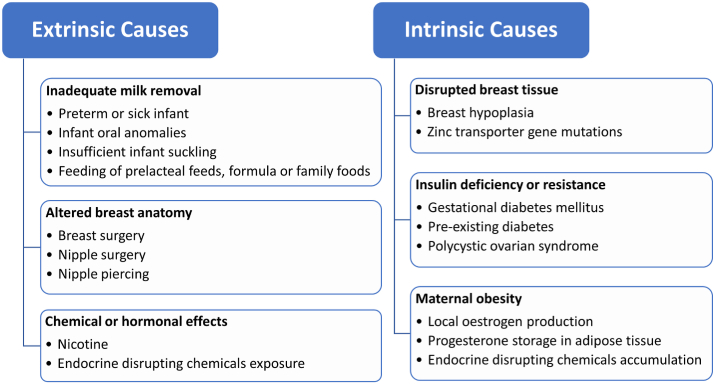
Low milk supply (LMS) poses a significant challenge to exclusive and continued breastfeeding, affecting ∼10% to 15% of mothers. Milk production is intricately regulated by both endocrine and autocrine control mechanisms, with estrogens and progesterone playing pivotal roles in this process. In addition to endogenously produced hormones, external substances capable of interfering with normal hormonal actions, including phytoestrogens, mycoestrogens, synthetic estrogens, and hormonal contraceptives, can influence milk production. The effects of these extrinsic hormones on milk production may vary based on maternal body mass index. This comprehensive review examines the multifaceted causes of LMS, focusing on the involvement of estrogens, progesterone, and related external factors in milk production. Furthermore, it investigates the interplay between hormonal factors and obesity, aiming to elucidate the endocrine mechanisms underlying obesity-associated LMS. Insights from this review provide valuable perspectives for developing interventions to improve milk production and address the challenges associated with LMS.
低奶量(LMS)对纯母乳喂养和持续母乳喂养构成了重大挑战,约影响 10%至 15%的母亲。乳汁分泌受到内分泌和自分泌控制机制的复杂调节,雌激素和孕激素在这一过程中起着关键作用。除了内源性产生的激素外,还有一些能够干扰正常激素作用的外源性物质,包括植物雌激素、真菌雌激素、合成雌激素和激素避孕药,也会影响乳汁分泌。这些外源性激素对乳汁分泌的影响可能因产妇的体重指数而异。本综述全面探讨了 LMS 的多种原因,重点关注雌激素、孕激素和相关外源性因素在乳汁分泌中的作用。此外,还研究了激素因素与肥胖之间的相互作用,旨在阐明肥胖相关 LMS 的内分泌机制。本综述提供了有价值的观点,有助于制定干预措施,以改善乳汁分泌,并应对与 LMS 相关的挑战。