Mayo Clinic, Mankato, Minnesota, USA
Mayo Clinic, Rochester, Minnesota, USA.
BMJ Open Gastroenterol. 2023 Oct;10(1). doi: 10.1136/bmjgast-2023-001141.
Forty distinct primary sclerosing cholangitis (PSC) genomic loci have been identified through multiancestry meta-analyses. The polygenic risk score (PRS) could serve as a promising tool to discover unique disease behaviour, like PSC, underlying inflammatory bowel disease (IBD).
To test whether PRS indicates PSC risk in patients with IBD.
Mayo Clinic and Washington University at St Louis IBD cohorts were used to test our hypothesis. PRS was modelled through the published PSC loci and weighted with their corresponding effect size. Logistic regression was applied to predict the PSC risk.
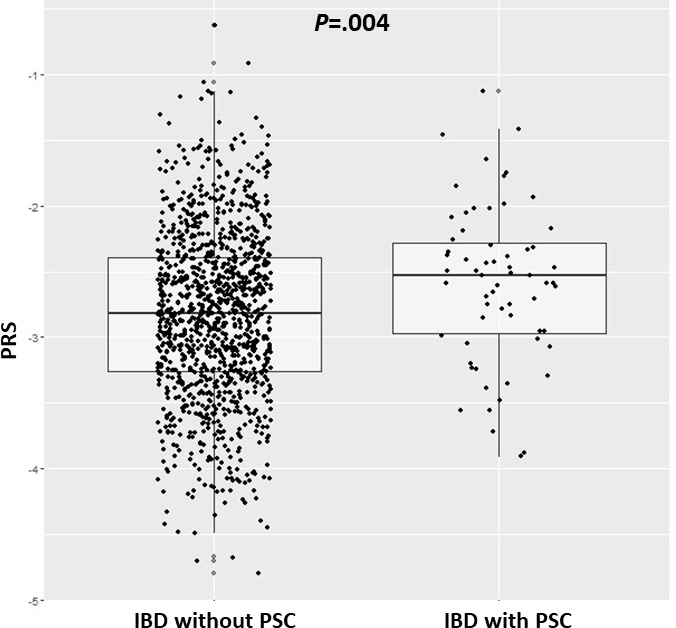
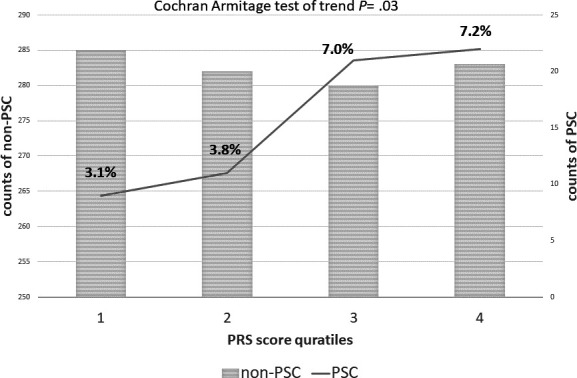
In total, 63 (5.6%) among 1130 patients with IBD of European ancestry had PSC. Among 381 ulcerative colitis (UC), 12% had PSC; in contrast to 1.4% in 761 Crohn disease (CD). Compared with IBD alone, IBD-PSC had significantly higher PRS (PSC risk: 3.0% at the lowest PRS quartile vs 7.2% at the highest PRS quartile, P =.03). In IBD subphenotypes subgroup analysis, multivariate analysis shows that UC-PSC is associated with more extensive UC disease (OR, 5.60; p=0.002) and younger age at diagnosis (p=0.02). In CD, multivariate analysis suggests that CD-PSC is associated with colorectal cancer (OR, 50; p=0.005).
We found evidence that patients with IBD with PSC presented with a clinical course difference from that of patients with IBD alone. PRS can influence PSC risk in patients with IBD. Once validated in an independent cohort, this may help identify patients with the highest likelihood of developing PSC.
通过多血统荟萃分析,已经确定了 40 个独特的原发性硬化性胆管炎(PSC)基因组位点。多基因风险评分(PRS)可以作为一种有前途的工具,用于发现像PSC 这样的炎症性肠病(IBD)的独特疾病行为。
测试 PRS 是否可以预测 IBD 患者的 PSC 风险。
使用梅奥诊所和圣路易斯华盛顿大学的 IBD 队列来检验我们的假设。PRS 通过已发表的 PSC 位点建模,并根据其相应的效应大小加权。应用逻辑回归预测 PSC 风险。
在总共 1130 名欧洲血统的 IBD 患者中,有 63 名(5.6%)患有 PSC。在 381 名溃疡性结肠炎(UC)患者中,有 12%患有 PSC;相比之下,761 名克罗恩病(CD)患者中仅有 1.4%患有 PSC。与 IBD 相比,IBD-PSC 具有显著更高的 PRS(PSC 风险:最低 PRS 四分位数为 3.0%,最高 PRS 四分位数为 7.2%,P =.03)。在 IBD 亚表型亚组分析中,多变量分析显示 UC-PSC 与更广泛的 UC 疾病相关(OR,5.60;p=0.002)和更年轻的诊断年龄(p=0.02)。在 CD 中,多变量分析表明 CD-PSC 与结直肠癌(OR,50;p=0.005)相关。
我们发现有证据表明,患有 PSC 的 IBD 患者的临床病程与单纯患有 IBD 的患者不同。PRS 可以影响 IBD 患者的 PSC 风险。一旦在独立队列中得到验证,这可能有助于识别最有可能发展为 PSC 的患者。