Associate Laboratory i4HB - Institute for Health and Bioeconomy, Laboratory of Toxicology, Department of Biological Sciences, Faculty of Pharmacy, University of Porto, Porto, Portugal.
UCIBIO - Applied Molecular Biosciences Unit, REQUIMTE, Laboratory of Toxicology, Department of Biological Sciences, Faculty of Pharmacy, University of Porto, Rua de Jorge Viterbo Ferreira, 228, 4050-313, Porto, Portugal.
Inflammation. 2024 Feb;47(1):264-284. doi: 10.1007/s10753-023-01908-0. Epub 2023 Oct 14.
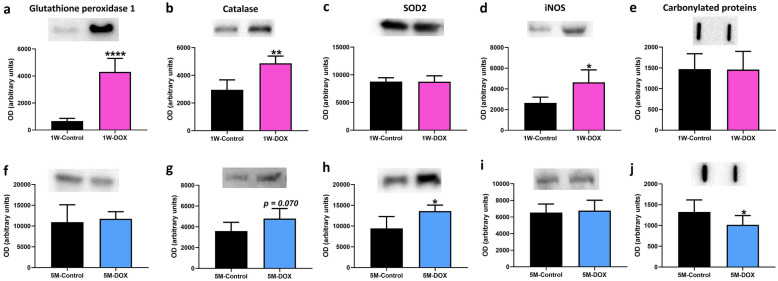
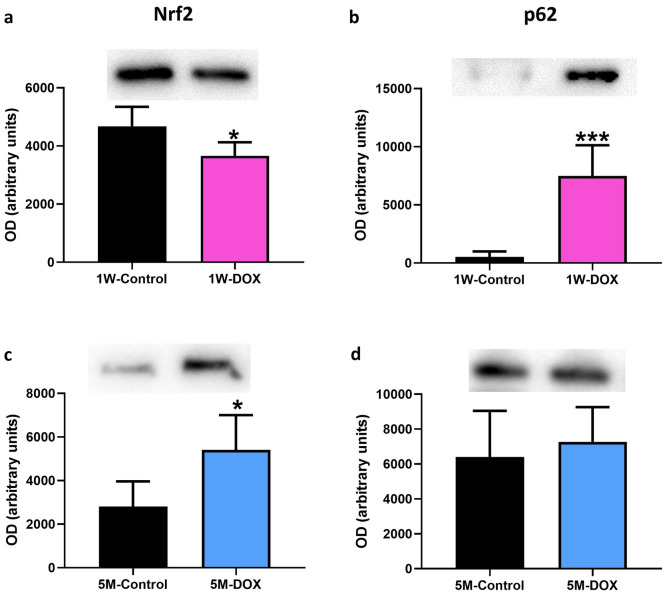
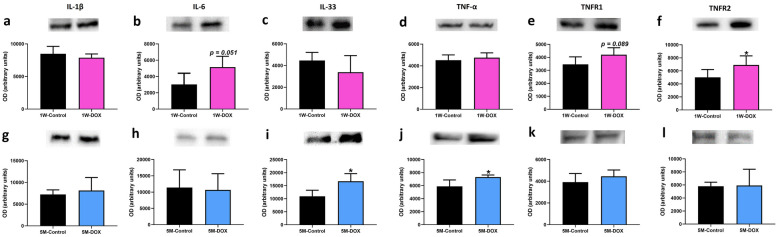
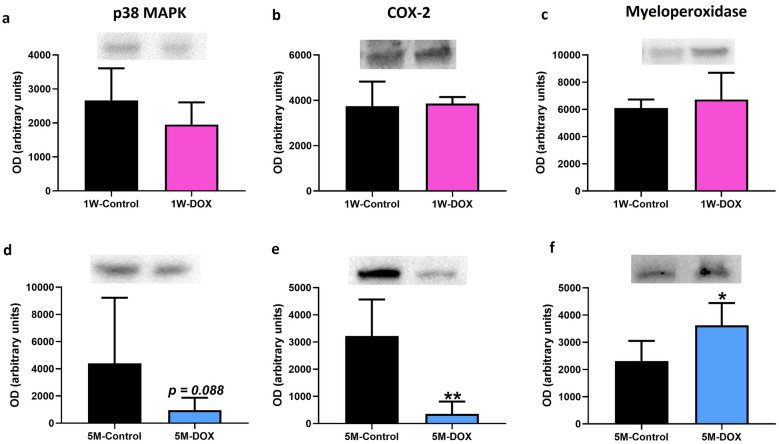
Doxorubicin (DOX) is a topoisomerase II inhibitor used in cancer therapy. Despite its efficacy, DOX causes serious adverse effects, such as short- and long-term cardiotoxicity. This work aimed to assess the short- and long-term cardiotoxicity of DOX and the role of inflammation and antioxidant defenses on that cardiotoxicity in a mice model. Adult CD-1 male mice received a cumulative dose of 9.0 mg/kg of DOX (2 biweekly intraperitoneal injections (ip), for 3 weeks). One week (1W) or 5 months (5M) after the last DOX administration, the heart was collected. One week after DOX, a significant increase in p62, tumor necrosis factor receptor (TNFR) 2, glutathione peroxidase 1, catalase, inducible nitric oxide synthase (iNOS) cardiac expression, and a trend towards an increase in interleukin (IL)-6, TNFR1, and B-cell lymphoma 2 associated X (Bax) expression was observed. Moreover, DOX induced a decrease on nuclear factor erythroid-2 related factor 2 (Nrf2) cardiac expression. In both 1W and 5M, DOX led to a high density of infiltrating M1 macrophages, but only the 1W-DOX group had a significantly higher number of nuclear factor κB (NF-κB) p65 immunopositive cells. As late effects (5M), an increase in Nrf2, myeloperoxidase, IL-33, tumor necrosis factor-α (TNF-α), superoxide dismutase 2 (SOD2) expression, and a trend towards increased catalase expression were observed. Moreover, B-cell lymphoma 2 (Bcl-2), cyclooxygenase-2 (COX-2), and carbonylated proteins expression decreased, and a trend towards decreased p38 mitogen-activated protein kinase (MAPK) expression were seen. Our study demonstrated that DOX induces adverse outcome pathways related to inflammation and oxidative stress, although activating different time-dependent response mechanisms.
多柔比星(DOX)是一种用于癌症治疗的拓扑异构酶 II 抑制剂。尽管具有疗效,但 DOX 会引起严重的不良反应,如短期和长期的心脏毒性。本工作旨在评估 DOX 的短期和长期心脏毒性,以及炎症和抗氧化防御在该心脏毒性中的作用在小鼠模型中。成年 CD-1 雄性小鼠接受 9.0mg/kg DOX 的累积剂量(2 次每周腹腔内注射(ip),持续 3 周)。在最后一次 DOX 给药后 1 周(1W)或 5 个月(5M),收集心脏。在 DOX 后 1 周,观察到 p62、肿瘤坏死因子受体(TNFR)2、谷胱甘肽过氧化物酶 1、过氧化氢酶、诱导型一氧化氮合酶(iNOS)心脏表达的显著增加,以及白细胞介素(IL)-6、TNFR1 和 B 细胞淋巴瘤 2 相关 X(Bax)表达的趋势增加。此外,DOX 诱导核因子红细胞 2 相关因子 2(Nrf2)心脏表达减少。在 1W 和 5M 时,DOX 导致浸润 M1 巨噬细胞的高密度,但只有 1W-DOX 组有明显更高数量的核因子κB(NF-κB)p65 免疫阳性细胞。作为晚期效应(5M),观察到 Nrf2、髓过氧化物酶、IL-33、肿瘤坏死因子-α(TNF-α)、超氧化物歧化酶 2(SOD2)表达增加,以及过氧化氢酶表达增加的趋势。此外,B 细胞淋巴瘤 2(Bcl-2)、环氧化酶-2(COX-2)和羰基蛋白表达减少,p38 丝裂原活化蛋白激酶(MAPK)表达减少的趋势。我们的研究表明,DOX 诱导与炎症和氧化应激相关的不良结局途径,尽管激活了不同的时间依赖性反应机制。